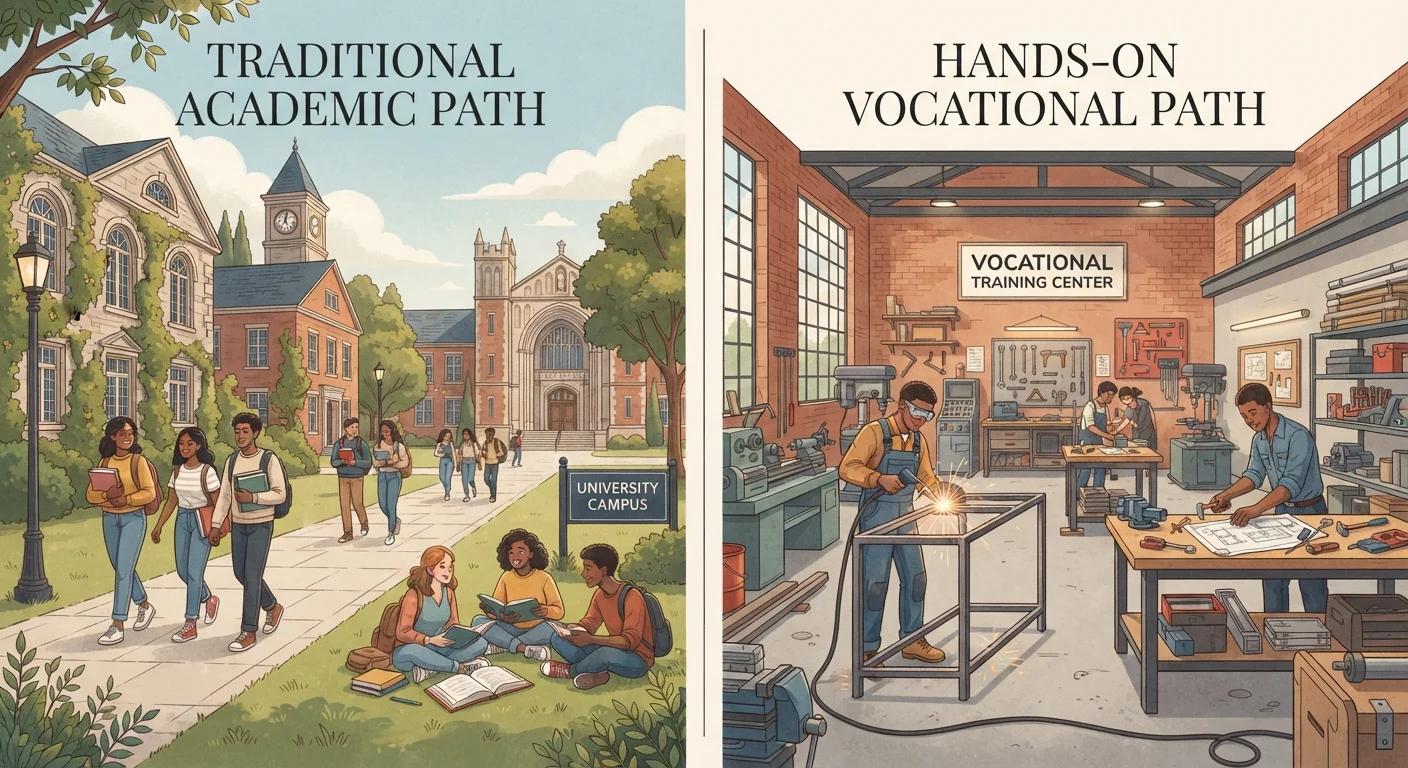
What Each Path Actually Involves
Before comparing outcomes, it helps to understand what each route looks like day-to-day. A university education typically leads to a bachelor's degree completed over four years of full-time study. Coursework blends foundational theory with elective choices, and students often spend time developing analytical, writing, and research skills alongside their chosen subject area.
Vocational training - also called career and technical education (CTE) - is structured around a specific occupation or industry. Programs are offered at community colleges, technical institutes, and trade schools, and they typically run from several months to two years. Time is spent on applied skills, industry-standard tools, and sometimes supervised work placements.
Before deciding, it is worth taking a step back and asking whether you have already identified your career direction. Our guide on mapping your interests to a career field can help you match your strengths to a realistic pathway before you commit to either route.
| Criterion | University Education | Vocational Training |
|---|---|---|
| Typical duration | 4 years (full-time) | 6 months - 2 years |
| Average cost (US) | Higher; varies by institution type | Lower; community college or trade school rates |
| Learning focus | Theory, analysis, broad subject knowledge | Applied skills, hands-on practice |
| Credential awarded | Bachelor's degree | Certificate, diploma, or associate degree |
| Time to first job | Typically 4+ years | Often under 2 years |
| Entry requirements | High school diploma; standardized test scores | High school diploma or equivalent; often flexible |
| Employer recognition | Widely recognized across industries | High in target trade or technical field |
| Path to further study | Direct route to postgraduate programs | Some credits may transfer; degree upgrade possible |
Costs, Timelines, and Return on Investment
Cost is one of the most significant differences between these two paths. According to the National Center for Education Statistics, average annual tuition and fees at public four-year universities in the US can reach several thousand dollars per year for in-state students - and considerably more at private institutions. When living costs and loan interest are factored in, total investment over four years can be substantial.
Vocational programs tend to cost far less overall, both because they are shorter and because tuition at community colleges and trade schools is typically lower. Many programs also qualify for federal financial aid, and some employers offer tuition reimbursement for job-relevant credentials.
However, cost alone should not drive the decision. Certain roles - including registered nursing, architecture, and software engineering - command salaries that can make a degree investment financially worthwhile over a career. Conversely, skilled trades such as plumbing, welding, and electrical work offer competitive earnings with far less upfront cost and debt.
~$10,940
Average in-state public university tuition per year
According to College Board's Trends in College Pricing report, average published tuition and fees at public four-year institutions reached approximately this figure for in-state students.
~$3,860
Average public two-year college tuition per year
The same College Board report shows community college costs are significantly lower, making them an accessible entry point for vocational and technical programs.
68%
Employers valuing skilled-trade credentials
A National Skills Coalition workforce report found that a large share of US jobs fall into the 'middle-skill' category, requiring more than a high school diploma but less than a four-year degree.
For a fuller picture of how each qualification type translates into employment, see our article on how education and work actually connect.
Credential Recognition and Accreditation
A qualification is only as valuable as its recognition. For university degrees, regional accreditation in the US is the primary indicator that a program meets established academic standards. Employers and graduate schools typically require degrees from regionally accredited institutions.
For vocational programs, recognition often works differently. Industry certifications - such as those from CompTIA, the National Center for Construction Education and Research, or state licensing boards - can carry more weight with employers than the name of the school itself. Before enrolling, check whether your target employers or licensing bodies recognize the specific credential the program awards.
Our detailed guide on how accreditation works explains exactly what to look for and why it matters regardless of which path you choose.
Online Programs: A Third Variable
Both university degrees and vocational certificates are now offered online, which changes the flexibility and scheduling trade-offs considerably. Online learning can suit working adults or those in areas with limited local institutions, but it also introduces unique challenges around self-discipline and networking. See our balanced look at the honest trade-offs of learning entirely online before factoring this option into your decision.
Flexibility, Learning Style, and What Comes Next
Personal learning preferences matter more than many students expect. University environments reward self-directed study, abstract thinking, and long-form writing. If you thrive in those conditions and enjoy exploring ideas across disciplines, that context can be energizing. If you find abstract coursework frustrating and prefer learning by doing, a hands-on vocational program may hold your attention and produce faster confidence.
It is also worth knowing that the two paths are not mutually exclusive. Many vocational graduates later pursue an associate or bachelor's degree to advance into supervisory or management roles. Some universities offer credit for prior learning, meaning vocational experience may count toward a degree. Apprenticeships represent another hybrid option - combining paid on-the-job training with structured instruction. Our overview of apprenticeships and work-based learning explains how these programs work and which industries offer them.
If a university degree leads you to consider further study, our article on what to weigh up before a postgraduate qualification offers a grounded look at the trade-offs involved.
This article is for general informational and educational purposes only. Career outcomes, earnings, and credential requirements vary by field, employer, location, and individual circumstances. Consult a licensed career counselor or educational advisor for guidance tailored to your situation.