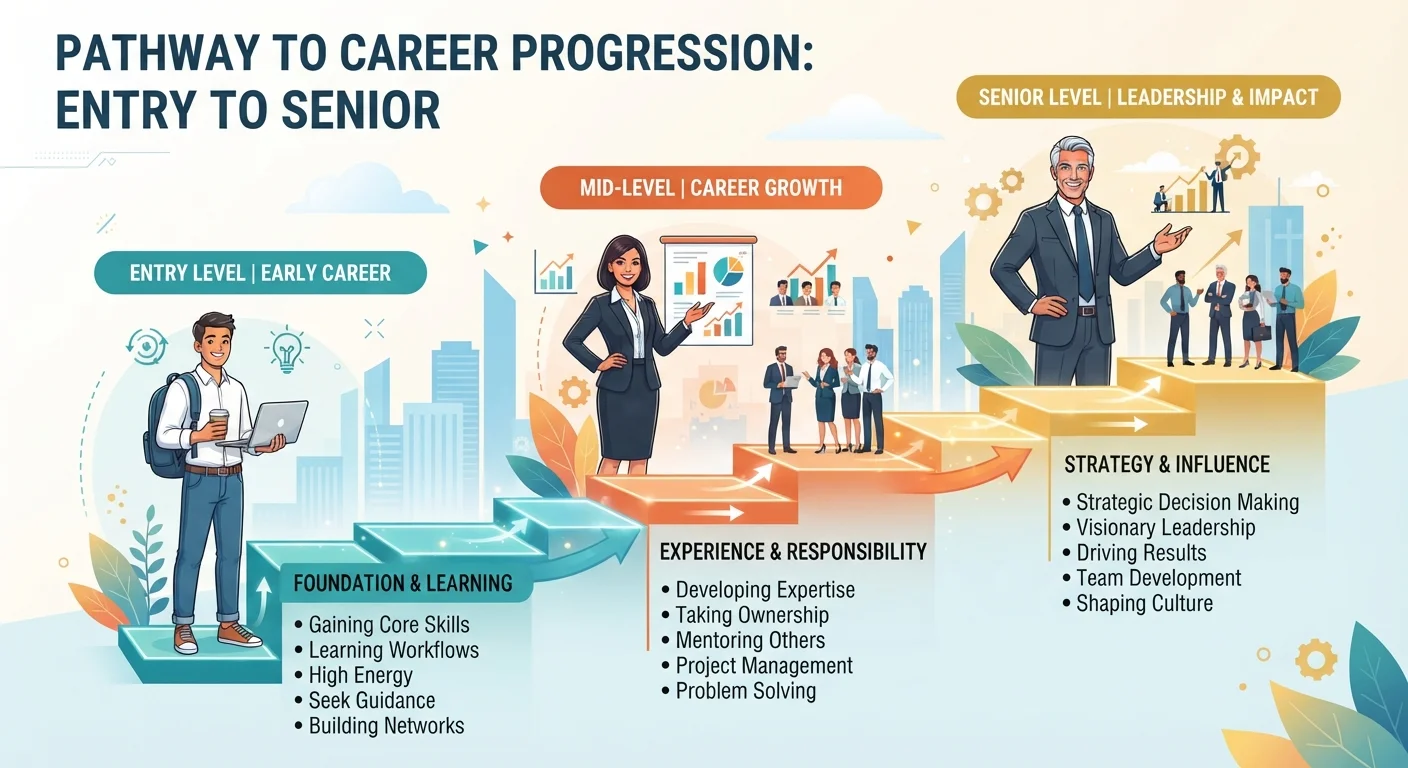
Why Career Levels Exist - and Why They Matter to Learners
Most professions are structured around levels of experience and responsibility. These levels exist because the skills needed to start a job differ from those needed to lead within it. For first-time learners, understanding this structure is practical, not abstract - it tells you what to study, what to practice, and what experience actually counts.
Before you commit to a course or credential, it helps to map where that qualification fits on a career pathway. Otherwise, you risk preparing for a level you are not yet targeting, or missing foundational skills that employers expect early on. If you have not yet thought about which field interests you, mapping your interests to a career field is a good starting point.
2-5 years
Typical entry-to-mid transition timeframe
Research from workforce studies consistently shows that most professionals move from entry to mid-level within two to five years, depending on industry and individual performance.
~70%
Workers who value on-the-job learning over credentials alone
A LinkedIn Workplace Learning Report found that the majority of employees consider on-the-job experience the most important factor in their professional development.
Entry Level: Building the Foundation
Entry-level roles are designed for people with limited professional experience in a field - including recent graduates, career changers, and those completing their first qualification. At this stage, employers generally do not expect expertise. They look for foundational knowledge, a willingness to learn, and basic professional competency.
Common characteristics of entry-level work include close supervision, structured tasks, and a steep learning curve. The goal is to absorb how the field actually operates in practice, which often differs from what textbooks describe.
What Helps You Get Here
- Relevant credentials, degrees, or certifications that demonstrate baseline knowledge
- Internships, volunteer work, or part-time roles that show applied experience
- A portfolio, capstone project, or demonstrable skill (especially in technical or creative fields)
- Clear communication and professional habits - often weighted heavily by hiring managers
Make Your Entry-Level Experience Count
Treat every task at the entry level as a learning opportunity, even routine ones. Professionals who advance quickly tend to ask questions, seek feedback proactively, and volunteer for projects that stretch their skills. Employers notice effort and attitude at this stage, often as much as raw ability.
Mid Level: Earning Independence
The move to mid-level is less about time served and more about demonstrated competence. Mid-level professionals are expected to handle their responsibilities with minimal supervision, solve problems without always escalating them, and produce consistent results. Employers at this stage want evidence - a track record, not just potential.
This is also when specialization tends to deepen. A generalist entry-level role may branch into a defined area of focus, and professional development choices become more targeted.
What Drives the Transition
- Taking on additional responsibilities and delivering reliably
- Building expertise in a specific area within the broader field
- Developing professional relationships and a reputation within an organization or industry
- Continuing education - advanced certifications, specialized training, or graduate-level study where relevant
Senior Level: Leading and Shaping the Work
Senior roles are fundamentally different from earlier career stages. While technical skill still matters, what distinguishes senior professionals is their ability to guide others, make decisions with incomplete information, and contribute to strategy - not just execution.
Senior professionals often mentor junior colleagues, represent their team in broader organizational conversations, and help define how work should be approached. This shift from doing to shaping is one that catches many mid-level professionals off guard when they first step into it.
“The most important thing a senior person brings is not the ability to do the work - it is the ability to help others do the work better. That requires a different kind of learning than most people anticipate.”
— Jenny Blake, Career strategist and author of Pivot
Not everyone aspires to senior leadership, and that is a legitimate choice. Many fields also offer deep expert tracks - sometimes called individual contributor paths - that allow professionals to advance in seniority without moving into management.
If your educational path has shifted and you are rethinking your original direction, understanding how career pivots work after your first qualification can help you reframe your existing experience rather than starting over.
Aligning Your Education to the Right Career Stage
One of the most common mistakes early learners make is choosing education without knowing what level it prepares them for. A short online certificate may be well-suited to entry-level skill building, while a graduate program may be designed to prepare people for senior specialist or leadership roles.
Neither is inherently better - what matters is fit. Ask yourself: where do I want to be in two to three years, and what does someone already in that role actually have on their resume?
Job Titles Can Be Misleading
Career level labels like 'Junior,' 'Associate,' 'Senior,' or 'Lead' are not standardized across industries or even companies. A 'Senior Analyst' at one firm may have responsibilities equivalent to a 'Manager' at another. Always read the job description carefully rather than relying solely on the title to understand what level a role actually represents.
Exploring online learning options can be a practical way to build credentials and skills incrementally while remaining in the workforce. Pair that with solid study skills to get the most from any program you pursue.
Career pathways are rarely straight lines. Lateral moves - stepping sideways into a related role - often accelerate long-term growth by expanding your skill base. The goal is not to climb as fast as possible, but to build capabilities that hold up at every level.