What the Price Tag Actually Signals
When you encounter a free online course, the first question worth asking is not "Is this good?" but rather "What has been left out to make this free?" Most free offerings are funded by platform advertising, by institutions building awareness, or by instructors who want wide reach. That funding model shapes what you receive.
Paid programmes, by contrast, generate revenue directly from learners, which generally allows platforms to pay instructors more, maintain course materials, and provide staff support. This does not guarantee quality - a high price can reflect marketing spend as easily as it reflects educational value. For a practical guide to evaluating any course regardless of cost, see quality signals to look for.
Before enrolling anywhere, it also helps to understand the basic structures of digital learning itself. Online learning formats vary considerably - from short video series to cohort-based programmes - and the format matters as much as the cost.
What Free Courses Typically Include (and Exclude)
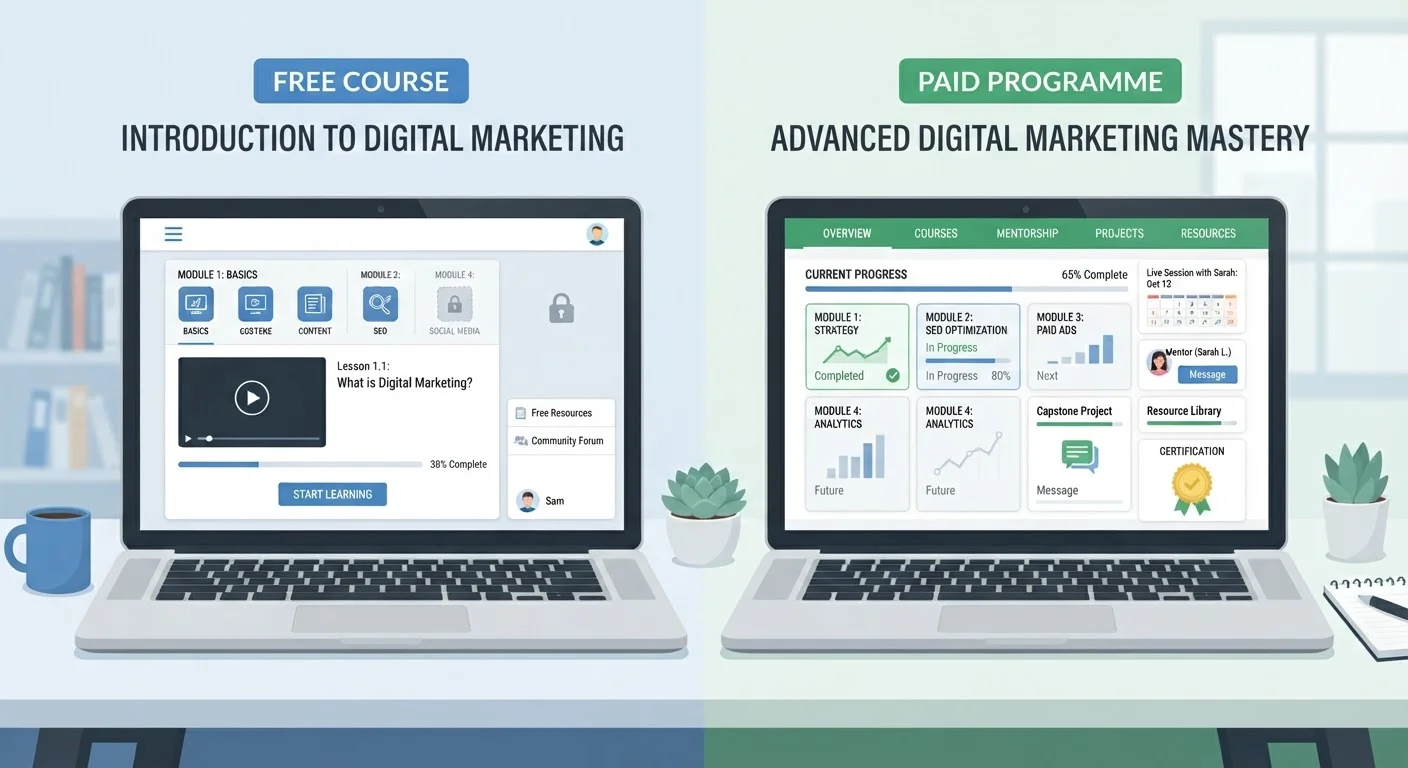
Free courses generally provide access to recorded video lectures, reading materials, and sometimes auto-graded quizzes. That content can be substantive and professionally produced. Many universities and independent educators publish genuinely rigorous material at no cost.
What free access typically does not include:
- Graded assignments with human feedback - auto-graders can check answers, but cannot evaluate reasoning or writing quality.
- Verified certificates - most platforms offer a paid certificate upgrade even when course content is free.
- Instructor access - forums may exist, but direct instructor Q&A is rare in free tiers.
- Structured pacing - without deadlines, many learners stall. Research on open online courses has consistently found that completion rates tend to be low when there is no accountability mechanism.
< 15%
Typical free MOOC completion rate
Studies of massive open online courses consistently find completion rates well below 15%, largely attributed to the absence of accountability structures.
3x
Completion rate lift with paid enrolment
Platform analyses have found that learners who pay for a certificate option complete courses at substantially higher rates than those auditing for free.
If you are learning for personal interest or to sample a topic before investing further, free courses are a rational starting point. If you are building toward a career move, these gaps become more significant.
What Paid Programmes Add to the Learning Experience
Paying for a course does not automatically make it better, but it does typically unlock features that support deeper learning and external validation.
| Feature | Free Courses | Paid Programmes | |
|---|---|---|---|
| Content access | Video lectures, readings | Full curriculum, often downloadable | |
| Graded feedback | Auto-graded only | Human feedback common | |
| Credential | None or unverified badge | Verified certificate or credit | |
| Instructor access | Rare or none | Forums, office hours, or direct Q&A | |
| Structured pacing | Usually self-directed | Deadlines and milestones typical | |
| Completion support | Minimal | Peer cohorts, reminders, mentorship |
Structured curricula with clear learning objectives, regular assessments, and cohort interaction are more common in paid programmes. Instructor or teaching assistant feedback - the kind that identifies why an answer is wrong rather than just that it is - is a meaningful differentiator. This matters especially for complex skills like writing, data analysis, or design, where nuanced critique accelerates improvement.
Credentials are another practical distinction. A verified certificate from a recognised institution or accredited programme may carry weight with employers. An unverified completion badge from a free tier generally does not. For guidance on how credentials connect to real-world opportunities, the career pathways hub provides useful context.
Accountability is underrated. Paid learners tend to complete courses at higher rates, likely because financial commitment raises the personal cost of dropping out. If you know you need external structure to stay consistent, that effect is worth factoring into your decision. You can also explore whether a self-paced or scheduled format suits your habits before committing.
How to Match Your Goal to the Right Option
The most useful frame is not "free vs. paid" but "what do I actually need from this course?" Consider three scenarios:
- Curiosity and exploration: You want to understand a topic before committing time or money. Free courses are appropriate here. Treat them as a sampling mechanism, not a complete programme.
- Skill-building for a current role: If your employer values the skill but not the credential, a rigorous free course with disciplined self-study may be sufficient. Pair it with practical study strategies to compensate for the lack of external structure.
- Career transition or advancement: When a credential matters to hiring managers or when you need demonstrated competence in a new field, a paid programme with recognised outcomes is harder to replace with free content alone.
Audit Before You Buy
Many platforms let you access course videos for free before purchasing a certificate track. Use this window to assess the instructor's teaching style, the depth of the curriculum, and whether the content matches your actual skill level. A week of auditing is often enough to make a confident decision about whether the paid tier is genuinely useful for your goals.
One practical approach: audit a free version of a course first. Many paid programmes allow free auditing of video content. If the material is engaging and the subject is genuinely relevant to your goals, that is a reasonable signal the paid tier may be worth the investment. For a fuller picture of what online study involves day-to-day, the honest trade-offs of online learning is worth reading before you enroll.