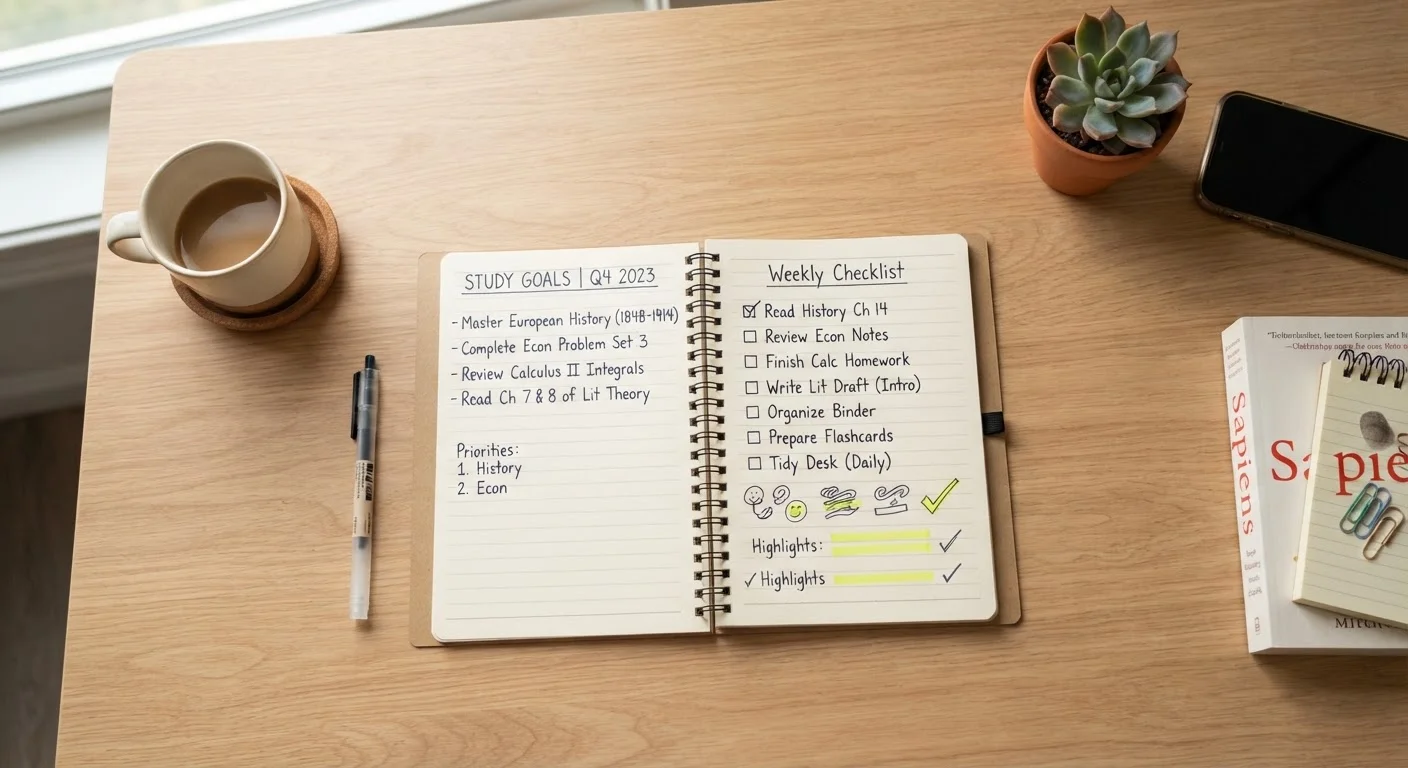
Why Vague Goals Undermine Study Sessions
Most new learners start with good intentions and poor targets. "Study more," "get through the material," or "work on chemistry" feel like plans - but they give your brain no usable direction. Without a defined task, you spend session time deciding what to do rather than doing it, and without a measurable endpoint, you have no way to know when you have succeeded.
Research in educational psychology consistently shows that specific, outcome-oriented goals improve both focus and retention compared with open-ended intentions. The mechanism is straightforward: a clear goal activates attention toward a defined target and makes it easier to notice when you wander off track. This is a foundational habit covered in depth in the complete beginner's guide to study skills.
The good news is that writing better goals is a learnable skill, and the method below is simple enough to apply before your very next session.
What you will need
What You Will Need
Before working through the steps, gather the following. You do not need anything elaborate - the process is intentionally low-tech so that it fits any learning environment.
Notebook or planner
Used to write and review session goals in a consistent, visible location.
Course syllabus or lesson outline
Provides the source material from which to derive specific, well-scoped goals.
Timer or clock
Helps match the scope of a goal to the realistic length of your session.
How to Write a Specific Study Goal
Follow these steps in order for each study session. With practice, the entire process takes under five minutes and pays off throughout the session.
Specificity Is What Makes Goals Work
A goal without a defined task and measurable endpoint is just a wish. Before every study session, confirm that your goal answers three questions: what subject, what action, and what result. If you cannot answer all three, rewrite the goal before you start.
Identify the specific topic for the session
Open your course syllabus, lesson list, or reading schedule and pinpoint exactly what you are covering today. Do not write a goal for an entire chapter or module - narrow it to a section, concept, or set of problems. For example, instead of "study biology," land on something like "the section on cell membrane structure in Chapter 3."
Choose an action verb that defines what you will do
Pair your topic with a clear learning action. Passive verbs like "look at" or "read over" are weak - they describe exposure, not learning. Choose verbs such as summarize, complete, explain, solve, outline, or recite. The verb forces you to engage with material rather than skim it.
- Weak: Read about cell membranes
- Strong: Summarize the three functions of the cell membrane in my own words
Define a measurable endpoint
Add a result you can check when the session ends. This could be a word count, a number of practice problems, a completed diagram, or the ability to answer a specific question from memory. The endpoint tells you when to stop - and confirms you actually achieved something. Example: "Summarize the three functions of the cell membrane in my own words, in five sentences or fewer, without looking at the textbook."
Match the goal to your available time
Check how long your session will realistically last. A 20-minute window calls for a different scope than a 90-minute block. If your goal feels too large for the time you have, trim it rather than rushing. Completing one focused goal is more valuable than half-completing three.
Write the goal down before you begin
Put the goal in writing - on paper or in a digital note - before you open any material. A written goal is a commitment; a mental note is easy to drift from. Keep the written goal visible during the session so it acts as a real-time anchor when distractions arise.
Review and log the outcome after the session
When your session ends, spend two to three minutes reviewing whether you met the goal. Note what you completed, where you got stuck, and whether the scope was well-calibrated. This brief reflection improves how you set the next goal and builds a running record of your progress - which is useful when motivation dips. See strategies for sustaining motivation independently for approaches that complement this habit.
Write Goals Before You Open Any Material
Setting your goal before you open a textbook or log in to a course forces you to plan rather than react. Even 60 seconds of intention-setting at the start of a session dramatically reduces time spent drifting between tasks. Pair this habit with a focused work cycle technique to reinforce structure further.
Connecting Session Goals to a Longer Routine
Individual session goals work best when they sit inside a consistent study routine. If you are still figuring out when and how often to study, the guide to building your first study routine from scratch walks through that process in beginner-friendly terms. Similarly, if your time is limited by work or family commitments, building a study routine that works around a full life addresses how to carve out realistic windows without burnout.
Specific goals also interact well with structured session formats. If you find your attention drifting mid-session even with a clear goal in place, a time-blocked approach can help maintain concentration across the full window.
Avoid Setting Too Many Goals at Once
New learners often overload a single session with five or six goals, then feel discouraged when they cannot complete them all. Start with one or two specific goals per session. Consistent completion of smaller goals builds the confidence and habit that sustain long-term progress.
Over time, the habit of writing and reviewing specific goals produces something more valuable than any single session: a clear, honest picture of how you learn, where you struggle, and how far you have come. That record becomes a resource in itself - especially in the stretches where progress feels invisible.