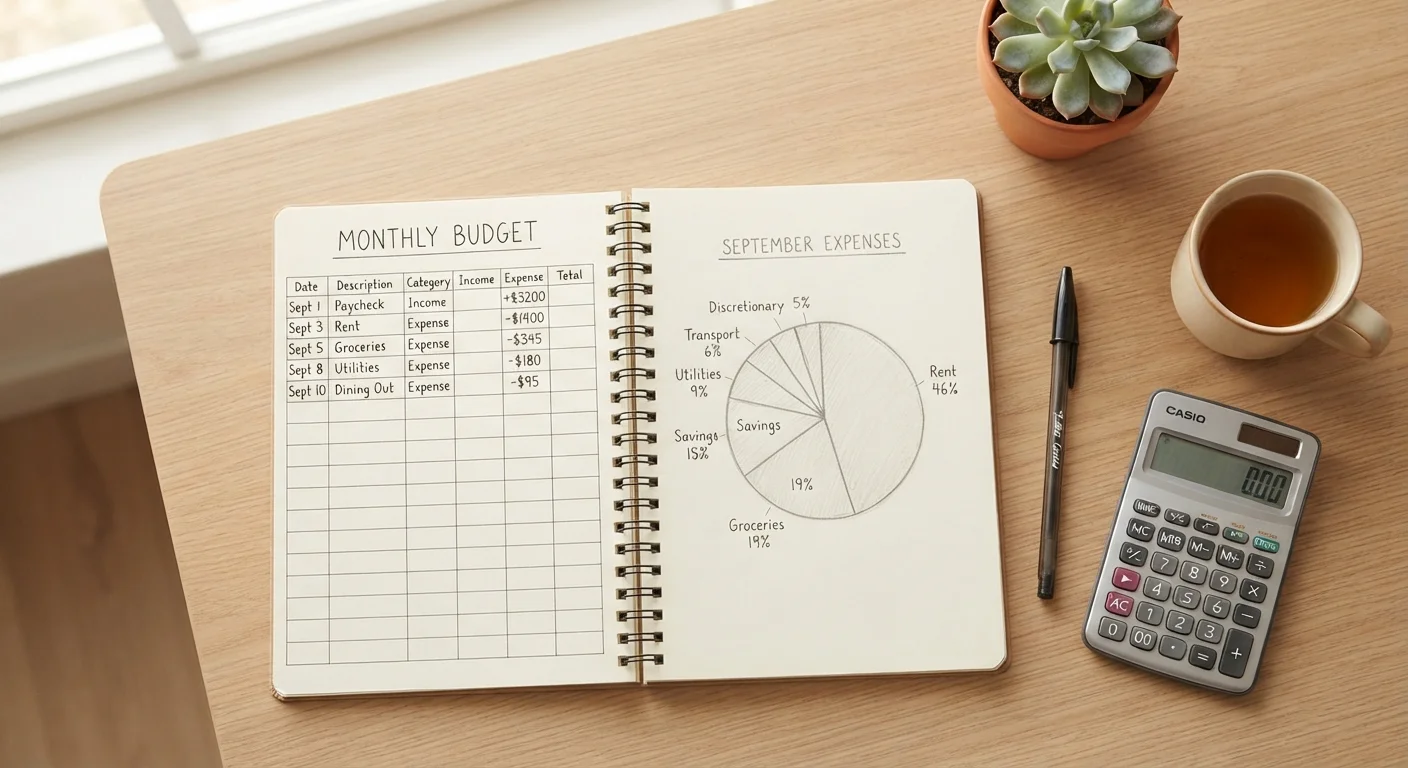
What a Budget Actually Is (and Isn't)
A budget is simply a written plan for how you will use your money during a given period - usually one month. It is not a punishment, a restriction, or a sign that you are in financial trouble. It is a decision made in advance about where your money goes, rather than a mystery you solve after the fact.
Many first-timers assume budgeting means tracking every cent obsessively or cutting out everything enjoyable. That is not the goal. A budget that accounts for both your obligations and the things you actually want to spend on is far more likely to hold up over time.
Before you build your first plan, it helps to be clear on a few core terms. A beginner's budgeting glossary covers the key vocabulary - net income, fixed versus variable expenses, discretionary spending - so the steps below will make immediate sense.
Net income
The money you actually receive after taxes and other deductions have been taken out of your paycheck. This is your real spending power.
Fixed expense
A cost that stays the same amount every month, such as rent or a loan payment. These are predictable and easy to plan for.
Variable expense
A cost that changes in amount from month to month, such as groceries or gas. These require estimation based on past spending.
Discretionary spending
Money spent on non-essential wants - dining out, entertainment, hobbies. This is usually the most flexible part of a budget.
Sinking fund
A small amount set aside each month to cover a known future expense, such as a car registration or holiday gifts, so it does not feel like a sudden burden.
Zero-based budgeting
A method where every dollar of income is assigned a purpose - expenses, savings, or debt - so that income minus all assignments equals zero. Nothing is left unplanned.
Step 1: Find Your Real Take-Home Income
Your budget must be built on the money that actually reaches your bank account - your net income - not your gross salary or hourly rate before deductions. Taxes, Social Security contributions, and health insurance premiums come out before you see a cent, so planning from the gross figure sets you up to overspend from day one.
Gather every source of monthly income:
- Your primary paycheck (after tax and deductions)
- Any part-time or freelance earnings (use a realistic average if amounts vary)
- Regular support payments, benefits, or other consistent deposits
If your income is irregular, calculate an average using your last three to six months of deposits, then use a slightly conservative figure as your planning number. This gives you a buffer rather than a shortfall.
Use Your Lowest Recent Month as a Baseline
If your income varies, resist the urge to budget based on your best recent month. Planning from a lower, more reliable figure means your essentials are always covered. Any extra income in a stronger month can then be directed intentionally toward savings or debt.
Step 2: List Every Expense You Have
Pull up two or three months of bank statements and credit card records. Go line by line and write down every category of spending you find. Most expenses fall into one of two types:
- Fixed expenses
- These are the same amount each month - rent or mortgage, car payment, insurance premiums, loan minimums, subscriptions with a set fee.
- Variable expenses
- These change month to month - groceries, utilities, gas, dining out, clothing, entertainment.
Do not forget irregular expenses that do not appear every month: car registration, annual subscriptions, medical co-pays, holiday gifts, or back-to-school costs. Divide these annual or semi-annual amounts by 12 and add the monthly equivalent to your budget. This technique is sometimes called a sinking fund - setting aside a small amount each month so the cost never catches you off guard.
Once complete, total your expenses. Compare that number against your take-home income from Step 1. If you are already using a checklist to keep this organized, our monthly budget setup checklist can help you confirm you have not missed a category.
Step 3: Assign Every Dollar a Job
Now you allocate. Start with your non-negotiable fixed expenses - housing, utilities, minimum debt payments, insurance. These come first because missing them carries the steepest consequences.
Next, estimate your variable necessities: groceries, transportation, basic household supplies. Use your bank statement averages as a realistic starting point rather than an optimistic guess.
What remains after necessities is available for savings goals and discretionary spending - the things you want rather than strictly need. A widely cited starting framework is the 50/30/20 guideline, which suggests roughly 50% of take-home income for needs, 30% for wants, and 20% for savings and extra debt repayment. Learn how the 50/30/20 rule works and whether it suits your situation before treating it as a firm rule.
Prioritize building even a small emergency fund within your savings allocation. Your first emergency fund guide explains how to set a starter goal and grow it over time.
Do Not Budget From Your Gross Salary
Building a plan around your pre-tax income is one of the most common first-timer mistakes. Taxes, retirement contributions, and insurance premiums reduce your usable income significantly. Always use the amount that actually lands in your bank account - your net pay - as the foundation for every calculation.
This article is for general informational and educational purposes only and does not constitute personalized financial advice. For guidance tailored to your individual circumstances, consider consulting a qualified financial professional.
Step 4: Review, Adjust, and Repeat
No first budget is perfect - and that is expected, not a failure. At the end of your first month, compare what you planned to spend against what you actually spent in each category. Look for patterns: which categories ran over? Which had money left?
Use those answers to adjust the following month's numbers. After two or three cycles, your budget will start to reflect how you actually live rather than how you imagined you would live - and that is when it becomes genuinely useful.
Making this a repeating habit is the real challenge for most people. Building a budgeting habit into a monthly routine offers practical strategies for staying consistent well beyond the first attempt.
As your financial picture grows - perhaps you are saving toward a vehicle - your budget will need to expand too. Setting a realistic budget for your first car shows how to factor a major purchase into your existing plan without derailing other goals.