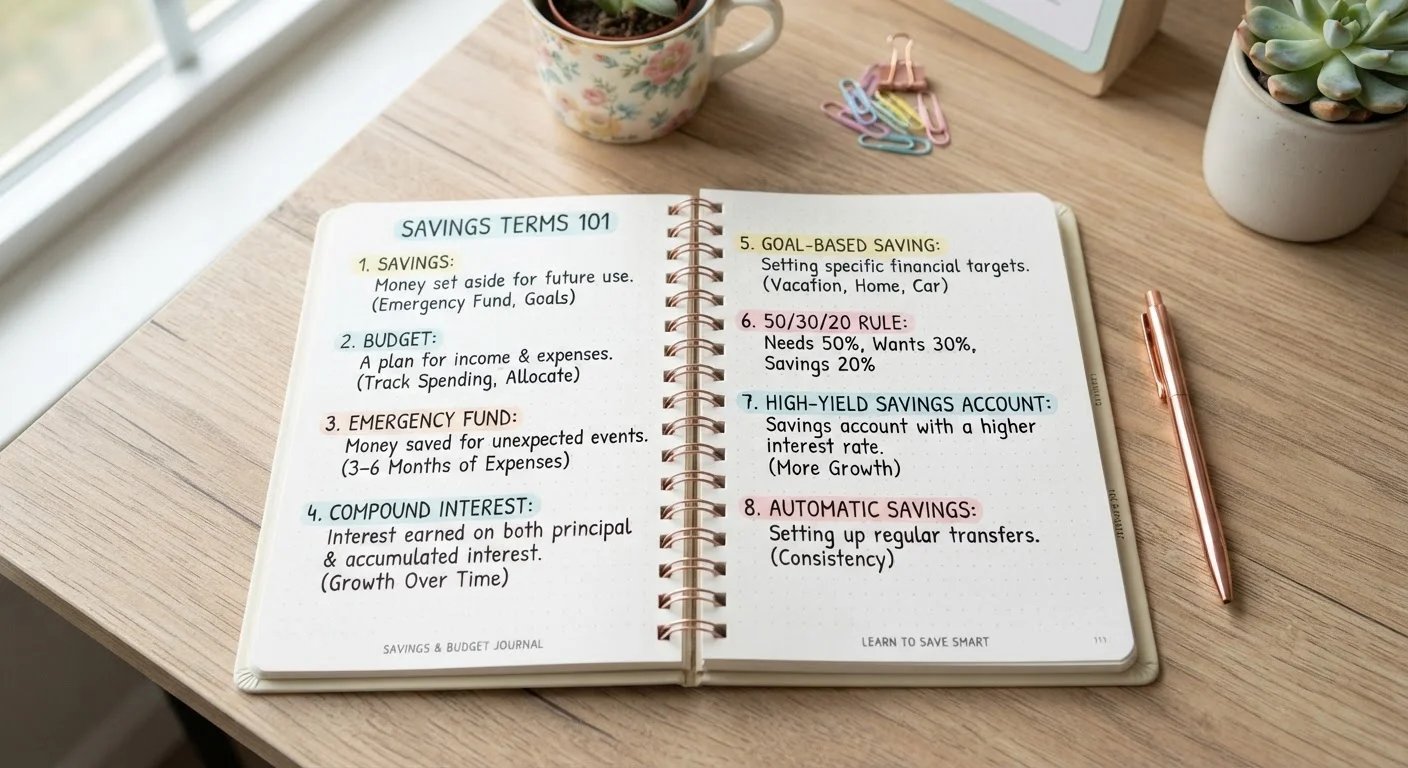
Why Savings Vocabulary Matters
Learning to save is easier when you understand the words people use to describe it. Terms like APY, liquidity, and compounding show up on bank websites and financial advice articles constantly - and if they feel like a foreign language, it is hard to make confident decisions.
This glossary is your starting point. Use it as a reference whenever you encounter an unfamiliar savings term. Each definition is written in plain English, with no assumed knowledge beyond everyday basics.
If you are also building a budget alongside your savings habit, our budgeting concepts glossary covers the vocabulary you will need there, and our budgeting basics hub offers practical strategies to track your spending.
This Article Is Educational, Not Financial Advice
The definitions here are intended to build general financial literacy, not to guide decisions about your specific accounts or circumstances. Interest rates and account features vary by institution and change over time. For guidance tailored to your situation, consider speaking with a licensed financial professional.
Core Savings Terms Defined
The terms below cover the concepts you are most likely to encounter when opening a savings account, comparing your options, or setting a savings goal. Refer back to this list any time a term feels unclear.
Annual Percentage Yield (APY)
The real rate of return you earn on a savings account over one year, including the effect of compounding interest. A higher APY means your money grows faster. Always compare APY - not just the stated interest rate - when evaluating savings accounts.
Compound Interest
Interest calculated on both your original deposit and the interest already earned. Over time, this creates a snowball effect where your savings grow faster the longer they stay invested. It is often described as earning 'interest on interest.'
Liquidity
How quickly and easily you can access your money without penalty. A checking account is highly liquid; a certificate of deposit (CD) with a long term is less liquid because withdrawing early usually incurs a fee.
Emergency Fund
A dedicated pool of savings set aside to cover unexpected expenses - such as medical bills, car repairs, or sudden job loss - without going into debt. Financial educators commonly suggest aiming for three to six months of essential living expenses, though any starting amount is better than none.
Certificate of Deposit (CD)
A type of savings account that holds a fixed amount of money for a fixed period (the 'term') in exchange for a guaranteed interest rate, which is usually higher than a standard savings account. Withdrawing funds before the term ends typically results in an early-withdrawal penalty.
High-Yield Savings Account
A savings account - usually offered by online banks or credit unions - that pays a noticeably higher APY than a traditional savings account. The underlying rules and federal deposit insurance protections are typically the same.
FDIC Insurance
Protection provided by the Federal Deposit Insurance Corporation that covers depositors at member banks up to $250,000 per depositor, per institution, per ownership category if the bank fails. The equivalent for credit unions is NCUA insurance.
Savings Rate
The percentage of your income you put into savings rather than spend. For example, saving $200 from a $2,000 monthly income gives you a 10% savings rate. Tracking this number helps you set and measure saving goals over time.
Automatic Transfer
A scheduled instruction that moves a set amount of money from one account to another - usually from checking to savings - on a regular basis without any manual action. Automating savings is widely recommended as a way to save consistently.
Sinking Fund
Money set aside over time for a specific planned future expense, such as a vacation, car repair, or holiday gifts. Unlike an emergency fund (for surprises), a sinking fund is for costs you know are coming. You can learn more in our budgeting concepts glossary.
Simple Interest
Interest calculated only on the original principal balance, not on accumulated interest. It is the simpler counterpart to compound interest and is more commonly applied to certain loans than to savings products.
Money Market Account
A federally insured deposit account that typically offers higher interest rates than standard savings accounts, sometimes paired with limited check-writing or debit card access. It is not the same as a money market fund, which is an investment product and not FDIC insured.
For vocabulary related to borrowing - such as interest rate on a loan, APR, or credit utilization - see our companion guide: key terms every first-time borrower should know.
Key Numbers to Keep in Mind
Knowing the terms is one thing; knowing the benchmarks helps you evaluate whether a savings account or strategy is actually working in your favor. The facts below give you quick reference figures drawn from widely recognized sources.
| FDIC insurance limit | $250,000 per depositor, per insured bank (Federal Deposit Insurance Corporation (FDIC)) |
| Common emergency fund target | 3-6 months of essential expenses (Consumer Financial Protection Bureau (CFPB) general guidance) |
| Compounding frequency options | Daily, monthly, quarterly, or annually |
| Minimum to open many savings accounts | Often $0-$25 at online banks |
| Early CD withdrawal penalty | Typically 60-150 days of interest (Varies by institution and CD term) |
These numbers are general reference points. Actual rates and limits may differ depending on the account type, financial institution, and current economic conditions. Always verify figures directly with your bank or credit union before making decisions.
Putting the Vocabulary to Work
Understanding savings terms is only useful if it leads to action. Here are a few ways to apply what you have just read:
- Compare APY, not just interest rate. When evaluating accounts, APY reflects compounding and gives you a true apples-to-apples comparison.
- Check for FDIC or NCUA coverage. Before depositing money anywhere, confirm the institution is insured. Your money should be protected up to the legal limit.
- Set up an automatic transfer. Even a small, recurring deposit to a separate savings account builds the habit and removes the temptation to spend first.
- Name your savings buckets. Separating an emergency fund from a sinking fund - even mentally - helps you see clearly what each pool of money is for.
$250,000
FDIC coverage per depositor per bank
The Federal Deposit Insurance Corporation insures deposits at member banks up to this limit per depositor, per ownership category.
~40%
U.S. adults who could not cover a $400 emergency with cash
According to the Federal Reserve's Report on the Economic Well-Being of U.S. Households, a significant share of Americans lack liquid emergency savings.
Building vocabulary is a form of financial preparation. The more fluent you become in savings language, the less intimidating financial decisions feel. Pair these definitions with the budgeting basics strategies to put a complete saving-and-spending plan in place.
This article provides general financial information for educational purposes only and does not constitute personalized financial advice. Consult a qualified financial professional for guidance specific to your situation.