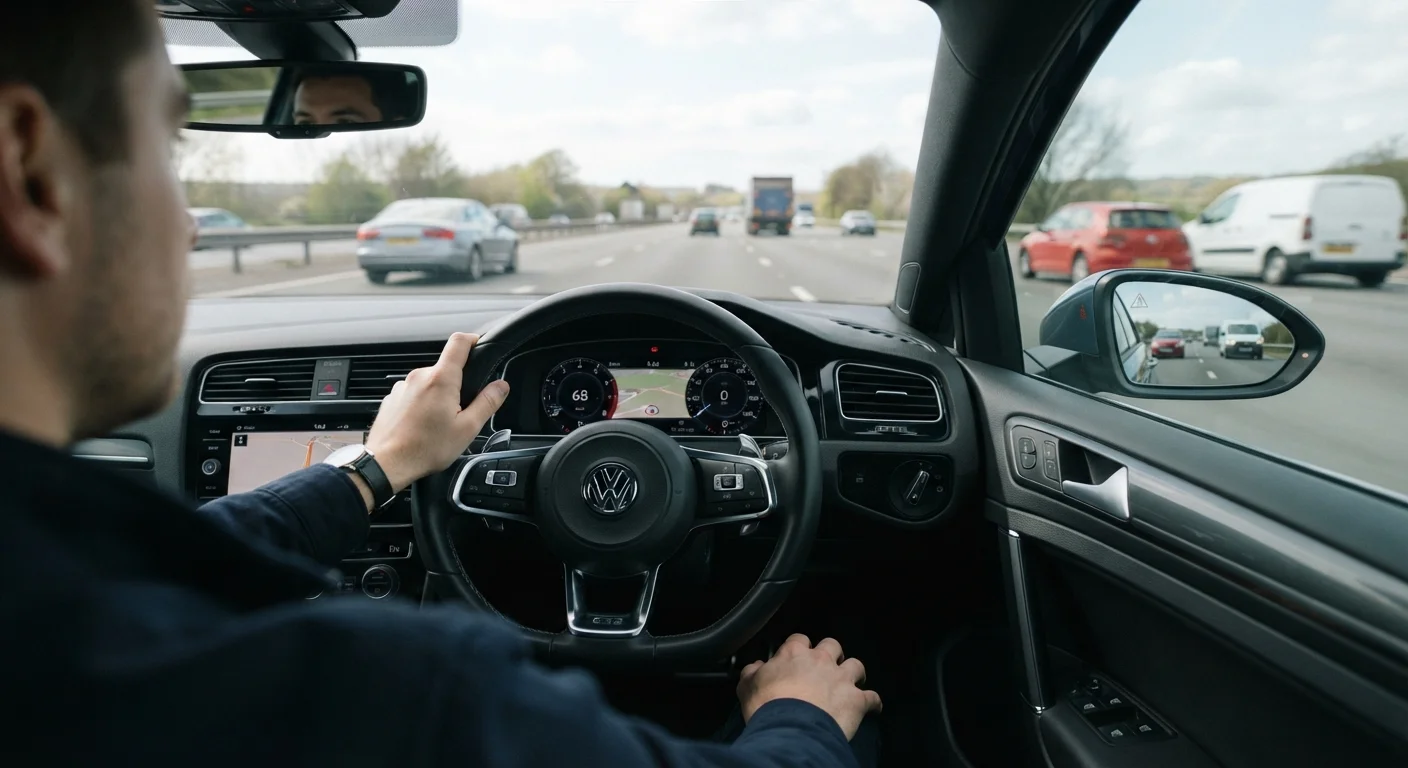
Why the Sequence Matters
New drivers often focus on the mechanics of operating the car - steering, accelerating, braking - and treat signalling as an afterthought. That instinct is understandable, but it's also one of the most common roots of near-misses and collisions. Lane changes are not single actions; they are sequences, and the order of each step exists for a precise reason.
The framework used in driver training across the US and many other countries is sometimes called Mirror-Signal-Manoeuvre (MSM). It sounds simple, yet research into crash causation consistently shows that drivers who reverse or skip steps - signalling before looking, or moving before signalling - dramatically increase risk to themselves and others. Understanding why each step comes when it does turns a rote routine into genuine road sense.
For an equally important habit to build before you even leave the driveway, see our pre-drive safety checklist - mirrors and seat position adjusted correctly make every subsequent step easier.
What you will need
The Step-by-Step Lane-Change Sequence
Follow these steps every time you intend to change lanes, whether on a city road or a multi-lane highway. With practice, the sequence becomes automatic - but early on, it helps to mentally narrate each step as you perform it.
Check the interior (rearview) mirror
Before anything else, glance at your rearview mirror to understand the traffic situation directly behind you. Note how close the nearest vehicle is and how fast it appears to be travelling. This tells you whether there is space to safely complete a lane change at all.
Check the relevant wing mirror
Next, look at the wing (side) mirror on the side you intend to move toward - left mirror for a left lane change, right mirror for a right. This gives you a view of traffic coming up alongside you in the target lane.
Activate your turn signal
Only after completing both mirror checks should you activate the indicator in the direction you intend to move. Push the stalk down for a right signal, up for a left - or the reverse depending on your vehicle's layout. Allow the signal to flash at least three or four times before proceeding so nearby drivers have time to register your intention.
Perform a shoulder (blind-spot) check
Quickly glance over your shoulder in the direction of your intended move. This covers the blind-spot zone that mirrors cannot fully capture - typically the area beside and slightly behind your rear door. If you see a vehicle there, hold your position and wait.
Execute the lane change smoothly
If all checks confirm a clear path, steer gradually into the new lane. Avoid sharp or sudden movements. Maintain your current speed unless the traffic flow in the new lane requires a small adjustment; do not slow down abruptly mid-manoeuvre.
Cancel the indicator and do a final mirror check
Once you are settled in the new lane, confirm your indicator has cancelled (most vehicles do this automatically when you straighten the wheel, but verify). Take one more glance at the rearview mirror to confirm your positioning and the behaviour of traffic behind you.
Build the habit with low-stakes practice
When first learning this sequence, practise on quiet roads or empty parking lots before attempting busy multi-lane highways. Narrating each step aloud - "mirrors, signal, shoulder check, move" - helps embed the order until it becomes instinctive. Many driving instructors recommend this self-commentary technique for any new manoeuvre.
Common Shortcuts That Cause Problems
Even drivers with some experience fall into habits that compress or reorder the sequence. The most frequent errors are worth naming explicitly.
- Signalling simultaneously with moving: The indicator is meant to warn others before you move, not announce a move already in progress. Give surrounding drivers at least three seconds to react.
- Mirror-checking but skipping the shoulder check: Mirrors cannot show the full blind-spot zone alongside your vehicle. A quick glance over the appropriate shoulder - left for a left lane change, right for a right - is non-negotiable. Our article on mirror myths new drivers believe explains exactly where those blind spots sit and why mirrors alone are insufficient.
- Forgetting to cancel the indicator: Leaving a turn signal on after completing a lane change misleads drivers behind you and can cause them to brake unnecessarily or make their own unsafe moves based on false information.
- Moving too abruptly: A smooth, gradual drift into the new lane - rather than a sharp turn of the wheel - gives any driver you may have misjudged extra time to adjust.
Speed Differences Demand Extra Time
On highways where traffic moves at 60-70 mph, distances close far faster than they appear. A vehicle that looks comfortably far away in your mirror may reach your position in two to three seconds. Always err on the side of a longer gap than you think you need, especially until judging closing speeds becomes second nature.
These same principles apply at more complex junctions. If you want to practise them in a structured environment, our guide to right of way at intersections pairs well with this article. Roundabouts in particular require confident lane discipline - see how roundabouts work for a plain-language walkthrough.