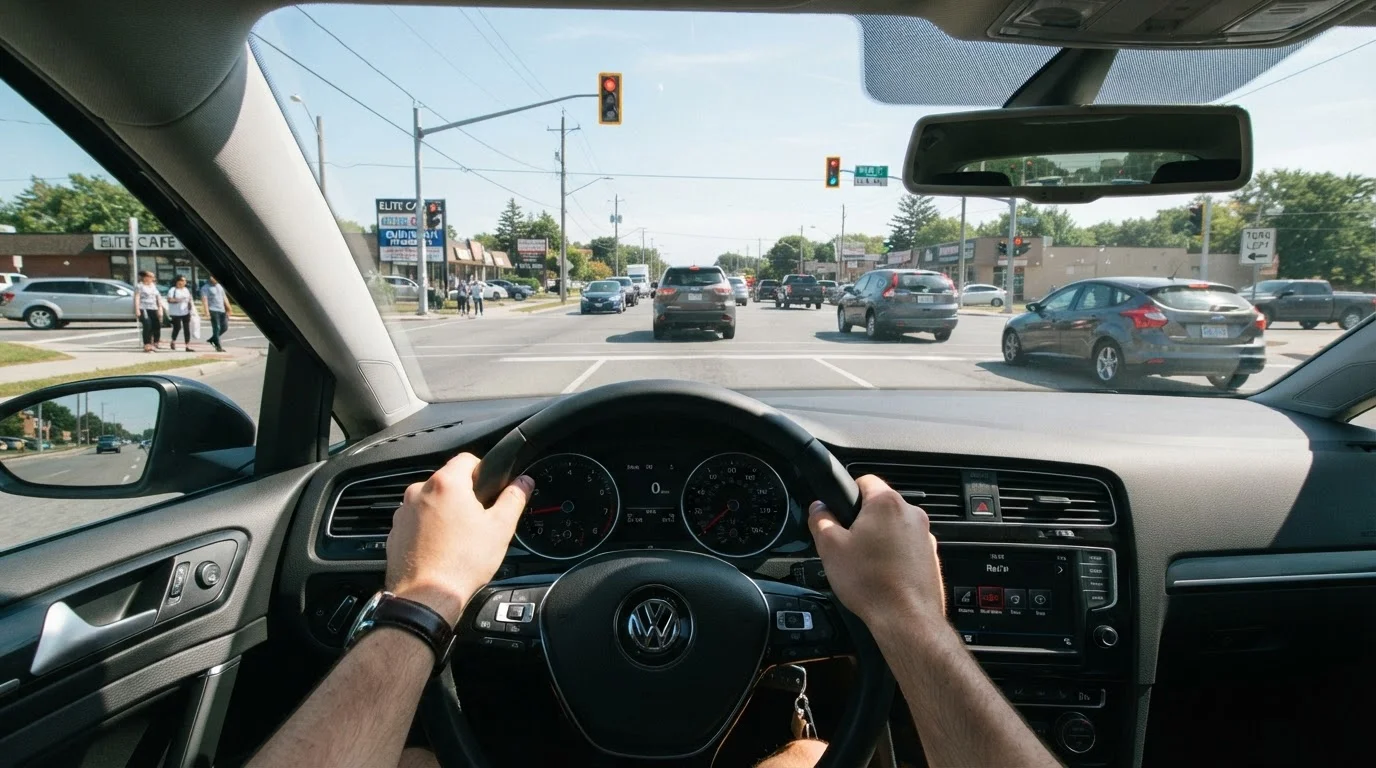
Why New Drivers React Late - and Experienced Drivers Don't
When a new driver brakes sharply for a hazard, it feels sudden because, to them, it was. The hazard appeared without warning. An experienced driver in the same car, watching the same road, would likely have slowed gently thirty seconds earlier - because they saw it coming.
This is not about faster reflexes. Human reaction time varies only modestly from person to person. What experienced drivers have developed is the ability to read the road: they gather information earlier, interpret it correctly, and act before the situation becomes a crisis. New drivers can develop the same habits with deliberate practice.
“The difference between a novice and an expert driver is not reaction time - it is anticipation. Experts use information earlier, and they use more of it.”
— Frank McKenna, Professor of Psychology, University of Reading - researcher in driver behaviour and hazard perception
The Scanning Pattern That Changes Everything
The most important technical habit in hazard perception is looking further ahead than feels natural. New drivers tend to focus on the vehicle directly in front of them - understandably, since that's the most immediate collision risk. But that focus leaves almost no time to respond to anything beyond it.
Experienced drivers divide their attention across a wider field:
- Far zone (12-15 seconds ahead): Where are intersections, bends, or merges? What is traffic doing beyond the car in front?
- Mid zone (4-12 seconds ahead): Are brake lights appearing? Is a cyclist drifting toward the lane? Has a pedestrian stepped off the curb?
- Near zone (under 4 seconds): Immediate space management - following distance, lane position, and any last-second input.
The eyes should move constantly between these zones rather than locking onto one point. This scanning motion is a learnable, practisable technique. Common mirror myths also affect how well new drivers monitor the zones behind them - worth understanding alongside forward scanning.
~94%
Of serious crashes involving human error
According to the U.S. National Highway Traffic Safety Administration, the vast majority of serious traffic crashes involve some form of driver error, including failure to recognize or respond to hazards in time.
1.5 sec
Average perception-reaction time at speed
Driver training research commonly cites 1.5 seconds as a typical perception-to-brake reaction time under normal conditions - illustrating why seeing hazards earlier is more effective than trying to react faster.
12-15 sec
Recommended forward scanning distance in time
Driver education programs widely recommend scanning 12 to 15 seconds ahead, giving drivers substantially more time to process and respond to developing hazards.
Reading Environmental Clues, Not Just Objects
A hazard rarely announces itself. What you learn to spot are clues - conditions that make a hazard likely even before it appears. Experienced drivers ask themselves a running question: what could go wrong here, and where would it come from?
Common environmental clues include:
- Parked vehicles: Any parked car is a potential source of a swinging door, a child running out, or a reversing vehicle. Approach with extra space.
- Road junctions and driveways: Even if you have right of way, another driver may not yield. Slow slightly and cover the brake (keep your foot hovering over it) as you pass.
- Pedestrian behaviour: Someone standing at a curb looking at their phone may step out without checking. Someone walking with a child is less predictable than one walking alone.
- Surface and weather: A road that looks wet after rain, or one that enters shade on a cold day, may have hidden ice or standing water.
Driving on urban streets and rural roads calls for different versions of this thinking. Urban vs. rural driving covers how to adjust your approach between the two environments.
Practice 'Commentary Driving' as a Passenger
Sit in the passenger seat during a journey and quietly try to identify every potential hazard before the driver responds to it. Over time this trains your eyes to seek out developing situations rather than waiting for them to arrive. Many driving instructors use this technique with learners because it builds scanning habits without the cognitive load of controlling the vehicle at the same time.
Building the Mental Habit: Deliberate Practice
Hazard perception improves with focused attention, not just accumulated mileage. Sitting in a passenger seat and consciously trying to spot hazards before the driver responds is one of the most effective low-stakes practice methods available to learners.
When you are driving, narrating your observations aloud - even briefly - forces the conscious engagement that builds long-term habit. Over time, what feels like deliberate analysis becomes automatic pattern recognition, which is exactly how experienced drivers describe their perception of the road.
Night Driving Adds a Layer of Difficulty
All of the scanning techniques described here are harder to apply after dark, when visibility is reduced and glare from oncoming headlights can temporarily overwhelm your vision. The fundamentals are the same, but the margin for error is smaller. See our guide to night driving for advice on adapting these habits when the sun goes down.
Confidence on the road grows alongside awareness. As your scanning becomes more instinctive, decision-making becomes calmer and less effortful - which in turn makes driving safer for everyone around you.