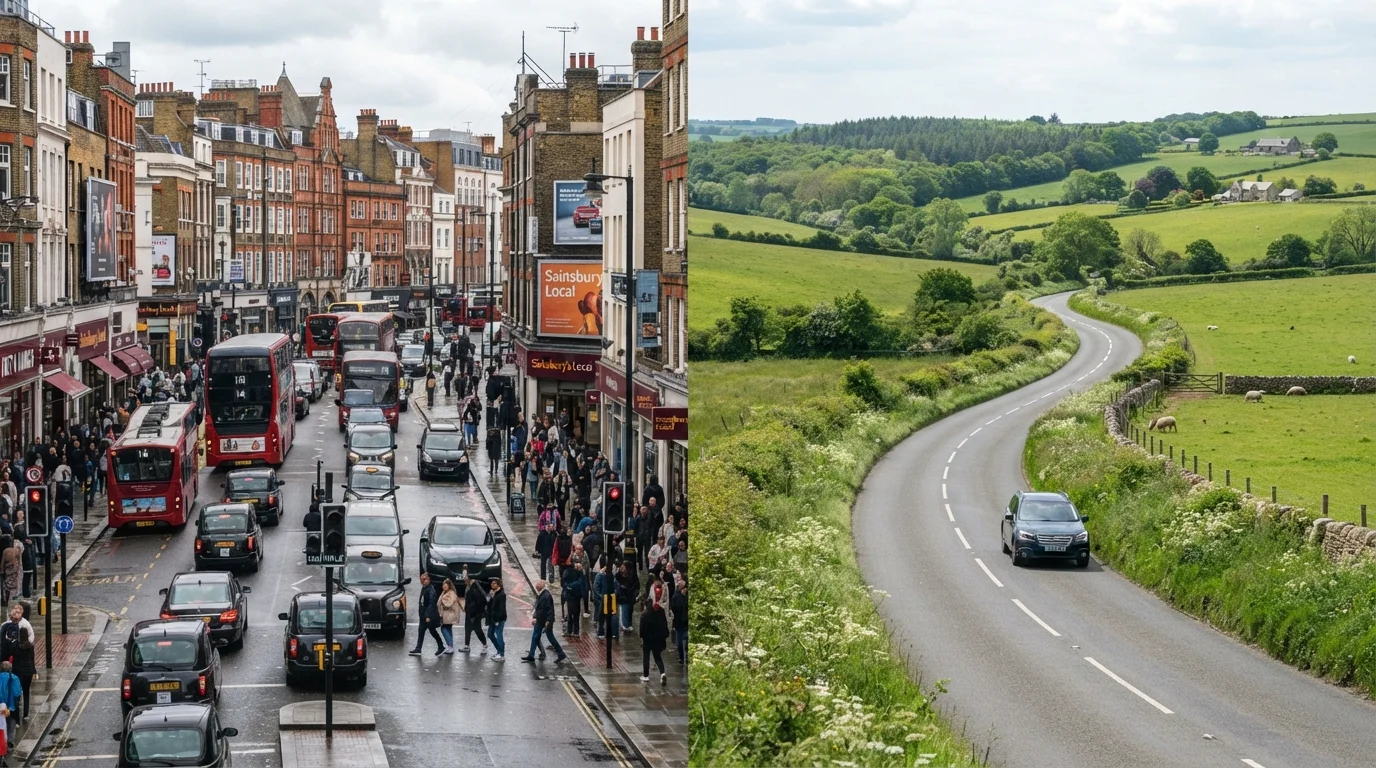
Why the Environment Shapes Your Driving Style
Many new drivers assume that once they've learned the rules of the road, those rules apply equally everywhere. In practice, where you're driving changes almost everything - your scanning pattern, your speed choices, the hazards you prioritize, and how much time you have to react.
Urban and rural roads aren't just different in appearance. They present genuinely different challenges that require deliberate adjustments. Understanding these differences in advance means you won't be caught off-guard the first time a cow wanders onto a country lane - or a cyclist materializes in your blind spot at a city junction.
For a deeper look at how experienced drivers mentally prepare for any road environment, see how experienced drivers read the road early.
Urban Driving: Dense, Slow, and Constantly Changing
City and town driving is characterized by high hazard density at lower speeds. You're rarely travelling fast, but you're processing a lot of information simultaneously - traffic signals, road markings, pedestrians stepping off curbs, cyclists filtering between lanes, and delivery vehicles stopped at unpredictable angles.
Key urban hazards to watch for
- Pedestrians and cyclists - often in your peripheral vision or emerging from between parked cars
- Stop-and-go traffic - requires short, controlled following distances and frequent brake checks
- Junctions and turning vehicles - demand constant mirror and shoulder checks
- Parked cars opening doors - known as a "dooring" risk, especially for cyclists, but also a hazard for drivers cutting too close
In urban areas, your eyes should be scanning constantly - ahead, to the sides, and in your mirrors - rather than fixating on the vehicle directly in front. Roundabouts are a particular pinch point for new urban drivers; understanding how roundabouts work can remove a lot of that anxiety.
Use a Wider Eye Line in Cities
New urban drivers often focus too narrowly on the car ahead. Train yourself to look 10-15 seconds of travel time ahead, taking in the full width of the road. This gives you more processing time and makes you less likely to be surprised by sudden stops or merging vehicles. Checking your mirrors every 5-8 seconds keeps your 360-degree picture current.
Rural Driving: Faster, Emptier, and Deceptively Risky
Open roads feel more relaxed - less traffic, fewer signals, wider visibility. But rural roads carry their own serious hazard profile, and the higher speeds involved mean mistakes are more consequential.
Key rural hazards to watch for
- Blind bends and crests - you can't see oncoming vehicles or obstacles until you're close; always approach at a speed that allows you to stop within your visible distance
- Animals on the road - livestock, deer, and dogs can appear suddenly, particularly near farms or woodland
- Narrow lanes - passing oncoming traffic in single-track roads requires patience, clear communication, and use of passing places
- Variable surfaces - mud, gravel, and pot holes affect braking and steering. Wet rural roads can be especially slippery due to mud or leaf debris
- Agricultural vehicles - wide, slow-moving, and sometimes occupying the middle of the lane
Following distances need to increase substantially on rural roads, not decrease just because the road feels open. Weather compounds all of these hazards - see how weather conditions affect driving technique for guidance on adjusting to rain, fog, and ice.
| Urban Roads | Rural Roads | |
|---|---|---|
| Typical speed range | 15-35 mph (city/town limits) | 40-60 mph (national speed limit roads) |
| Primary hazards | Pedestrians, cyclists, junctions, parked cars | Blind bends, animals, mud, narrow lanes |
| Recommended following distance | 2-second rule minimum in dry conditions | 3+ seconds; increase in poor conditions |
| Scanning pattern | Wide, frequent; check mirrors every 5-8 seconds | Far ahead to anticipate bends and crests |
| Speed management | Frequent acceleration/braking cycles | Steady pace; slow before blind features |
| Road surface variation | Generally consistent; watch for wet manhole covers | Can vary sharply; watch for mud and gravel |
The Mindset That Works in Both Environments
The clearest common thread between urban and rural driving is the value of anticipation over reaction. Drivers who wait until a hazard is directly in front of them have already lost most of their response time. Those who read the road ahead - scanning for clues, predicting pedestrian behaviour, slowing before blind corners - stay in control across both environments.
This is the principle behind defensive versus reactive driving. A defensive mindset doesn't mean driving slowly everywhere - it means adjusting your speed and position so that you always have options if something unexpected happens.
As your experience grows, you'll find that switching between environments becomes more automatic. Initially, it's worth being deliberate about it: when you leave an urban area and join a rural road (or vice versa), treat it as a moment to consciously reset - check your speed, reassess your following distance, and update your hazard expectations for the new setting.
This article is intended as general driving education for new drivers and does not replace formal instruction from a qualified driving instructor.
~60%
Fatal crashes occurring on rural roads
According to the NHTSA, rural roads consistently account for a disproportionate share of traffic fatalities relative to the miles driven on them, despite lower traffic volumes.
3 sec+
Recommended following gap on rural roads
Highway safety guidance generally advises increasing following distance beyond the standard two-second rule when driving on rural roads at higher speeds or in poor visibility.