Why the Nutrition Facts Label Exists
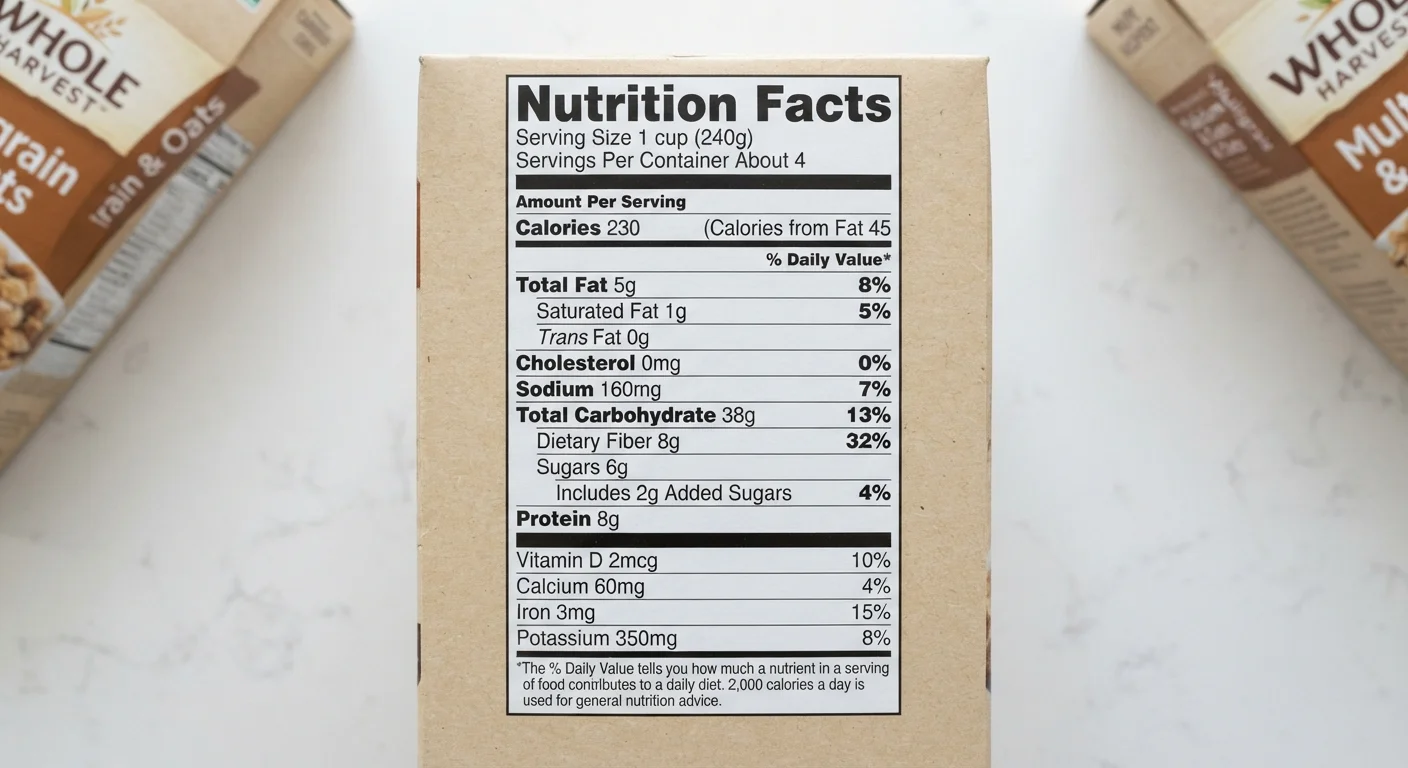
The Nutrition Facts label is a federally mandated panel required by the U.S. Food and Drug Administration (FDA) on most packaged foods sold in the United States. Its purpose is straightforward: to give consumers standardized, comparable information about the nutritional content of what they're eating. The current label format was updated in 2020 to reflect newer nutrition science and eating patterns.
For beginners, the label can feel like a wall of numbers with no obvious starting point. In reality, it follows a logical top-to-bottom structure - each row building on the one before it. Once you understand the structure, you can read any label in under a minute. You'll also be better equipped to look past front-of-package marketing language; for more on that, see our article on what packaging claims actually mean.
What you will need
How to Read a Nutrition Facts Label, Step by Step
Labels Are Education, Not Prescriptions
The Nutrition Facts label is a general information tool based on a 2,000-calorie reference diet. Your individual calorie and nutrient needs may differ depending on your age, health status, activity level, and other factors. This article is for informational purposes only - consult a registered dietitian or qualified healthcare provider for guidance tailored to your personal health situation.
"Per Container" vs. "Per Serving" Can Be Misleading
Some labels display two columns: one for a single serving and one for the entire container. Always check which column you're reading. A drink that looks reasonable per serving may contain two or three servings per bottle, meaning calorie and sugar totals can be two to three times what you first assumed.
Start with serving size and servings per container
The very first section of any Nutrition Facts label tells you the serving size - the measured amount (in common household units plus grams) that all the numbers below it are based on. Directly beneath that is the number of servings per container.
This is the most important step. If a bag of crackers lists a serving size of 10 crackers but you eat 20, every number on the label doubles for your intake. Always establish this baseline before reading anything else.
Read the calorie count in context
Calories are displayed in large type just below the serving information. This number represents the total energy provided by one serving from all three macronutrients - fat, carbohydrates, and protein - combined.
Calories alone don't tell you whether a food is nutritious. A food can be calorie-dense and nutrient-rich (like nuts) or calorie-light and nutrient-sparse. Use this number as one data point alongside everything else on the label, not as the sole measure of a food's value.
Identify nutrients to limit
The middle section of the label lists individual nutrients. The nutrients to limit - meaning most Americans already get enough or too much - are:
- Saturated fat - linked to cardiovascular risk when consumed in excess; listed in grams and as % Daily Value (DV)
- Sodium - relevant to blood pressure management; watch this especially in processed and packaged foods
- Added sugars - sugars added during manufacturing, listed separately below total sugars. Learn more about how this differs from naturally occurring sugar in our guide to added vs. natural sugar
The label no longer requires trans fat to be listed if a product contains none, but check if it appears - any partially hydrogenated oil in the ingredient list may indicate small amounts.
Identify nutrients to prioritize
Below the "limit" nutrients, you'll find nutrients that many people may not get enough of:
- Dietary fiber - supports digestive health and helps you feel full longer
- Vitamin D, calcium, iron, and potassium - required by the FDA to be listed because deficiencies are common in the US population
For these, a higher % DV per serving is generally a positive sign. For a broader overview of what these vitamins and minerals do in the body, see our vitamins and minerals reference.
Interpret the % Daily Value column
The right-hand column shows each nutrient as a percentage of the Daily Value (% DV). Daily Values are reference amounts set by the FDA based on a 2,000-calorie diet and represent how much of each nutrient one serving contributes to a full day's intake.
This column is most useful for quick comparisons and for spotting extremes - a single food that delivers 40% of your daily sodium, for example, is worth noting. It does not mean you should aim to hit exactly 100% DV from any one food or meal.
[tip_callout]Check the footnote and put it all together
At the bottom of most labels, a footnote reminds you that % DV figures are based on a 2,000-calorie diet and that your own needs may be higher or lower. This is a built-in acknowledgment that the label is a general educational tool, not a personalized prescription.
Once you've worked through all sections, you have a complete picture of one serving's contribution to your daily nutrient intake. Pair this skill with an understanding of what a balanced plate looks like to see how individual foods fit into broader meal patterns.
After working through these steps, reading the ingredient list is a natural next move - ingredients are listed by weight from most to least, which reveals a lot about what's actually in the product. Our guide to ingredient lists walks you through that process in the same beginner-friendly format.
This article is for general informational and educational purposes only and does not constitute medical or dietary advice. Individual nutritional needs vary. Consult a qualified healthcare provider or registered dietitian for guidance specific to your health situation.