Why These Two Tools Are Often Confused
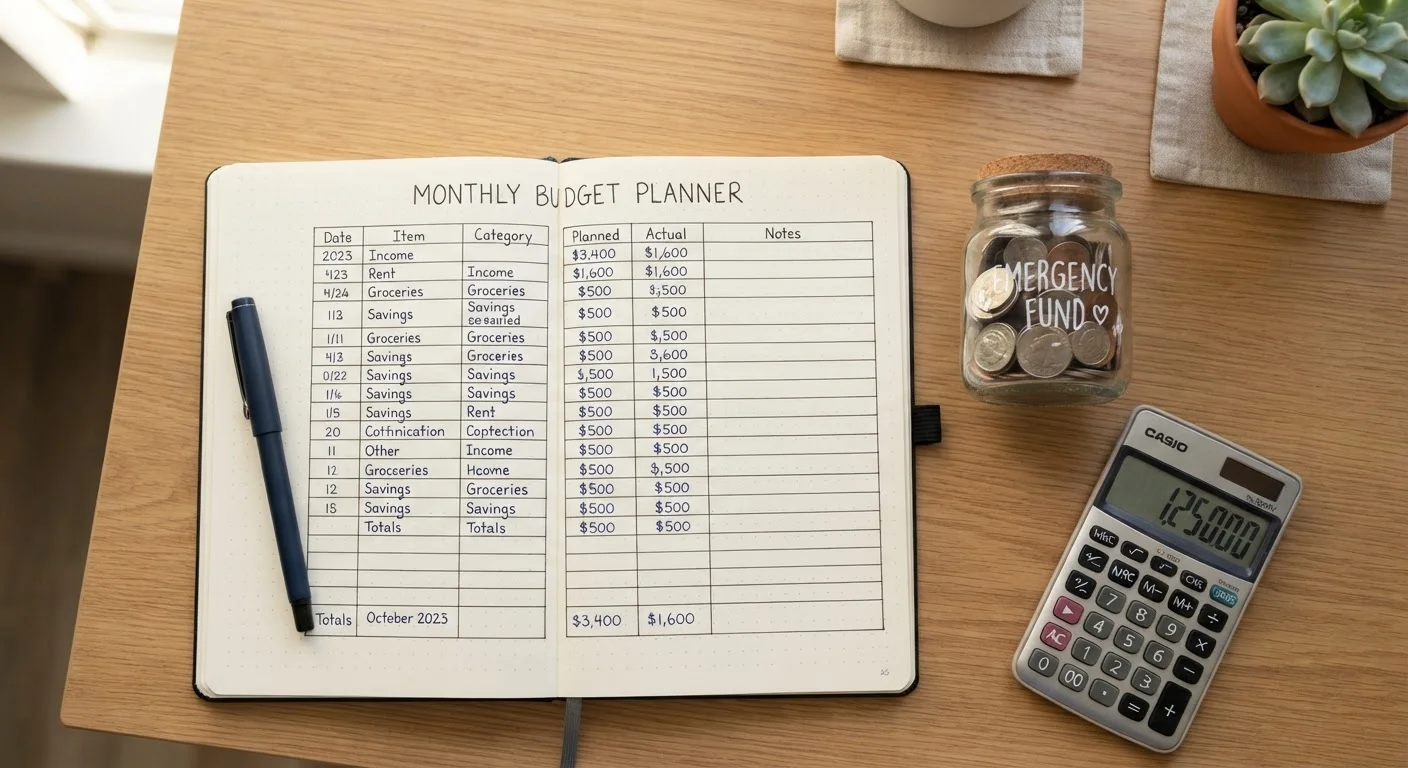
People frequently treat budgeting and emergency savings as interchangeable - or assume that having one means they don't need the other. In reality, they solve different problems. A budget answers the question: Where should my money go this month? An emergency fund answers a different question: What happens when something I didn't plan for costs me money?
Without a budget, most people never find the margin to save consistently. Without an emergency fund, a single unexpected expense - a broken appliance, an urgent dental visit, a car breakdown - can force you to break your budget, take on debt, or drain savings meant for something else. The two tools fill each other's gaps.
Explore the full Saving & Emergency Funds hub for a broader look at building financial resilience from the ground up.
How a Budget Creates Room for Emergency Savings
The most common reason people don't have an emergency fund isn't lack of income - it's lack of a plan. When spending isn't tracked, money tends to disappear into small purchases that don't feel significant individually but add up substantially. A budget makes the invisible visible.
Once you map your income against your fixed costs (rent, utilities, loan payments) and variable needs (groceries, transportation, healthcare), you can identify a realistic savings margin. That margin - even if it's modest at first - becomes the source of your emergency fund contributions.
Make Your Savings Contribution Non-Negotiable
Automate your emergency fund contribution so it transfers to a savings account on the same day you receive each paycheck. This 'pay yourself first' approach removes the need for willpower and ensures savings happen before spending decisions are made. Even automating $30 or $50 per pay period builds meaningful protection over time.
The key mindset shift is treating your emergency fund contribution like a bill you owe yourself. List it as a line item in your budget alongside rent and groceries. When savings feel optional, they rarely happen. When they feel obligatory, they usually do.
For a deeper look at how much to aim for, see how much an emergency fund should cover - the three-to-six-month rule explained in practical terms.
~40%
Americans who couldn't cover a $400 emergency
Federal Reserve surveys have consistently found that a significant share of U.S. adults would struggle to cover an unexpected $400 expense without borrowing or selling something.
3-6 months
Recommended emergency fund coverage
The Consumer Financial Protection Bureau (CFPB) and widely cited financial educators generally recommend saving three to six months of essential living expenses as a baseline target.
How an Emergency Fund Protects Your Budget
A well-funded emergency account acts as a shock absorber. When an unexpected expense hits - and at some point, one will - you can cover it without blowing up your monthly plan or turning to credit cards. This is where the relationship between the two tools becomes clearest: the budget builds the fund, and the fund shields the budget.
Without this buffer, even a $500 car repair can trigger a cascade - missed savings contributions, credit card interest, overdraft fees, or depleted funds meant for rent or groceries. With an emergency fund in place, that same $500 expense is a manageable withdrawal, not a financial crisis.
It's also worth understanding where your emergency fund should live. Keeping it in a separate account from your everyday checking reduces the temptation to spend it. Read more about keeping your emergency fund at a separate bank.
When You Use Your Emergency Fund, Your Budget Is the Rebuild Plan
Many people drain their emergency fund during a genuine crisis and then struggle to replenish it - often because they never adjust their budget afterward. Understanding why rebuilding stalls is the first step toward avoiding that pattern.
The fix is straightforward in principle: after using emergency savings, return to your budget and temporarily increase your monthly savings contribution until the fund is restored. That might mean cutting discretionary spending, pausing a non-essential subscription, or redirecting a bonus or tax refund. Your budget is the mechanism that makes the rebuild possible.
Not sure if your emergency fund is truly ready? The Emergency Fund Readiness Checklist walks you through exactly what to verify.
“A budget is telling your money where to go instead of wondering where it went. The emergency fund is what makes sure an unexpected bill doesn't undo all that planning.”
— John C. Maxwell, Author and speaker, widely cited in personal finance education contexts
This article is for general informational purposes only and is not personalized financial advice. Consult a qualified financial professional for guidance specific to your situation.