Why Tracking Your Spending Is the Foundation of Budgeting
Before you can make a realistic budget, you need to know where your money is actually going. Most people underestimate how much they spend in certain categories - a pattern the Consumer Financial Protection Bureau (CFPB) identifies as a key barrier to building financial stability. Tracking spending closes that gap by giving you real data instead of guesses.
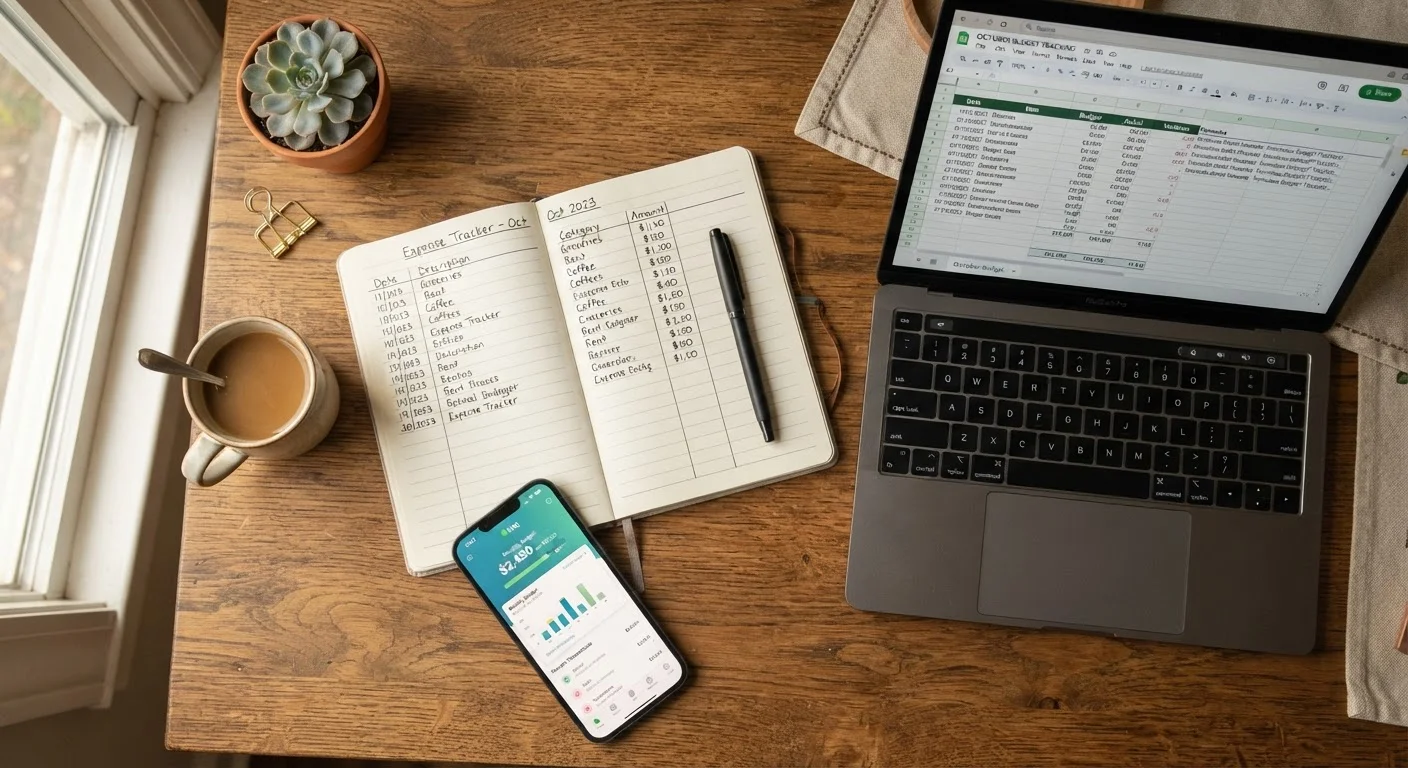
Three methods dominate for beginners: digital budgeting apps, spreadsheets, and pen-and-paper logs. Each has genuine strengths and real drawbacks. Understanding them helps you pick one you'll actually stick with - because an abandoned system, however sophisticated, helps no one. For a broader starting point, see our monthly budget setup checklist which walks through the full budgeting process from scratch.
Budgeting Apps: Convenience With Caveats
Smartphone budgeting apps can link directly to your bank accounts and credit cards, categorizing transactions automatically. This reduces the manual effort significantly and gives you a near-real-time picture of your finances.
Strengths
- Speed: Transactions are imported automatically - no manual entry required.
- Visualization: Most apps display charts and category breakdowns that make patterns easier to spot.
- Reminders: Push notifications can alert you when you're approaching a spending limit.
Drawbacks
- Privacy concerns: Linking bank credentials to a third-party app carries data-sharing risks worth evaluating carefully.
- Miscategorization: Automated systems often label transactions incorrectly and require periodic correction.
- Subscription costs: Several capable apps charge monthly or annual fees.
For a detailed, balanced look at what apps do - and don't - deliver, read our article on the honest trade-offs of budget tracking apps.
Test an App Before Sharing Bank Credentials
Many budgeting apps allow manual transaction entry without requiring account linking. Start in manual mode for a few weeks to evaluate whether the app's interface and categories work for you before deciding to connect financial accounts. This also gives you a low-stakes way to compare the app experience with a parallel pen-and-paper log.
Spreadsheets: Flexibility for the Detail-Oriented
A spreadsheet - whether in a free tool like Google Sheets or a locally stored program - puts you in complete control of how your data is organized, categorized, and visualized. You build it the way your financial life actually works.
Strengths
- Customization: Create categories that match your real spending habits, not a pre-set template.
- No data sharing: Your financial information stays on your own device or private cloud account.
- Flexibility over time: Easy to modify as your income or priorities change - especially useful if you have variable income. Our guide on budgeting with irregular income explains how to structure a spreadsheet around unpredictable paychecks.
Drawbacks
- Manual entry: Every transaction must be entered by hand, which takes consistent effort.
- Setup time: Building a useful template from scratch requires some planning upfront.
- Formulas required: Basic math functions are easy to learn, but errors can go unnoticed if you're not careful.
| Budgeting Apps | Spreadsheets | Pen-and-Paper | |
|---|---|---|---|
| Setup effort | Low - connect accounts and go | Medium - build or adapt a template | Minimal - open a notebook |
| Ongoing time commitment | Low - automation handles most entry | Medium - manual entry required | High - every transaction logged by hand |
| Customization | Limited by app structure | Very high - fully flexible | Unlimited but unstructured |
| Data privacy | Lower - third-party data sharing | High - stays on your device | Complete - fully offline |
| Spending awareness built | Moderate - passive viewing | Moderate - active input helps | High - writing reinforces attention |
| Trend analysis | Easy - charts auto-generated | Good - requires formula setup | Difficult - all manual |
| Cost | Free to paid subscription | Free tools widely available | Negligible - just a notebook |
Pen-and-Paper: The Case for Going Analog
Writing down every purchase by hand is the oldest tracking method - and research in behavioral economics suggests that physically recording an expense can make you more conscious of it in the moment, potentially encouraging more deliberate choices.
Strengths
- Zero technology required: Works anywhere, anytime, with no login or internet connection.
- Deep awareness: The act of writing reinforces memory and attention to spending decisions.
- Complete privacy: No data ever leaves a notebook.
Drawbacks
- Time-consuming to review: Totaling categories manually takes longer than automated summaries.
- No backup: A lost notebook means lost records.
- Difficult to spot trends: Without charts or formulas, patterns across months require extra effort to identify.
Many beginners find that starting with pen-and-paper for two to four weeks builds a foundational awareness before moving to a digital tool. Building any tracking system into a reliable routine is covered in our piece on making budgeting a lasting monthly habit.
How to Choose the Right Method for You
The best tracking system is the one you'll actually use consistently. Consider these practical questions before deciding:
- How comfortable are you with technology? If apps feel overwhelming, a notebook removes friction entirely.
- How much time can you commit? Pen-and-paper and spreadsheets require daily or weekly manual input. Apps reduce that load significantly.
- How private do you want your financial data to be? If linking bank accounts makes you uneasy, keep your records offline or in a locally stored spreadsheet.
- Do you have irregular income? A customizable spreadsheet may be easier to adapt month-to-month than a rigid app template.
- Are you a tactile learner? Writing by hand reinforces memory for many people - if that's you, analog may outperform digital initially.
There's also no rule against combining approaches. Some people keep a daily pen-and-paper log for awareness and transfer totals to a monthly spreadsheet for pattern analysis. Once you have a handle on your spending, connecting those insights to a savings and emergency fund strategy becomes much more actionable.
This article is for general informational and educational purposes only and does not constitute personalized financial advice. For guidance specific to your financial situation, consider speaking with a qualified financial professional.