What Each Method Actually Does
Before comparing the two, it helps to understand what each one is really asking you to do. If you're starting from scratch, our step-by-step first budget guide covers the fundamentals you'll need regardless of which method you choose.
Zero-Based Budgeting
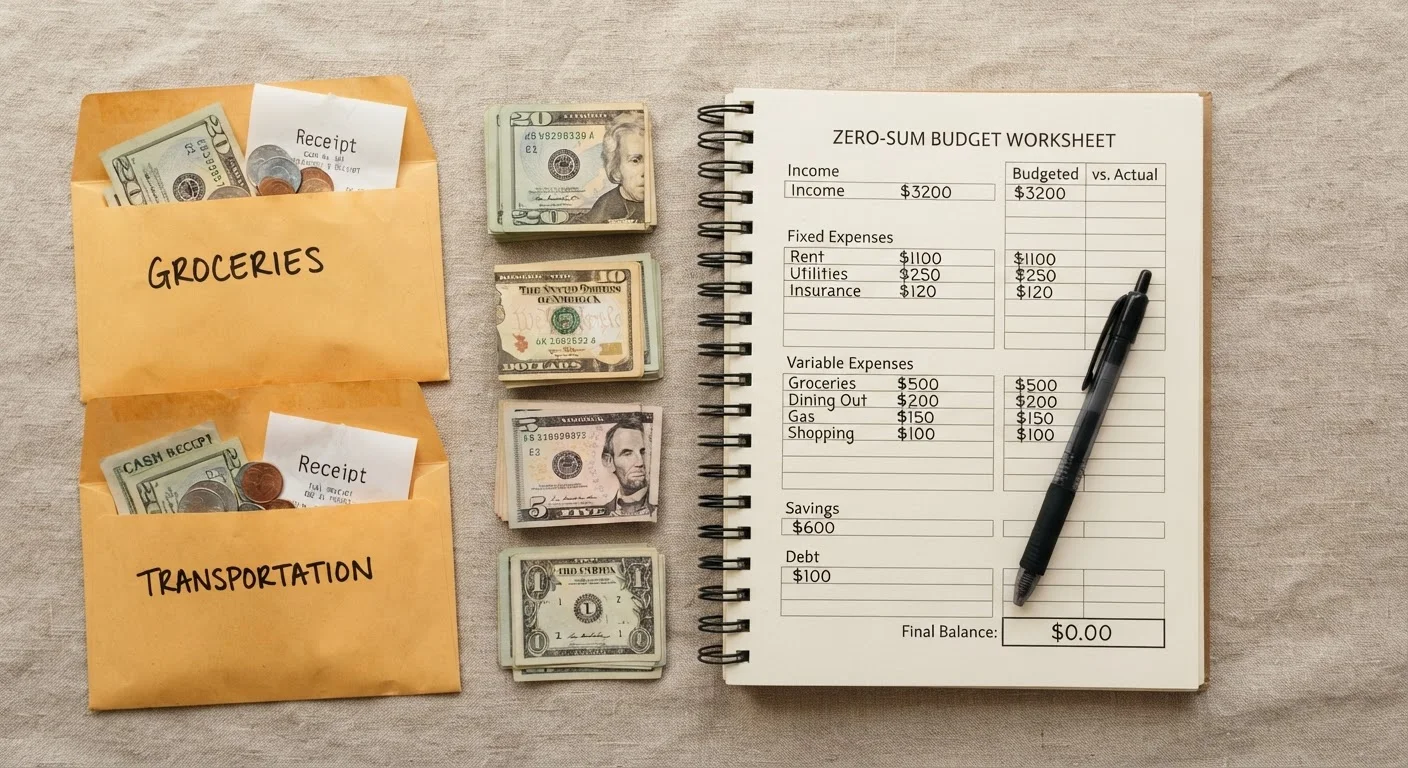
Zero-based budgeting (ZBB) starts with your total monthly take-home income and assigns every single dollar to a category - housing, groceries, savings, debt payments, entertainment - until the remaining balance is exactly zero. "Zero" doesn't mean you spend everything; money assigned to savings or an emergency fund still counts as allocated. The point is that no dollar is left floating without a purpose.
The Envelope Method
The envelope method takes a more physical approach. At the start of the month, you withdraw cash and divide it into labeled envelopes, one for each spending category. When an envelope is empty, spending in that category stops for the month. Traditionally cash-based, some people now replicate it with digital tools or separate bank accounts acting as virtual envelopes.
| Criterion | Zero-Based Budgeting | Envelope Method |
|---|---|---|
| Core mechanism | Assign every dollar to a category | Divide physical cash into envelopes |
| Spending control type | Self-monitored via tracking | Automatic - empty envelope = stop |
| Flexibility mid-month | Easy to reallocate digitally | Requires deliberate cash transfer |
| Works best with | Apps, spreadsheets, or software | Cash or virtual envelope apps |
| Ideal income type | Variable or irregular income | Steady, predictable income |
| Time commitment | Higher - full monthly rebuild | Lower - divide cash once monthly |
| Behavioral reinforcement | Relies on self-discipline | Built-in friction discourages overspending |
Key Differences in How They Work Day-to-Day
The biggest practical difference is when and how control happens. With zero-based budgeting, your plan is a detailed spreadsheet or app - spending control depends on you regularly checking your numbers and consciously staying within limits. With envelopes, the cash itself is the control: once it's gone, there's nothing left to spend.
Zero-based budgeting is more flexible mid-month. If you underspend on dining, you can reassign those dollars to another category with a quick edit. Envelope budgeting is more rigid - moving money between envelopes requires a deliberate, physical act, which is actually part of its value as a behavioral tool.
~30%
Americans who follow a formal budget
Gallup polling has consistently found that fewer than one-third of U.S. adults maintain a detailed household budget, suggesting most people could benefit from adopting a structured method.
18%
More spent with cards vs. cash
Multiple consumer behavior studies, including work cited by the American Psychological Association, suggest people tend to spend meaningfully more when paying by card than by cash.
For a plain-language explanation of terms like discretionary spending and sinking funds that come up in both methods, see our budgeting concepts glossary.
Strengths, Limitations, and Who Each Method Suits
Zero-based budgeting gives you a complete financial picture each month. Its main limitation is time - rebuilding a detailed budget from scratch monthly takes discipline and attention. It suits people with variable incomes, multiple savings goals, or those who enjoy detailed planning.
The envelope method's strength is behavioral: the physical act of handing over cash feels more "real" than a card swipe, which research on consumer spending behavior consistently associates with more mindful spending. Its weakness is practicality in an increasingly cashless world, though digital envelope apps address this partially.
A Note on "Digital Envelopes"
Several budgeting apps now offer virtual envelope or "bucket" features that mimic the envelope method without requiring cash. These can work well for people who rarely carry physical currency. The key trade-off is that a digital envelope doesn't create the same psychological friction as physically handing over cash - but it does provide the same hard category limits, which is often enough.
Both methods share a common requirement: you must know your actual monthly income before allocating anything. If you're navigating a tight budget, our article on budgeting on a low income addresses how these principles adapt when margins are thin.
There's also no rule against combining elements of both - using zero-based budgeting for your overall plan while applying envelope-style cash limits to your two or three most problematic categories is a common hybrid approach.
This article provides general financial education and is not personalized financial advice. For guidance tailored to your own situation, consider consulting a qualified financial professional.