Why Your Repayment Strategy Matters
If you carry multiple debts - credit cards, a car loan, a personal loan - simply paying minimums keeps you in debt far longer and costs significantly more in interest. A deliberate repayment strategy directs any extra money you can put toward debt in the most effective order possible.
Before choosing a strategy, build a complete picture of what you owe. List every debt with its current balance, interest rate (APR), and minimum monthly payment. This inventory is your starting point regardless of which method you choose. For a broader view of how consumer debt works, see our complete guide to consumer debt.
Once your list is ready, you have three main approaches to consider: the avalanche, the snowball, and hybrid variations that blend elements of both.
~$1,000
Average annual credit card interest paid per US household
The Consumer Financial Protection Bureau has noted that interest and fee costs on revolving credit card balances represent a significant ongoing expense for many American households.
3-5 yrs
Typical debt repayment timeline with a structured strategy
Financial planning organizations generally estimate that borrowers following a consistent payoff strategy can eliminate moderate consumer debt within three to five years, depending on balance size and extra payment capacity.
The Debt Avalanche: Mathematically Optimal
The debt avalanche method ranks your debts from highest interest rate to lowest. You pay the minimum on every debt, then put all remaining available money toward the highest-rate debt. Once that balance reaches zero, you roll that payment into the next highest-rate debt, and so on.
How it works in practice
- List debts from highest APR to lowest.
- Pay minimums on all debts every month.
- Direct any extra payment funds to the top-of-list debt.
- When that debt is paid off, add its full payment to the next debt on the list.
The case for avalanche
Because you're eliminating the most expensive debt first, you pay less total interest over the life of your repayment plan. For borrowers carrying high-rate credit card debt alongside lower-rate loans, the savings can be substantial. The trade-off is that your first payoff may take a long time if your highest-rate debt also carries a large balance - which can test your patience.
The Debt Snowball: Psychologically Powerful
The debt snowball method, popularized in behavioral finance research, ranks debts from smallest balance to largest - ignoring interest rates. You pay minimums on everything, then throw extra money at the smallest balance. When it's gone, that payment rolls into the next smallest.
How it works in practice
- List debts from smallest balance to largest.
- Pay minimums on all debts every month.
- Direct extra funds to the smallest-balance debt.
- Once eliminated, add its payment to the next debt on the list.
The case for snowball
Early payoffs create a concrete sense of progress. Research, including work cited by consumer financial education organizations, has found that some people are more likely to stay consistent with a debt plan when they experience visible wins early on. The snowball costs more in total interest compared to the avalanche, but a plan followed consistently outperforms a mathematically superior plan abandoned halfway through.
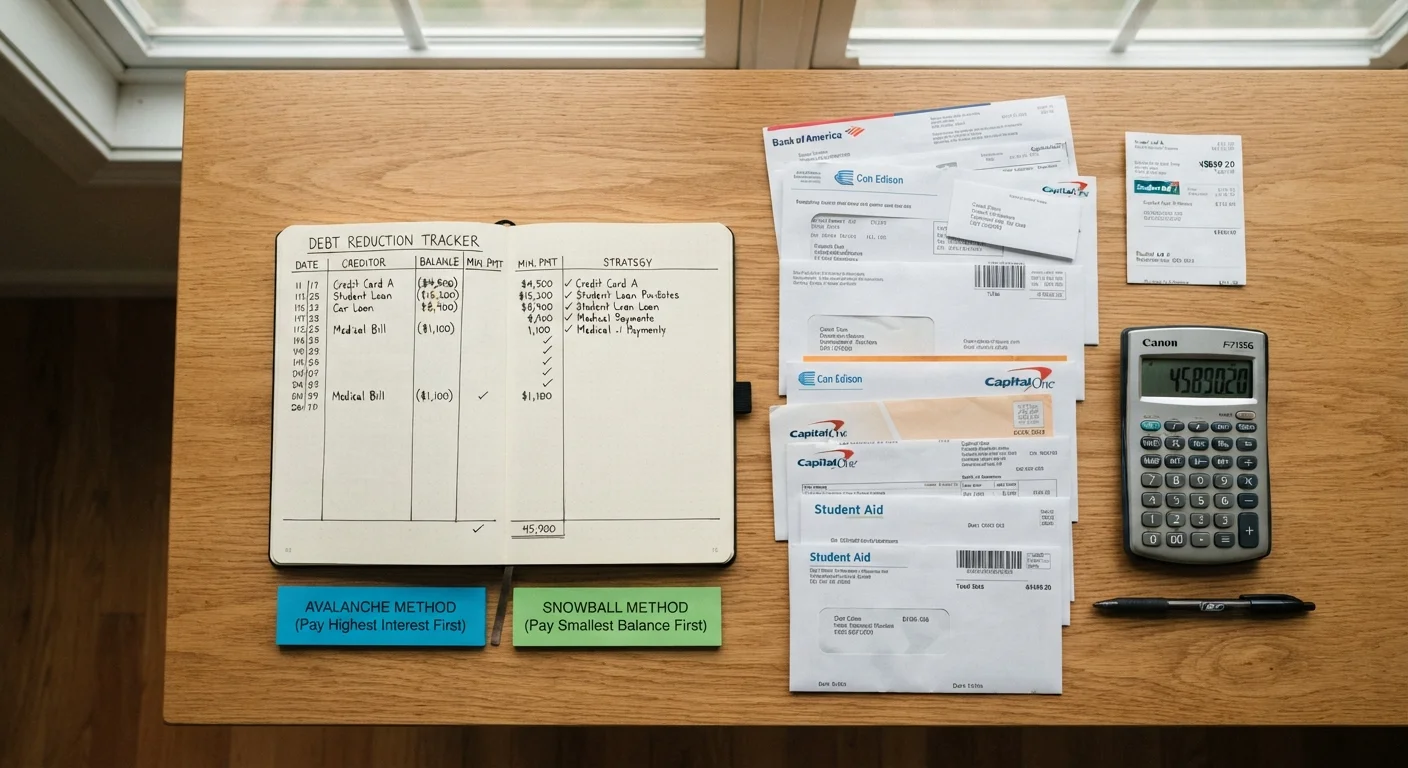
Start With a Written Debt Inventory
Before choosing avalanche, snowball, or hybrid, write down every debt you carry: creditor name, current balance, interest rate, and minimum payment. This single exercise clarifies your full picture and makes it easy to apply any ordering method. You can use a simple spreadsheet or even a notebook - the format matters far less than having accurate, complete information in one place.
Comparing Avalanche, Snowball, and Hybrid Approaches
A hybrid approach acknowledges that most real situations don't fit neatly into one camp. You might start with the snowball to clear one or two small debts quickly, then switch to avalanche ordering once you feel financially and emotionally steadier. Alternatively, you might use the avalanche by default but make one exception for a particularly small, annoying balance you want gone immediately.
The table below compares the three approaches across practical criteria to help you identify the best fit. For context on how borrowing decisions interact with repayment planning, see our comparison of personal loans and credit cards.
| Debt Avalanche | Debt Snowball | Hybrid | |
|---|---|---|---|
| Ordering principle | Highest interest rate first | Smallest balance first | Flexible, situation-dependent |
| Total interest paid | Lowest of the three | Higher than avalanche | Between avalanche and snowball |
| Speed of first payoff | Slower if top debt is large | Fastest early wins | Varies by chosen starting point |
| Psychological motivation | Requires patience | High - quick early wins | Moderate to high |
| Best for | Disciplined, numbers-focused borrowers | Motivation-driven borrowers | Borrowers wanting balance |
| Complexity | Low - straightforward ranking | Low - straightforward ranking | Moderate - requires judgment calls |
How to Put Your Strategy Into Action
Whichever method you choose, the mechanics of implementation are the same:
- Set up automatic minimum payments on every debt to avoid late fees and credit score damage.
- Identify your extra payment amount - even $25-$50 per month directed strategically makes a measurable difference over time.
- Track your progress monthly - update balances and celebrate payoffs to maintain motivation.
- Avoid adding new debt while in repayment mode where possible. Our pre-borrowing checklist can help you evaluate any new credit before committing.
Once your debts are under control, shifting focus to saving becomes more feasible. See our guide on saving versus paying off debt for help navigating that transition. For habits that keep debt manageable long term, visit our long-term debt management guide.
This article is for general informational and educational purposes only and does not constitute personalized financial, tax, or legal advice. Consult a qualified financial professional for guidance specific to your situation.