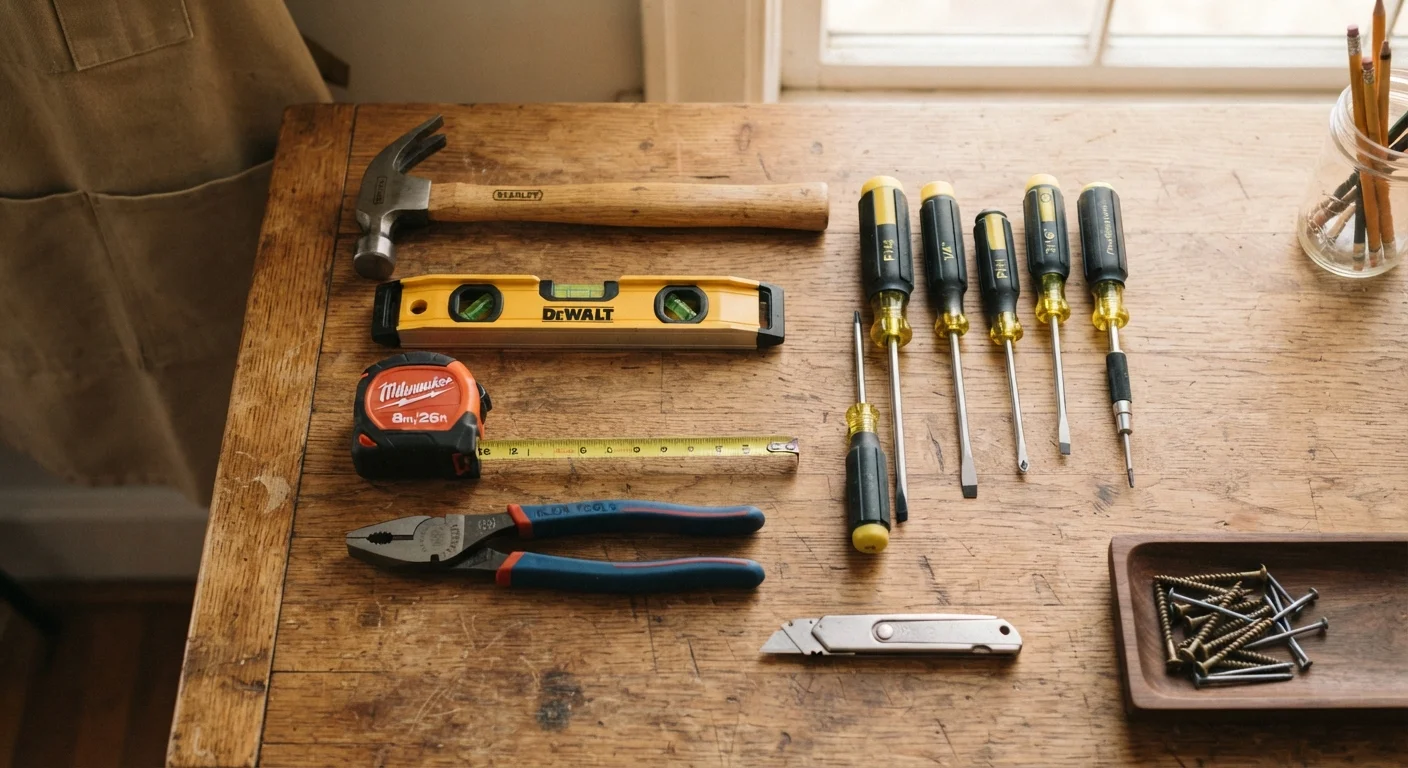
Why Hand Tools Matter Before Power Tools
Many new homeowners assume a cordless drill is the first thing to buy. In reality, hand tools lay the foundation. They're quieter, safer to learn on, require no charging or batteries, and are more than sufficient for the dozens of small fixes that come with owning a home - tightening a loose hinge, hanging a picture, checking if a shelf is level, or patching a screen.
This isn't about going low-tech for its own sake. It's about building genuine competence from the ground up. Once you understand what a tool does and why, every future project - whether you do it yourself or hire someone - becomes easier to manage. If you're also thinking through how to set up your space once repairs are handled, the guide to home organization from zero is a practical companion read.
Below are the hand tools that consistently earn their keep in a beginner's toolkit, along with honest context for each.
Claw Hammer
The claw hammer is the most versatile striking tool in any home toolkit. One end drives nails; the curved claw on the other pulls them back out. A 16-ounce hammer strikes a balance between driving power and control that works well for most household tasks - hanging artwork, assembling flat-pack furniture, or light demolition like removing a baseboard.
When choosing one, look for a handle that feels comfortable in your grip. Fiberglass and wood handles both absorb vibration reasonably well, which matters if you're doing repetitive work.
A 16-ounce claw hammer handles the vast majority of everyday household tasks.
Screwdriver Set (Flathead and Phillips)
Screws hold together more of your home than you might realize - outlet covers, cabinet hinges, light switch plates, door hardware, and furniture alike. Having both flathead (straight-blade) and Phillips (cross-shaped) screwdrivers in two or three sizes covers nearly every fastener you'll encounter.
A multi-bit screwdriver with interchangeable tips is a space-efficient alternative. Make sure the handle provides a firm, non-slip grip; a screwdriver that slips under torque can strip a screw head and turn a two-minute fix into a frustrating project.
Flathead and Phillips screwdrivers in multiple sizes cover nearly every fastener in a typical home.
Tape Measure
A tape measure is essential any time you're hanging shelves, buying furniture, planning a garden bed, or checking clearances for appliances. A 25-foot tape with a locking mechanism and a wide, rigid blade - one that holds itself extended without curling - makes solo measuring much easier.
Learn to read both the whole-inch and fractional markings (the smaller lines between inches represent halves, quarters, eighths, and sixteenths of an inch). Accurate measuring prevents costly mistakes before any cutting or purchasing happens.
Measuring accurately before cutting or purchasing prevents the most common and costly beginner mistakes.
Spirit Level
A spirit level (also called a bubble level) tells you whether a surface, shelf, or hanging is perfectly horizontal or vertical. The small liquid-filled tube with a bubble inside shows alignment when the bubble sits between two marked lines.
A 24-inch level works well for shelves and cabinets, while a torpedo level (about 9 inches) fits into tighter spaces like door frames and pipes. Using a level saves you from crooked shelves, off-center art, and furniture that rocks - all things that are much easier to fix before you've committed to drilling.
A level takes seconds to use and saves you from crooked results that are frustrating to fix later.
Adjustable Wrench
An adjustable wrench - sometimes called a crescent wrench - opens and closes to grip different sizes of nuts and bolts. It handles tasks like tightening a loose faucet supply line connection, assembling outdoor furniture, or working on a garden hose fitting.
An 8- or 10-inch adjustable wrench covers most household needs without becoming unwieldy. Keep it clean and lightly oiled at the adjustment screw so the jaw moves smoothly. Note: for anything involving shutoff valves or supply lines connected to your main plumbing, know where your water shutoff is before you start, and consult a plumber if you're unsure.
An adjustable wrench handles nuts and bolts of many sizes - one tool, dozens of uses.
Needle-Nose Pliers
Needle-nose pliers have long, tapered jaws that reach into tight spaces - behind panels, inside junction boxes (when the power is off), or when you need to bend wire, hold small parts in place, or retrieve something dropped into a gap. They're also useful for removing staples or manipulating picture-hanging wire.
Most come with a wire cutter built into the jaw base, adding to their usefulness. Keep them out of any live electrical work - that's a task for a licensed electrician.
Needle-nose pliers reach where fingers can't, making them indispensable in tight repair situations.
Utility Knife
A utility knife with replaceable blades cuts through cardboard, drywall patches, caulk beads, rope, weatherstripping, and carpet edges. The retractable blade design keeps it safer to store, and fresh blades are inexpensive and easy to swap.
Always cut away from your body, use a straightedge as a guide when precision matters, and replace blades when they dull - a sharp blade requires less force and gives you more control than a worn one. Store it with the blade retracted.
A sharp utility knife with fresh blades is safer and more precise than a dull one - replace blades often.
Build Gradually, Choose Wisely
You don't need to acquire all of these at once. A hammer, a multi-bit screwdriver, and a tape measure will get you through a surprising number of first-year tasks. Add tools as specific projects demand them - that way each purchase has an immediate purpose, and you'll actually learn to use it properly.
Start With a Simple Tool Roll or Box
Storing your hand tools together in a canvas tool roll or a basic toolbox keeps them accessible and in good condition. Loose tools rattling around in a drawer get damaged and are harder to find when you need them. Designate one spot in your home for your toolkit from day one - you'll thank yourself the first time a small repair comes up unexpectedly.
A word of caution: hand tools have limits, and so does DIY in general. Repairs involving your home's electrical system, gas lines, load-bearing walls, or main plumbing connections are areas where the risk of getting it wrong is serious. For those jobs, always consult a licensed professional. If you're unsure what falls inside or outside safe DIY territory, the common home improvement myths article is worth reading before you start any project.
And if the terminology on a repair job has you puzzled - words like stud, pilot hole, or torque - the home repairs glossary for new owners breaks down the language in plain English.