Why the 'Maybe' Pile Is So Common
Almost every decluttering attempt produces three natural groups: things to keep, things to discard, and a stubborn middle pile that grows larger the longer you sort. That middle pile isn't a sign of indecisiveness - it's a sign that those items carry genuine complexity. They might represent money spent, a past version of yourself, or a vague future use that feels just plausible enough to justify holding on.
Understanding why borderline items are hard to judge is the first step toward moving past them. Why decluttering feels so hard for most people comes down to a mix of loss aversion and identity - the brain treats letting go of objects as a small but real loss. Knowing this helps you approach the 'maybe' pile with strategy rather than willpower.
What you will need
A Framework for Making the Call
Instead of asking a general question like 'do I want to keep this?', try asking three targeted questions in sequence:
- Have I used or worn this in the past 12 months? If the answer is no, the burden of proof shifts to keeping it, not discarding it.
- Would replacing it be genuinely difficult or expensive? If it's easy to replace and inexpensive, the case for keeping a rarely used item weakens considerably.
- Does it serve a specific, concrete purpose in my home right now? 'Maybe someday' is not a purpose. A bread maker you use every Sunday is a purpose.
Running each item through this sequence takes only a few seconds per item, but it converts a vague emotional reaction into a more structured assessment. If an item fails all three questions, it almost certainly belongs in the discard or donate pile.
Make Questions Concrete, Not Emotional
Questions like 'does this spark joy?' can feel too abstract to produce reliable answers under pressure. Functional questions - 'did I use this in the last year?' or 'where would this actually live in my home?' - tend to cut through hesitation more effectively. The more specific the question, the faster the answer usually comes.
The Holding Box Method
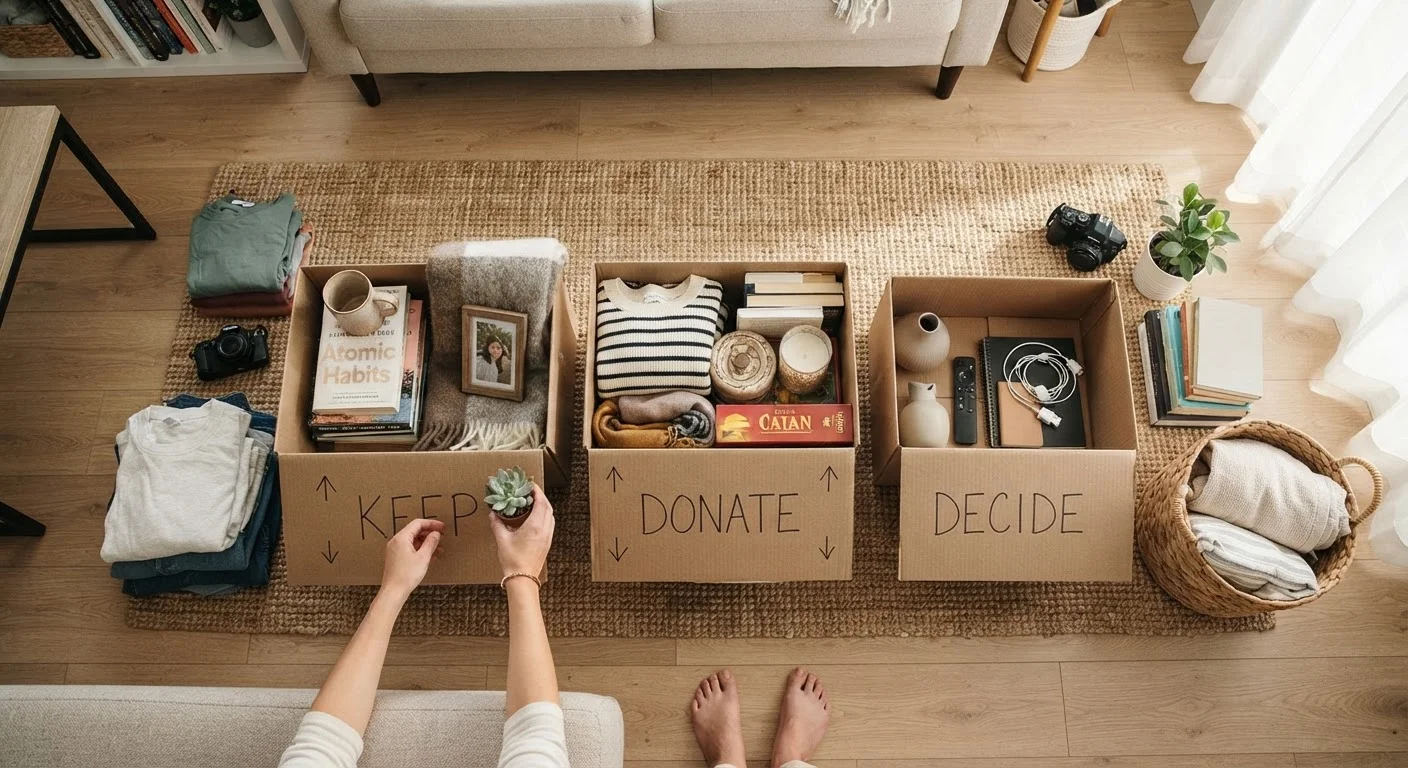
For items that still feel genuinely unresolved after the framework above, the holding box is the most practical tool available. The idea is simple: box the item, label the box with a date 30 to 90 days in the future, and store it out of daily sight.
Gather your borderline items in one place
Pull every undecided item into a single pile or area before you begin. Sorting from a consolidated group is faster and more decisive than moving room to room. Keep the pile physically separate from your 'keep' area so it stays visually distinct.
Run each item through the three-question framework
Pick up each item one at a time and ask: Have I used this in the past year? Would it be hard or costly to replace? Does it serve a specific current purpose? Answer honestly - if you have to invent a scenario to justify 'yes', that answer probably doesn't count.
Place unresolved items in a dated holding box
For items that remain genuinely uncertain after the framework, place them into a box or bin. Write a date 30 to 90 days from today on the outside. Store the box somewhere accessible but out of everyday view - a closet shelf or garage corner works well.
Review the box when the date arrives
When the date on the box comes, open it and check: Did you miss or retrieve anything from this box during the waiting period? Items you reached for deserve to go back into regular circulation. Items you never thought about are strong candidates for donation or disposal.
If you reach the date and haven't once gone looking for something in that box, the contents can go without guilt. If you did retrieve something, it earns its place back. This method sidesteps the 'but what if I need it?' anxiety by turning it into a testable prediction rather than an unanswerable hypothetical.
For a broader look at how you're approaching sorting overall, sorting by category versus sorting by room can help you structure the session around the holding box so undecided items don't scatter across multiple rooms.
Common Borderline Item Types and How to Handle Them
Certain types of items reliably end up in the 'maybe' pile. Recognizing the category helps you apply the right response faster:
- Sentimental objects with no display or use: Consider photographing them before donating. The memory transfers; the physical space does not.
- Duplicates: Keep the one in better condition. There is rarely a scenario that requires two can openers.
- Items kept out of obligation: Gifts you don't use or inherited items you don't love are still taking up real space. Keeping them does not honor the giver - using and appreciating them does.
- Specialty equipment used once: If you haven't used it in over a year and the activity isn't actively planned, treat it as done. Equipment for activities you genuinely plan to restart is a different case.
- Broken items awaiting repair: Set a concrete repair deadline. If it hasn't been fixed within that window, it isn't going to be.
Don't Let the Holding Box Become Permanent Storage
The holding box only works if the review date is taken seriously. If boxes accumulate without being opened, they stop being a decision tool and become a new form of clutter. Limit yourself to one active holding box at a time to prevent this pattern from forming.
Staying on top of borderline items is also how you prevent clutter from cycling back. Clutter keeps coming back when the decision habit doesn't stick - so treating each 'maybe' item as practice for a longer-term system is genuinely worth the effort.