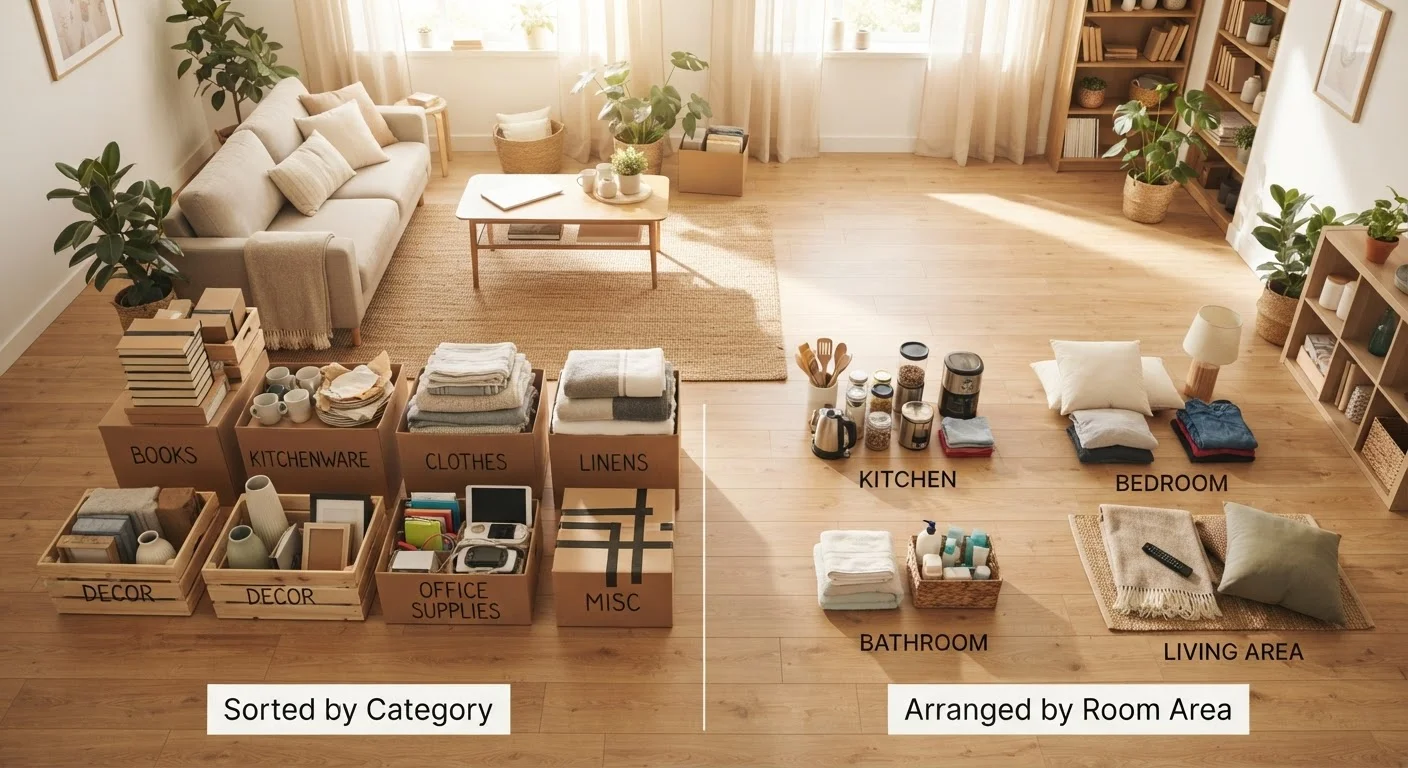
How Each Method Actually Works
Before choosing a decluttering approach, it helps to understand exactly what each one involves in practice - not just in theory.
Category-based sorting means gathering every item that belongs to a single category - say, books, or cables, or kitchenware - from every room in your home before making a single keep-or-discard decision. Nothing gets sorted until the full picture is visible. The logic is that you can't make an honest judgment about how many spatulas you need until all eight of them are in the same place at the same time.
Room-by-room sorting works the opposite way: you choose one physical space - the bedroom closet, the kitchen, the entryway - and work through everything within it completely before touching anything in another room. Each session has clear walls. When the room is done, it stays done.
Both methods share the same underlying goal: reducing what you own to what you genuinely use and value. The difference is the unit of work - a category of object versus a physical location. See our complete room-by-room organizing guide for a broader look at how each space in your home can be approached systematically.
| Criterion | Category-Based Sorting | Room-by-Room Sorting |
|---|---|---|
| Unit of work | One item type, whole home | One physical space at a time |
| Time commitment per session | Larger blocks required | Flexible, shorter sessions work |
| Visible progress speed | Slower - disorder increases first | Faster - rooms finished sequentially |
| Duplicate detection | Excellent - all visible at once | Limited - items can shift rooms |
| Temporary disruption | High - items spread across home | Low - confined to one area |
| Best suited to | Thorough purges, repeat clutter | New moves, tight schedules |
| Long-term clutter prevention | Stronger - sets quantity limits | Moderate - depends on habits |
The Strengths and Drawbacks of Each Approach
Neither method is universally superior - each has real advantages and genuine trade-offs worth knowing before you commit.
Category-Based Sorting
The biggest strength here is clarity about quantity. Most people significantly underestimate how much of something they own until it's all in one pile. Pulling every piece of clothing or every tool from across the entire home makes redundancies impossible to ignore. This approach also tends to produce more durable results: because you set a deliberate limit on how much of any category you're keeping, clutter in that category is less likely to creep back.
The drawback is that this method requires a higher tolerance for temporary disorder. Sorting by category means your home will look significantly worse before it looks better - a full day's work might leave the living room floor blanketed in items pulled from five different rooms. It also demands a larger block of uninterrupted time per session.
Room-by-Room Sorting
The room-by-room approach produces faster, more visible progress. Finishing one room - even a small one like a bathroom cabinet - gives you a completed, functional space to enjoy while the rest of the house is still in progress. This momentum matters enormously for beginners who might otherwise stall out.
The limitation is that items tend to get relocated rather than truly evaluated. A junk drawer gets tidied, but half the contents move to another drawer in another room. Without the full-category perspective, it's harder to recognize when you simply own too much of something. For a practical look at managing borderline items that crop up in either approach, see what to do with items you're not sure about keeping.
Neither Method Requires a Specific System
Category-based and room-by-room sorting are organizational philosophies, not branded programs. You don't need to follow any particular guru's rules to use either approach effectively. Adapt whichever method you choose to your home's layout, your schedule, and your comfort level - the goal is a functional space, not a perfect process.
Choosing the Right Method for Your Situation
The best decluttering method is the one you'll actually complete. A few practical factors can help you decide.
Available time: If your schedule allows only short, irregular windows, room-by-room sorting fits more naturally - each session has a defined start and finish. Category sorting works better when you can commit larger blocks of time, since a half-sorted category is genuinely disruptive to daily life.
Home size: In a larger home, pulling every item from a single category across multiple floors and storage areas can be a physically demanding undertaking. In a smaller apartment, the category method is more manageable, though even then it can quickly fill your only common space. For tailored strategies in tight quarters, see organization strategies for compact homes.
Your organizing history: If you've tidied the same rooms repeatedly with limited lasting results, the room-by-room method may be treating symptoms rather than causes. A category pass - at least for the problem areas - tends to produce more durable change.
Combining both: Many people find success using room-by-room sorting as the primary structure (especially when newly moved in - a room-by-room checklist for a newly moved-in home is a useful starting point), and then running a category pass on areas where clutter persistently returns. Once you've established an organized baseline, understanding why clutter keeps coming back can help you maintain it long-term.
1 in 4
US homeowners with a cluttered garage
According to a survey by the National Association of Professional Organizers, roughly one in four American homeowners cannot park a car in their garage due to stored items.
~40%
Household items rarely or never used
Research from the National Soap and Detergent Association suggests that eliminating clutter could reduce the amount of housework in the average home by roughly 40%.