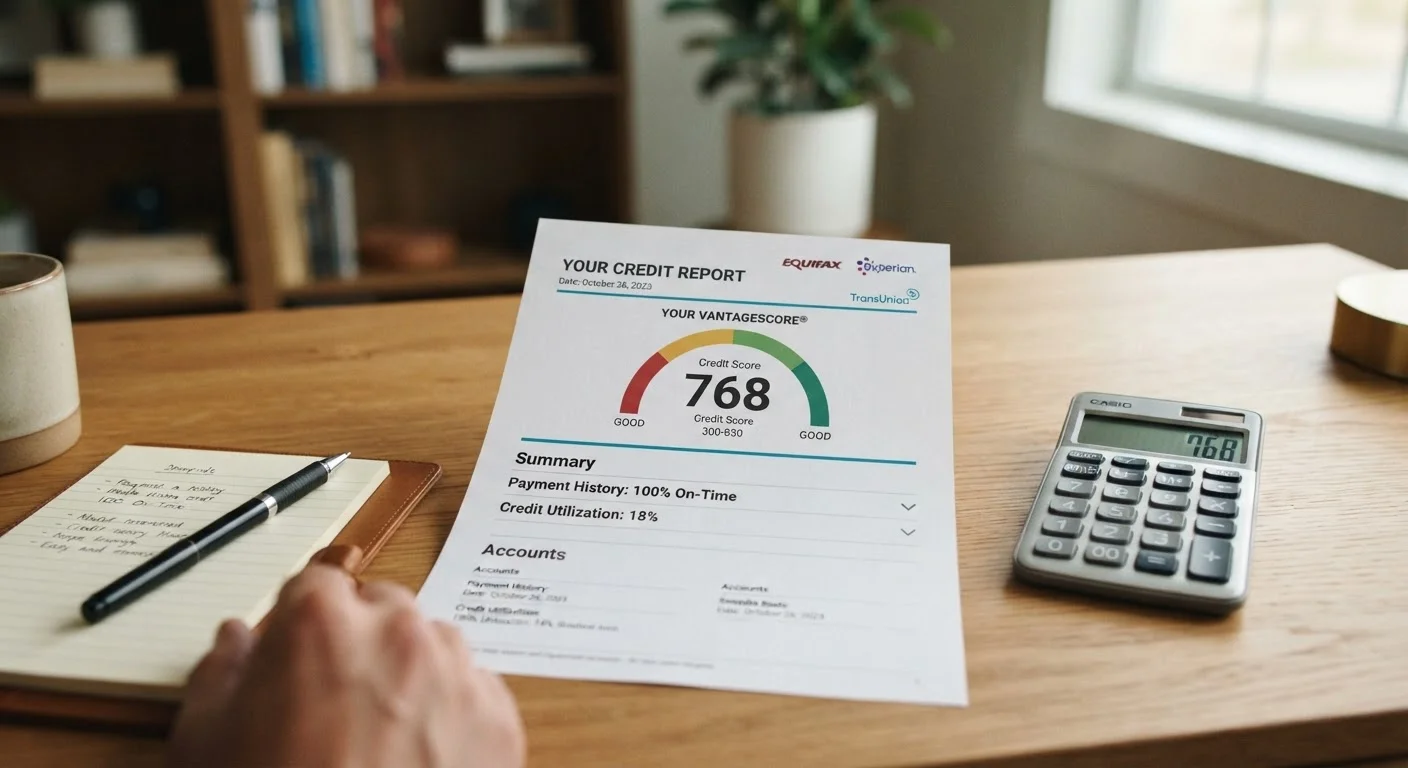
What a Credit Score Is - and Isn't
A credit score is not a measure of your wealth, income, or financial worth. It is purely a measure of your credit behavior - how consistently you've borrowed money and paid it back. Someone earning a modest salary who always pays on time can have an excellent score, while a high earner who misses payments regularly may have a poor one.
The number is generated by a mathematical model that reads the data inside your credit reports. The three major credit bureaus - Equifax, Experian, and TransUnion - each maintain a separate report on you, and your score can differ slightly depending on which bureau's data is used and which scoring model is applied.
For a plain-language breakdown of credit vocabulary, see our first-time borrower glossary.
300-850
Standard FICO Score range
The FICO Score, the most widely used credit scoring model in the U.S., operates on a scale from 300 (lowest) to 850 (highest).
~35%
Weight of payment history in FICO scoring
According to Fair Isaac Corporation's published guidance, payment history is the single largest factor in a FICO Score calculation.
3
Major U.S. credit bureaus
Equifax, Experian, and TransUnion each maintain independent credit files, which means your score may vary slightly depending on which bureau's data is used.
How the Number Is Calculated
Credit scores are built from five broad categories of information drawn from your credit report. While exact formulas are proprietary, the FICO model publicly discloses its general weighting:
- Payment history (~35%): Whether you've paid past accounts on time. A single missed payment can have a significant negative effect.
- Amounts owed (~30%): How much of your available credit you're currently using - known as credit utilization. Lower is generally better.
- Length of credit history (~15%): How long your accounts have been open. Older accounts support a higher score.
- Credit mix (~10%): Whether you manage a variety of account types - credit cards, installment loans, and so on.
- New credit (~10%): How recently you've applied for new credit. Multiple applications in a short period can signal risk.
For a deeper look at each factor, see The Five Factors Behind Your Credit Score.
Check Your Credit Reports for Free
Under federal law, you're entitled to a free credit report from each of the three major bureaus once every 12 months at AnnualCreditReport.com - the official, government-authorized source. Reviewing your reports regularly helps you catch errors or unfamiliar accounts early, before they affect your score.
Why Lenders Pay Close Attention to It
When a lender considers your application for a mortgage, auto loan, or credit card, they face a fundamental question: how likely is this person to repay? Your credit score gives them a standardized, data-backed answer in seconds.
A higher score typically means a lender sees you as lower-risk, which can translate to approval with a lower interest rate. A lower score may result in a higher rate, a smaller credit limit, or a denial. Over the life of a large loan like a mortgage, even a half-percentage-point difference in rate can add up to thousands of dollars.
Lenders aren't the only ones who may review your credit. Landlords often check scores when evaluating rental applications, and some employers in financial roles review credit history as part of background screening - though this varies by state and employer.
Common Misconceptions Worth Clearing Up
Several widespread myths lead people to worry unnecessarily - or to overlook real problems.
Myth: Carrying a credit card balance helps your score. Paying in full each month is generally better. Carrying a balance adds to your utilization ratio and costs you interest. See how credit utilization works for more detail.
Myth: Closing old accounts improves your score. Closing an account can actually reduce your available credit and shorten your average account age - both of which may lower your score.
Myth: You only have one credit score. You likely have dozens of scores depending on the model and bureau. When a lender quotes a score, ask which model they're using.
Some habits chip away at a score gradually and without obvious warning. Habits that quietly undermine a credit score covers the patterns worth watching.
This article is for general informational and educational purposes only and does not constitute personalized financial or legal advice. For guidance specific to your situation, consult a qualified financial professional.
“A credit score is a tool that summarizes your financial reputation in a single number. Understanding what goes into it gives you the power to shape it deliberately rather than hoping it works out.”
— Consumer Financial Protection Bureau, U.S. federal agency responsible for consumer financial education and protection