What a Credit Score Is Made Of
A credit score is not a single judgment - it's a calculated result built from five separate pieces of your credit history. Understanding what goes into that number helps you take deliberate, informed steps rather than guessing. For a broader starting point, see Credit Scores Explained for plain-language context on what the number actually measures.
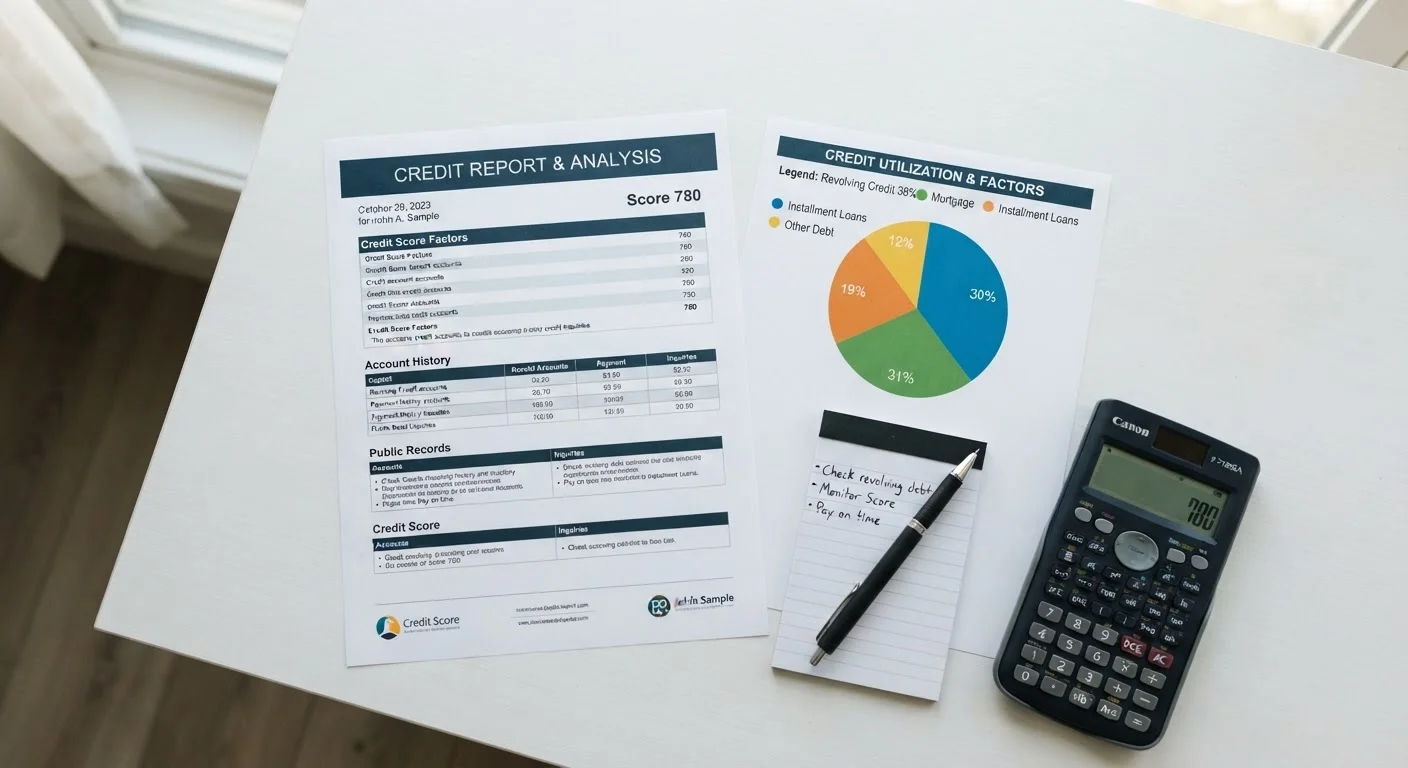
The most widely used scoring model, FICO, assigns a specific percentage weight to each factor. Those weights reflect how strongly each category predicts whether a borrower will repay a debt. The five factors are listed below in order of their influence.
| Payment History Weight | 35% (FICO scoring model) |
| Amounts Owed (Utilisation) Weight | 30% (FICO scoring model) |
| Length of Credit History Weight | 15% (FICO scoring model) |
| Credit Mix Weight | 10% (FICO scoring model) |
| New Credit (Inquiries) Weight | 10% (FICO scoring model) |
| Negative Items Stay on Report | Up to 7 years (most items) (Fair Credit Reporting Act (FCRA)) |
The Five Factors, One by One
1. Payment History - 35%
This is the single largest factor. It records whether you have paid your bills on time across all credit accounts - credit cards, loans, mortgages, and certain collection accounts. A single missed payment can stay on your report for up to seven years, though its impact typically fades over time as positive history accumulates.
2. Amounts Owed (Credit Utilisation) - 30%
This measures how much of your available revolving credit you are currently using, expressed as a ratio. For example, carrying a $3,000 balance on a card with a $10,000 limit means a 30% utilisation rate. Lower utilisation generally signals less financial strain to lenders. To go deeper on this factor, see Credit Utilisation: The Ratio That Quietly Shapes Your Score.
3. Length of Credit History - 15%
Longer histories give scoring models more data to assess your behaviour. This factor considers the age of your oldest account, the age of your newest account, and the average age across all accounts. Closing older accounts can reduce your average age and lower this component.
4. Credit Mix - 10%
Lenders like to see that you can manage different types of credit responsibly. Credit mix looks at whether your portfolio includes revolving credit (such as credit cards) alongside installment loans (such as auto or student loans). You do not need every type - this factor simply rewards demonstrated variety over time.
5. New Credit - 10%
Each time you formally apply for credit, the lender performs a hard inquiry - a request to review your full credit report. Multiple hard inquiries in a short window can signal financial pressure and may modestly lower your score. Rate-shopping for mortgages or auto loans within a brief period (typically 14-45 days) is usually treated as a single inquiry by most scoring models.
Hard Inquiry
A formal review of your full credit report triggered when you apply for new credit. Hard inquiries can slightly lower your score and remain on your report for two years, though their scoring impact is typically minor and short-lived.
Credit Utilisation Rate
The percentage of your available revolving credit that you are currently using. It is calculated by dividing your total revolving balances by your total revolving credit limits.
Revolving Credit
A type of credit account with a reusable limit, such as a credit card or home equity line of credit. You can borrow, repay, and borrow again up to the set limit.
Installment Loan
A loan repaid in fixed, scheduled payments over a set term - such as a car loan, student loan, or mortgage. Unlike revolving credit, the limit does not reset after repayment.
Credit Mix
The variety of credit account types in your credit file, including both revolving accounts and installment loans. A diverse mix can modestly benefit your score over time.
What This Means in Practice
Because payment history and amounts owed together account for 65% of your score, those two areas offer the greatest opportunity for meaningful improvement. Paying on time - every time - and keeping revolving balances low relative to your limits are the most high-impact habits you can build. For patterns that quietly work against these goals, Habits That Quietly Undermine a Credit Score outlines subtle missteps many borrowers don't notice.
If you are starting from scratch, the factors still apply - you simply have no history yet to measure. Your First Credit Score covers how to establish positive history responsibly. And once you are borrowing regularly, Keeping Debt Manageable Over the Long Term provides habits for staying on track.
Scores Can Vary Across Models
There are multiple credit scoring models in use - including various FICO versions and VantageScore. While the underlying factors are broadly similar, the exact weights and calculations can differ. The percentages cited here reflect the widely referenced base FICO model. The score a specific lender sees may vary depending on which model and bureau they use.
This article is for general informational and educational purposes only and does not constitute personalised financial or credit advice. Consult a qualified financial professional for guidance specific to your situation.