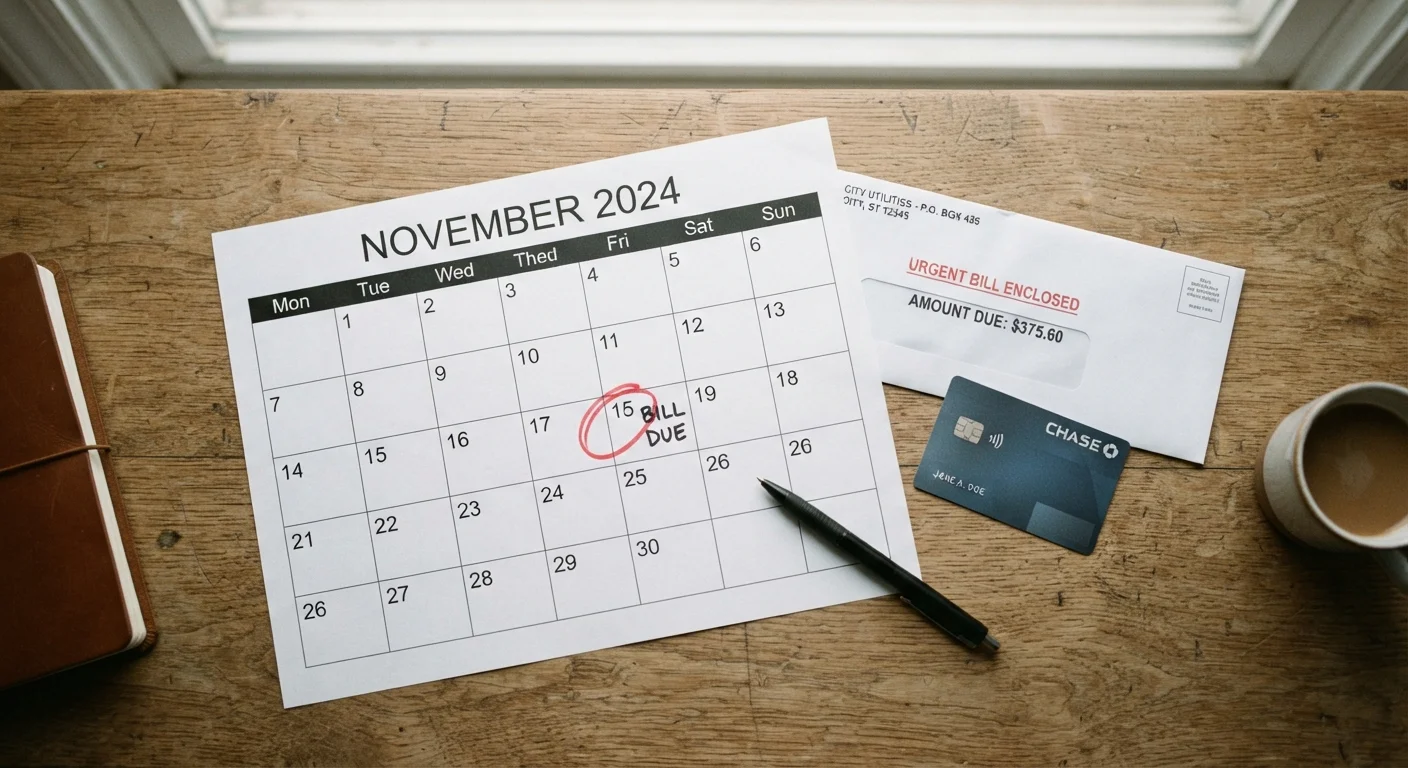
The First 24-29 Days: Fees and Frustration
The moment your due date passes without a payment, the clock starts. Most credit card issuers charge a late fee immediately - typically a flat amount permitted under your cardholder agreement. For loans, the grace period and fee structure vary, so it is worth reading your specific terms.
During these first few weeks, the situation is recoverable without lasting credit damage. Your lender has not yet reported anything to the credit bureaus. You will likely receive reminder notices by email, text, or phone. Interest continues to accrue on any unpaid balance, which means the total you owe begins to grow.
This window is your best opportunity to act. If you can pay even the minimum amount due - along with any applicable late fee - you stop the clock before any permanent record is created. See our glossary of key borrowing terms if you are unsure what terms like "minimum payment" or "grace period" mean in your agreement.
Set Up Autopay for the Minimum
Enrolling in autopay for at least the minimum payment amount is one of the simplest ways to avoid a missed payment entirely. Even if you plan to pay more manually each month, the autopay acts as a safety net. Check your lender's settings - most banks and card issuers offer this option at no charge.
Day 30: The Credit Bureau Report
At the 30-day mark, the consequences shift from financial to reputational. Under FCRA guidelines, creditors are permitted to report a payment as late to the three major credit bureaus - Equifax, Experian, and TransUnion - once it is 30 days past due.
This is significant because payment history is the single largest factor in most credit scoring models. A 30-day late mark can cause a noticeable score drop, and the higher your score was before the missed payment, the steeper the initial fall tends to be.
35%
Weight of payment history in FICO scoring
According to FICO, payment history is the largest single factor in most standard credit score calculations.
7 years
How long a late payment stays on your report
The Fair Credit Reporting Act limits most negative information, including late payments, to seven years from the original delinquency date.
90-180 days
Typical window before debt goes to collections
Most unsecured creditors charge off and transfer accounts to collections within this range, though timelines vary by lender and debt type.
The late payment entry will appear on your credit report and can stay there for up to seven years. To understand exactly why payment history carries so much weight, our article on the five factors behind your credit score explains each element in plain terms.
60-180 Days: Escalating Delinquency
If the account remains unpaid past 30 days, additional late marks accumulate - a 60-day delinquency, then a 90-day delinquency - each adding further weight to your credit report. Some lenders also increase your interest rate at this stage, a practice sometimes called a penalty APR.
Around the 90- to 180-day mark, depending on the lender and the type of debt, the account may be declared in default. At this point, lenders typically charge off the debt - an accounting step where they write it off as a loss - and either assign it to an internal collections team or sell it to a third-party debt collector.
A collections account appears as a separate, additional negative entry on your credit report on top of the original late payment marks. This makes the record harder to recover from and may affect your ability to qualify for future credit, housing, or even certain employment.
Charge-Off Does Not Erase the Debt
Many people assume a charge-off means the debt is forgiven. It does not. A charge-off is an internal accounting entry by the lender; you still legally owe the balance. The debt can be collected by the original creditor or a third party, and the charge-off itself is a separate negative mark on your credit report distinct from the late payment entries.
How to Limit the Damage
Understanding the timeline gives you leverage. Here are concrete steps based on where you are in the process:
- Before 30 days: Pay what you can and call your lender to request a late fee waiver. Explain your situation honestly. Many lenders have hardship programs that are not widely advertised.
- At or just after 30 days: Bring the account current as quickly as possible to prevent additional delinquency marks. Ask whether the lender will remove the late mark as a goodwill gesture once paid.
- After 60-90 days: Contact your lender about a repayment plan or debt management options. If a collector contacts you, know that you have rights under the FDCPA regarding how and when they may communicate with you.
Building habits that prevent future misses is equally important. Our guide to keeping debt manageable over the long term covers practical strategies for staying on top of repayments. You may also want to review habits that quietly undermine a credit score to see what other patterns erode credit health over time.
This article is for general informational and educational purposes only and does not constitute personalized financial, legal, or credit advice. For guidance specific to your situation, consider consulting a qualified financial counselor or credit advisor.