Why Cat Behaviour Confuses New Owners
Cats have a reputation for being mysterious, but most of what they do makes complete sense once you understand the logic behind it. Unlike dogs, cats evolved as both predators and solitary survivors, which means their communication style is subtler - and easy to misread if you're new to living with one.
This guide walks through ten behaviours that new cat owners commonly question or misinterpret. For each one, you'll learn what's actually going on, and how to respond in a way that strengthens your relationship with your cat. If you're still in the early days of ownership, our guide to the first week at home is a good companion read.
Slow blinking at you
When your cat holds eye contact and slowly closes and reopens their eyes, they're signalling trust and relaxed comfort. Behaviourists often call this a "cat kiss." You can return the gesture - slow blink back - and many cats will respond in kind. It's one of the clearest friendly overtures a cat can make.
A slow blink is your cat's way of saying they feel safe and comfortable with you.
Kneading with their paws
Kneading - rhythmically pushing their front paws alternately against a soft surface - begins in kittenhood, when kittens knead their mother's belly to stimulate milk flow. Adult cats carry this behaviour forward as a self-soothing response associated with contentment. If your cat kneads on you, take it as a compliment: they're deeply relaxed in your presence.
Kneading is a deeply ingrained comfort behaviour that signals your cat feels completely at ease.
Chattering or chirping at birds
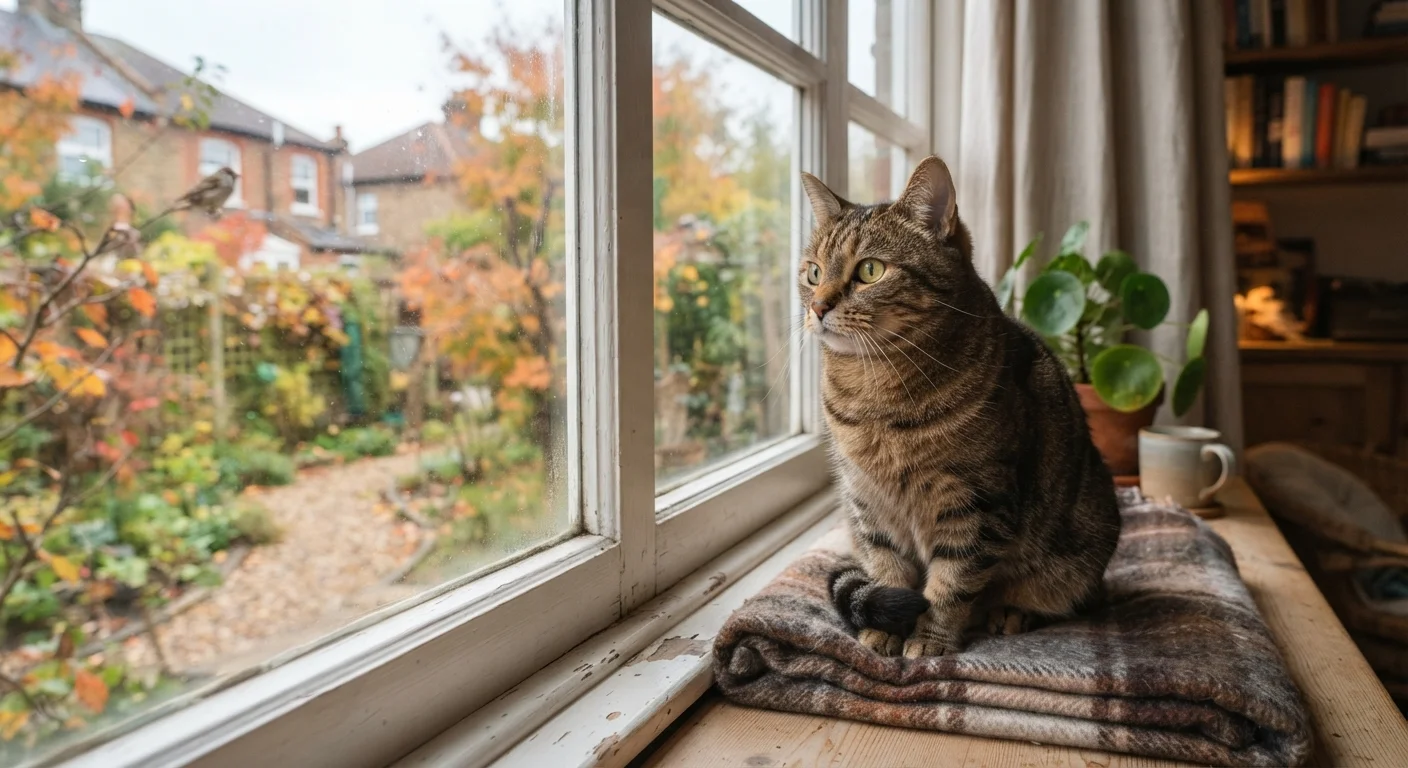
That rapid jaw-quivering sound cats make when watching birds through a window is called chattering. Exactly why cats do it isn't fully settled, but the most widely held view is that it's an involuntary predatory response - a mix of excitement and frustration at prey they can't reach. It's harmless and completely normal. Some cats also chirp, a shorter, higher-pitched sound that may be an imitation of bird calls.
Chattering at birds is a natural predatory reflex - your cat is excited, not distressed.
Head-butting and face rubbing
Cats have scent glands on their cheeks, forehead, and chin. When your cat rubs their face against you or bumps their head into yours, they're depositing their scent - a behaviour called bunting. In cat terms, this marks you as part of their social group. It's a strong sign of affection and belonging.
Head-butting is how cats claim you as their own - it's one of the highest compliments they give.
Bringing you "gifts"
If your cat drops a toy - or occasionally something they've caught - at your feet, they're sharing a successful hunt. Cats are driven by predatory instinct, and bringing prey to a trusted companion is a natural social behaviour observed in cats that live in groups. Respond calmly rather than with alarm; scolding can confuse your cat since they're doing something that feels instinctively generous.
Gifting prey, real or toy, is your cat's instinct to share a successful hunt with someone they trust.
Sitting in a loaf position
The "loaf" - where your cat tucks all four paws under their body and sits like a compact brick - indicates comfort and mild alertness. A cat won't tuck their limbs away if they're anxious or expecting to need a quick escape. Loafing is a resting state, not a sleepy one: your cat is content but paying gentle attention to their surroundings.
The loaf position means your cat is relaxed, comfortable, and not expecting any trouble.
Tail held straight up
A tail pointing straight up - often with a slight curve at the tip - is a confident, friendly greeting. Cats approach people and other cats they like with their tail raised. It's the feline equivalent of a wave hello. A puffed-out tail, by contrast, signals fear or agitation. Tail and body language signals are worth learning together, as they work as a system.
A tail raised straight up is your cat's confident, friendly greeting - the feline version of a wave.
Hiding in enclosed spaces
Cats are drawn to boxes, bags, and tight corners because enclosed spaces feel safe - predators can only approach from one direction. This is especially common when a cat is adjusting to a new environment, feeling unwell, or overstimulated. Providing a designated hiding spot (like a covered bed or an open carrier with a blanket) gives your cat a healthy outlet for this impulse and reduces stress overall.
Hiding in small spaces is a normal feline safety strategy, not antisocial or worrying behaviour.
Knocking things off surfaces
This behaviour is widely joked about, but it usually has a practical explanation. Cats investigate objects by touching them - pawing at something tells them how it moves and whether it's alive. Knocking an object off a shelf is often a form of play or environmental investigation. Cats that do this frequently may also be signalling that they want more interactive stimulation.
[note_callout]Knocking objects off surfaces is mostly investigation and play - a sign your cat wants engagement.
Rolling over to show their belly
Exposing the belly is a sign of trust, because the underside is a cat's most vulnerable area. However, it doesn't always mean your cat wants to be touched there. Many cats roll over as a greeting or sign of contentment but will swipe if their belly is actually stroked. Read the rest of your cat's body language - a relaxed face and slow blinking alongside the roll is more likely an invitation than a tense stare is.
A belly roll signals trust, but doesn't always mean your cat wants that area touched - read the full picture.
Building Confidence Through Understanding
Reading your cat's behaviour accurately is one of the most practical skills a new owner can develop. The more fluent you become in feline signals, the easier it is to tell a quirky-but-normal habit from something that genuinely needs attention. For a deeper look at how posture and body language fit together, see how cats communicate through body language.
Keep a Simple Behaviour Log
If you're unsure whether something your cat does is normal, jot down when it happens, how long it lasts, and any surrounding context. Even a few notes on your phone can help your vet spot patterns quickly. It also helps you notice gradual changes that are easy to miss day to day.
If a behaviour changes suddenly or is paired with physical symptoms - reduced appetite, lethargy, or changes in litter box use - that's worth flagging to your vet. Signs your cat may be unwell can help you figure out when a quirk crosses into a concern.
This article is for general informational and educational purposes only. It is not a substitute for professional veterinary advice. Always consult a qualified veterinarian if you have concerns about your cat's health or behaviour.