Why Punishment Feels Logical - But Often Isn't
When a dog does something frustrating - chewing furniture, jumping on visitors, ignoring commands - it is completely natural to want to stop that behaviour immediately and firmly. Punishment feels intuitive because it seems to work in the moment. The dog stops. The behaviour pauses. But what happens next is where the problems often start.
Punishment suppresses behaviour without replacing it. The dog learns what not to do in that exact moment, with you present - but they do not learn what to do instead. And if the punishment is harsh, inconsistent, or poorly timed, the dog may not even connect it to the original behaviour at all. What they do register is unpredictability, fear, or pain - none of which build the kind of cooperative relationship that makes training actually stick.
Many common problem behaviours - excessive barking, destructive chewing, restlessness - also have underlying causes that punishment cannot address. Mental under-stimulation is one of the most overlooked drivers of unwanted behaviour in dogs. Correcting a bored dog without solving the boredom rarely produces lasting change.
Myth
You have to show your dog who's boss by being dominant and assertive - otherwise they'll walk all over you.
Fact
Modern animal behaviour research does not support dominance theory as a framework for dog training. Dogs learn through consequences, not through social rank battles with humans.
The idea that dogs are constantly vying for dominance over their owners became popular in the mid-20th century but has since been largely rejected by veterinary and animal behaviour organisations. Dogs are not trying to "outrank" you - they are simply doing what has worked for them in the past. When a dog jumps on guests, for example, it's usually because jumping previously earned attention, not because the dog is asserting dominance. Teaching an alternative behaviour (like sitting to greet people) and reinforcing it consistently is far more effective than trying to assert physical authority.
Myth
Scolding your dog immediately after an accident or destructive behaviour teaches them not to do it again.
Fact
Dogs live largely in the present moment. Unless you catch the behaviour as it happens, punishment after the fact does not connect meaningfully to the action - it only causes confusion and stress.
If you discover a chewed shoe twenty minutes after it happened, your dog cannot link your anger to that specific earlier event. What they may learn instead is that your return home sometimes leads to frightening reactions - which can actually create anxiety around your arrivals. For house training especially, the timing of your response matters enormously. See how puppy house training actually works for a clear explanation of why patience and timing go hand in hand.
Myth
A dog that looks 'guilty' after misbehaving knows they did something wrong.
Fact
The "guilty look" - crouching, avoiding eye contact, tucked tail - is a stress response to your body language, not an expression of moral understanding.
Research published in animal cognition journals has shown that dogs display the so-called guilty look in response to an owner's tone and posture, regardless of whether the dog actually misbehaved. The dog is reading your signals and responding appeasingly. Punishing based on this look does not address the behaviour - it just increases the dog's anxiety around you. Understanding what your dog's body language is actually communicating is a foundational skill. Reading your dog's body language can help you interpret those signals accurately.
Myth
Positive reinforcement is just bribery - it doesn't produce real obedience.
Fact
Reward-based training is grounded in well-established learning science. It produces reliable, willing behaviour and strengthens the bond between dog and owner.
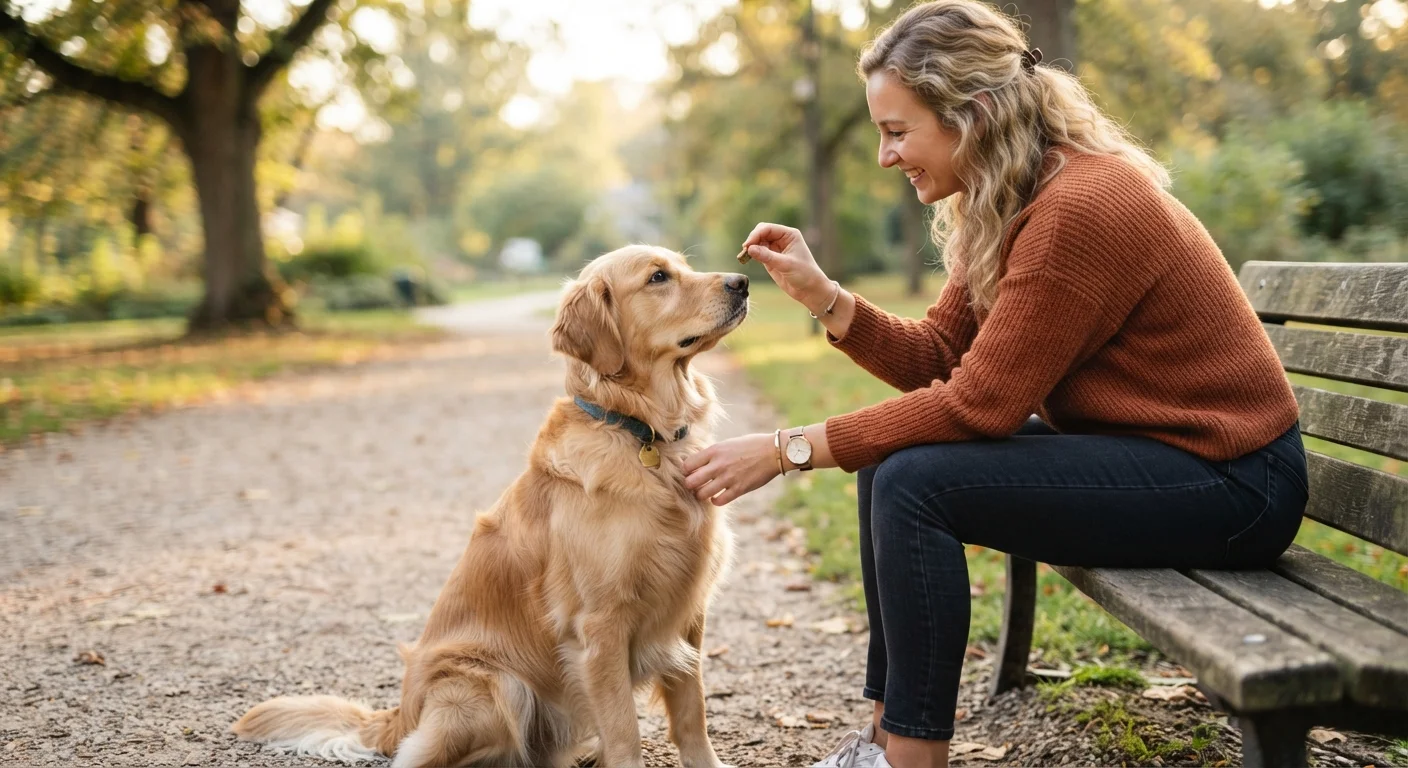
Bribery implies showing the reward before the behaviour to coax compliance. Reinforcement works differently: the dog performs the behaviour, and the reward follows - teaching the dog that the action itself predicts something good. Over time, treats are faded and the behaviour becomes reliable on its own. Dogs trained with positive reinforcement tend to be more confident, more engaged, and less likely to show fear or aggression than dogs trained with aversive methods, according to studies published in peer-reviewed veterinary behaviour journals.
Myth
Physical corrections like leash jerks or scruff shakes are natural because that's how dogs correct each other.
Fact
Adult dogs rarely physically correct each other the way humans do. These techniques are not natural dog communication - and they carry real risks of injury and behavioural fallout.
The scruff shake, in particular, is sometimes justified as mimicking how a mother dog corrects puppies - but mother dogs primarily use gentle mouth contact and body blocking, not forceful shaking. Physical corrections applied by humans can cause neck injuries, heighten reactivity, and damage the dog's trust in people. Dogs that are regularly subjected to pain or fear in training are more likely to develop anxiety-driven behaviours, including aggression. If a behaviour is persistent and difficult to manage, a certified professional dog trainer or a veterinary behaviourist is the appropriate next step.
What to Do Instead: Practical Positive Techniques
The good news is that the alternative to punishment is not passivity - it is active, clear communication. Positive reinforcement means you are consistently telling your dog what works, rather than only reacting when things go wrong.
Avoid Punishment That Arrives Too Late
Dogs can only connect a consequence to a behaviour if it happens within a second or two of the action. Punishing a dog minutes or hours after the fact does not teach them anything useful - it only causes stress and confusion. If you did not catch the behaviour in the act, the most effective response is to manage the environment to prevent it happening again, then train a better habit going forward.
Start with these principles:
- Catch good behaviour. When your dog is calm, sitting politely, or playing appropriately, say so. A calm "good dog" or a small treat in that moment teaches the dog that those behaviours pay off.
- Redirect before correcting. If your dog is about to jump, ask for a sit first. Reward the sit. The unwanted behaviour gets crowded out by an incompatible one.
- Keep sessions short and positive. Five to ten minutes of focused, reward-based practice is more productive than a long, frustrated session. End on a success whenever possible.
- Be consistent. Dogs learn from patterns. If jumping is sometimes allowed and sometimes corrected, the behaviour will persist. Everyone in the household needs to respond the same way.
When you are ready to introduce specific commands, sit, stay, and come are the three foundational cues that make daily life significantly easier and safer. These also give your dog a clear "job" to do, which reduces frustration on both sides.
If you are dealing with behaviours that feel beyond basic training - severe reactivity, aggression, or extreme anxiety - consult a certified professional dog trainer (CPDT-KA) or a board-certified veterinary behaviourist. These are not signs of a bad dog or a bad owner; they are signs that professional, personalised guidance is the right next step.
This article is for general educational purposes only and is not a substitute for professional veterinary or animal behaviour advice. If your dog is showing signs of significant fear, aggression, or distress, consult a qualified professional.