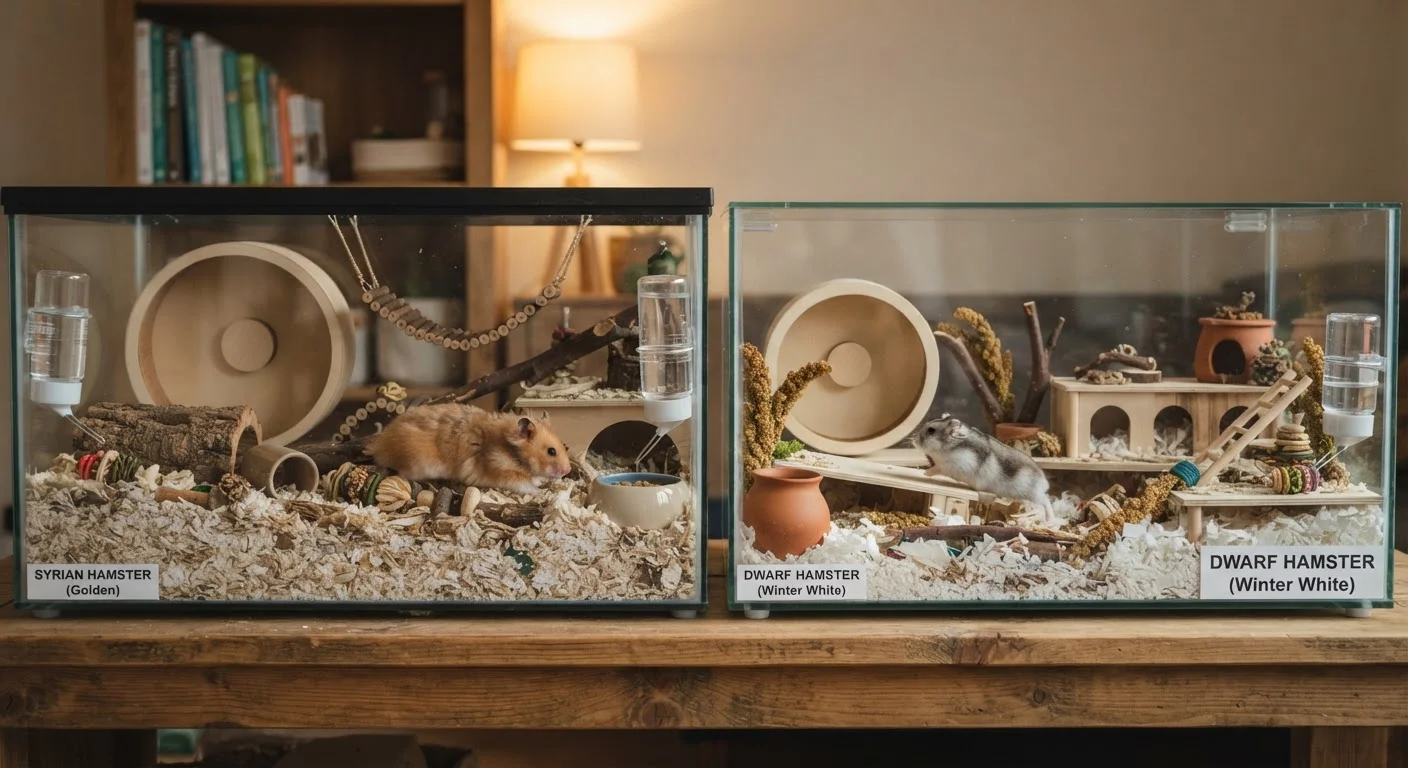
Why the Difference Matters Before You Buy
Walk into any pet store and you'll find Syrian and dwarf hamsters housed a few shelves apart, often in near-identical starter cages. That visual similarity leads many new owners to assume their needs are interchangeable. They aren't - and getting it wrong can result in a stressed, unhealthy animal within weeks of bringing it home.
Syrians (Mesocricetus auratus) are the largest common pet hamster, typically reaching 5-7 inches in length. Dwarfs - a group that includes Roborovski, Campbell's, and Winter White species - usually top out at 2-4 inches. Size isn't the only difference; temperament, sociability, and enclosure requirements all diverge in ways that directly affect daily care. If you're still deciding between hamsters and other small pets entirely, our guide to choosing a small pet can help you weigh your options first.
Space and Enclosure Requirements
The single most common mistake new hamster owners make is underestimating cage size. Both species are crepuscular (most active at dawn and dusk) and can travel several miles in a single night in the wild. A cramped cage causes chronic stress, repetitive bar-chewing, and stereotypic behaviours like pacing - all signs of poor welfare.
The general guidance from many exotic-animal veterinarians and welfare organisations is a minimum of 450 square inches of unbroken floor space for any hamster. For Syrians, larger is always better - some experts recommend 620 sq. in. or more. A 40-gallon breeder-style tank or a large, bar-spaced cage with solid flooring are commonly recommended formats.
| Criterion | Syrian Hamster | Dwarf Hamster |
|---|---|---|
| Adult body length | 5-7 inches | 2-4 inches |
| Minimum cage floor space | 450-620+ sq. in. | 450 sq. in. |
| Can be housed in pairs? | No - always solitary | Sometimes (same-sex, same species) |
| Ease of handling for beginners | Generally easier | More challenging (very fast) |
| Minimum wheel size | 10-11 inches | 6-8 inches |
| Diabetes risk from diet | Low | Higher (esp. Campbell's dwarf) |
| Substrate depth needed | 6+ inches for burrowing | 6+ inches for burrowing |
For dwarfs, a slightly smaller footprint can work, but the enclosure still needs to be substantially bigger than the tiny acrylic starter kits typically sold alongside them. Deep-base enclosures that hold 6 or more inches of substrate (bedding) for burrowing are important for both species. Thin plastic cage floors with minimal substrate frustrate a hamster's natural digging instinct.
Sociability: The One Rule You Cannot Ignore
Syrian hamsters are strictly solitary. In the wild, adults occupy and defend solo territories, meeting only briefly to mate. Housed together, two Syrians will fight - and fights can be lethal. This is not a matter of introductions or enclosure size; it is an innate behavioural drive. No exceptions. Never house Syrians together beyond the very young weaning stage.
Dwarf hamsters are more nuanced. Some species, particularly Roborovskis and Campbell's, can cohabit as same-sex pairs when raised together from a young age. However, cohabitation is never guaranteed to remain peaceful. Owners who keep dwarf pairs must watch for signs of bullying (one animal monopolising food, hiding, or losing weight) and be ready to separate them immediately. Winter Whites and Chinese hamsters are generally better kept solo.
Dwarf Cohabitation Is Never Guaranteed
Even dwarf species that can live together may become incompatible as they mature. Hormonal changes, resource competition, or simple personality shifts can trigger aggression months after a peaceful introduction. Always keep a spare enclosure on hand so you can separate cohabiting dwarfs quickly if fighting begins. A vet experienced with small animals can advise if you're unsure whether two animals are bonded or merely tolerating each other.
Understanding this distinction before purchase saves a great deal of distress - both yours and the animals'.
Handling, Taming, and Temperament
Syrian hamsters have a well-deserved reputation as the more beginner-friendly option for hands-on interaction. Their larger size makes them easier to cup in your hands without dropping, and many individuals tame down to comfortable handling within a few weeks of gentle, consistent sessions. Evening handling - when they're naturally awake - produces better results than waking a sleeping hamster mid-afternoon.
Dwarf hamsters are fast. Very fast. Their small bodies and quick reflexes mean that even a tame individual can dart off a lap or table in seconds. Children under eight often find dwarfs frustrating or frightening to hold, and accidental drops are a real injury risk. That doesn't make dwarfs bad pets - they're fascinating to observe and interact with at enclosure level - but prospective owners should calibrate their expectations accordingly.
If you're setting up a hamster in a rented home or shared accommodation, our guide to keeping small pets in rented homes covers practical considerations around space, noise, and landlord policies.
Diet, Enrichment, and Daily Care
Both Syrian and dwarf hamsters eat similar diets - a quality hamster-specific pelleted or mixed food forms the foundation, supplemented with small amounts of fresh vegetables and occasional protein sources such as plain cooked egg or mealworms. Avoid sugary fruits and high-starch treats, especially for dwarf hamsters: Campbell's dwarfs in particular are genetically predisposed to diabetes, making sugar-rich foods a meaningful health risk for them.
5+ miles
Distance a hamster may run in one night
Research into hamster activity levels highlights why large enclosures and appropriately sized wheels are essential for welfare, not optional extras.
6+ inches
Recommended minimum substrate depth
Exotic animal welfare organisations widely advise deep bedding layers so hamsters can construct multi-chamber burrows, a core natural behaviour.
Wheel size is non-negotiable for both. A wheel that forces the animal to arch its back can cause spinal problems over time. Syrians need a 10-11 inch solid-surface wheel (no rungs, which catch feet); dwarfs need at least 6-8 inches. Both species also benefit from hides, tunnels, and regular foraging enrichment - scattering food in the substrate rather than always using a bowl encourages natural behaviour. For a broader look at what it's like to own other small species with equally specific needs, see our exotic small pet ownership guide.
This article provides general educational information about hamster care and is not a substitute for advice from a qualified exotic animal veterinarian. If your hamster shows signs of illness or distress, consult a vet experienced with small animals.