Why the 'Small' Label Can Be Misleading
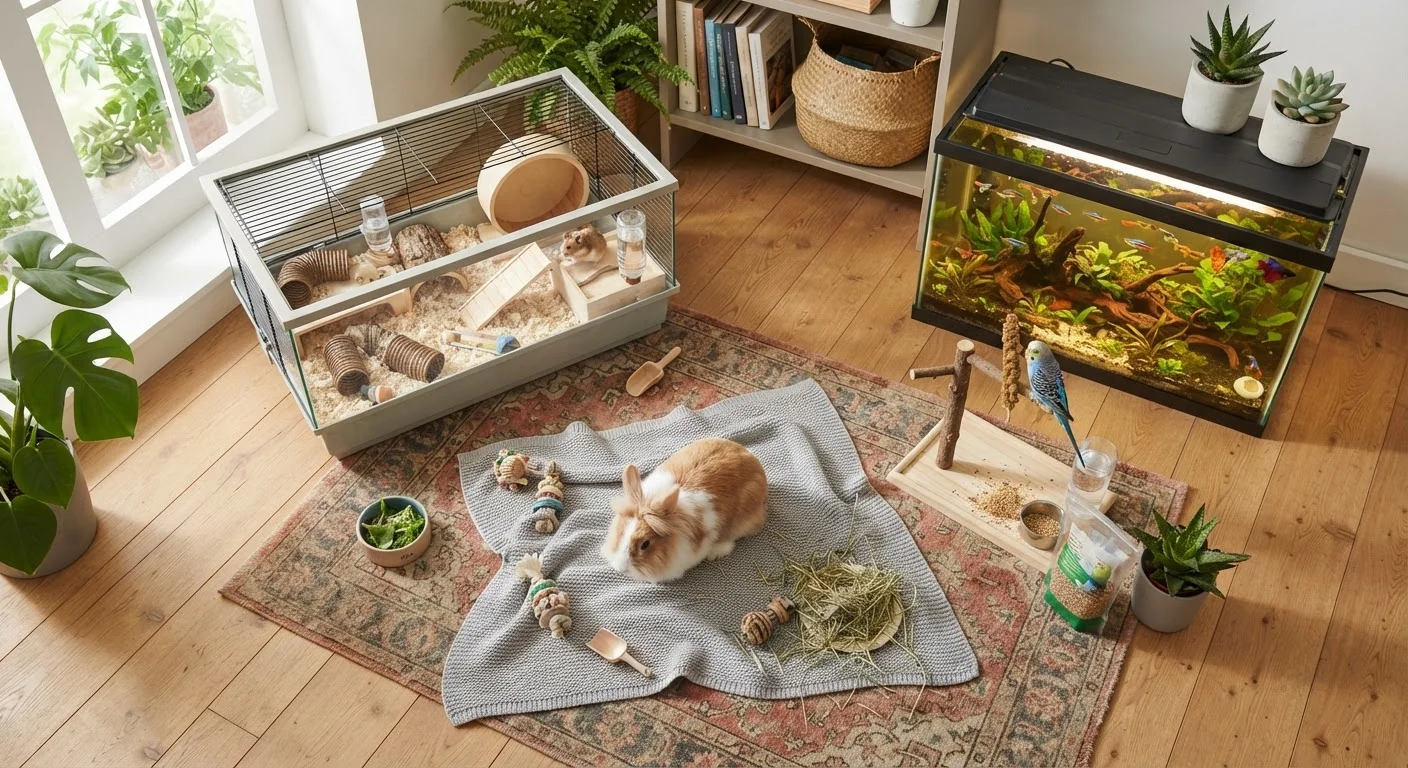
"Small pet" suggests simplicity, but the four most popular options - rabbits, hamsters, fish, and birds - have genuinely different care demands, costs, and temperaments. Choosing based on appearance or price alone is one of the most common reasons new owners feel overwhelmed within weeks. This comparison breaks down what each animal actually needs day to day so you can find the right match before bringing one home.
If you're still at the very beginning of your research, our complete starting point for first-time small pet owners covers the foundational steps before any species decision.
| Rabbit | Hamster | Fish | Bird | |
|---|---|---|---|---|
| Daily time commitment | High - 2+ hrs interaction & exercise | Low - 20-30 min handling | Low - feeding & water checks | High - daily social time required |
| Space needed | Large enclosure + exercise area | Moderate cage, minimal floor space | Tank size varies by species | Cage + out-of-cage fly time |
| Noise level | Quiet (thumps occasionally) | Very quiet | Silent | Moderate to loud (species-dependent) |
| Setup cost | Moderate to high | Low to moderate | Moderate to high | Moderate to high |
| Ongoing monthly cost | Moderate - hay, veg, vet fund | Low - pellets, bedding | Low to moderate - food, water treatments | Moderate - food, enrichment, vet fund |
| Handling & bonding | Strong bond, takes patience | Can bond, prefers short sessions | Not handleable | Strong bond, highly interactive |
| Suitable for children | Older children with supervision | Older children (nocturnal) | All ages (supervised) | Older children with guidance |
| Lifespan (typical) | 8-12 years | 2-3 years | 1-10+ years (species-dependent) | 5-15+ years (species-dependent) |
| Vet access needed | Exotic animal vet required | Exotic animal vet required | Aquatic vet for illness | Avian vet required |
| Allergy risk | Moderate (fur, hay dust) | Low to moderate (fur, bedding) | Very low | Moderate (feather dander) |
Rabbits: Rewarding But Genuinely High-Maintenance
Rabbits are intelligent, social animals that can bond closely with their owners - but they are one of the most misunderstood pets in this group. They need a large enclosure (not a small hutch), several hours of free-roaming exercise daily, a hay-based diet, and regular mental stimulation. Their digestive systems are sensitive, and changes to diet or environment can cause serious health problems quickly.
Rabbits also require care from a vet who specialises in exotic animals, since not all general veterinary practices treat them. Spaying or neutering is strongly recommended by most rabbit welfare organisations to prevent reproductive cancers and behavioural problems. A rabbit's daily routine involves more structure than most beginners expect. For housing specifics, see how to set up a rabbit enclosure.
Check Exotic Vet Availability Before You Commit
Rabbits, hamsters, and birds all require a vet experienced with exotic or small animals - not every general practice treats them. Before bringing any of these pets home, locate an exotic-animal or avian vet in your area and confirm they accept the species you're considering. Emergency care for a sick rabbit or bird can be difficult to find without planning ahead.
Hamsters: Low-Cost but Often Mismatched With Families
Hamsters are frequently marketed as starter pets for children, but their biology makes them a better match for calm, patient older owners. They are nocturnal - most active between dusk and early morning - and react poorly to being woken during the day. A stressed hamster bites, and chronic disturbance shortens their already-brief lifespan.
On the positive side, hamsters are quiet, relatively affordable to house and feed, and entertaining to watch during their active hours. They need a cage large enough to allow burrowing (many commercially sold cages are too small by current welfare guidelines), an exercise wheel, and enrichment to prevent boredom. Their short lifespan of roughly 2-3 years means a smaller long-term commitment, which suits some households well.
Hamsters Are Not Ideal Daytime Pets
Hamsters are naturally nocturnal, meaning they sleep through much of the day and become active in the evening and overnight. Repeatedly waking a hamster during daylight hours causes stress and can lead to biting and health decline. Households expecting a pet to interact with during daytime hours - especially with young children - often find this a significant mismatch.
Fish: Calming Companions With a Learning Curve
Fish are often assumed to be the simplest pet possible, but maintaining healthy water conditions requires more understanding than most beginners expect. The nitrogen cycle - the biological process that breaks down fish waste in an aquarium - needs to be established before fish are introduced, a step many first-time owners skip entirely. Skipping it is one of the leading causes of early fish death.
Once a tank is properly cycled and stable, fish are genuinely low-maintenance on a daily basis: feeding, a visual health check, and regular partial water changes are the main tasks. They cannot be handled, so the interaction is observational rather than tactile. Fish are well-suited to people with allergies, limited space, or busy schedules who still want a living, engaging presence in their home. For a clear picture of what fish-keeping actually involves, separating fish-keeping myths from facts is a useful read.
8-12 yrs
Average domestic rabbit lifespan
The House Rabbit Society notes that well-cared-for indoor rabbits commonly live 8-12 years, a longer commitment than many new owners anticipate.
2-3 yrs
Typical hamster lifespan
Syrian hamsters generally live 2-3 years; dwarf varieties are similar, making them a shorter but still meaningful commitment.
Birds: Interactive and Intelligent, but Demanding
Birds - particularly budgerigars (budgies), cockatiels, and canaries - offer a level of personality and interaction that surprises many new owners. Budgies and cockatiels can learn to mimic sounds and words, recognise their owners, and develop clear preferences and moods. That intelligence comes with a need for daily out-of-cage time, social engagement, and mental stimulation.
Birds are also sensitive to airborne toxins - non-stick cookware fumes, scented candles, and cigarette smoke can be fatal. They require an avian vet, which may not be available in all areas. Noise is a real factor: canaries sing, budgies chatter, and cockatiels can be loud at dawn and dusk. What beginner bird ownership actually looks like day to day helps set realistic expectations before you choose a species.
Costs and Practical Considerations
Setup and ongoing costs vary considerably across these four animals. Fish tanks and quality rabbit enclosures tend to have higher upfront costs; hamster setups are generally more affordable. All four animals have ongoing expenses beyond food - bedding, enrichment, and a financial reserve for veterinary care. Unexpected vet bills are the cost most commonly overlooked by new owners.
Living situation matters too. Renters should confirm which animals are permitted before committing. Keeping small pets in rented or shared homes covers what to check and how to approach landlord conversations. For a detailed breakdown of what each animal realistically costs month to month, see what small pets actually cost beyond the purchase price.
Illness in small pets can escalate quickly, partly because many species instinctively hide signs of sickness. Knowing the warning signs is essential regardless of which pet you choose. Signs in small pets that mean a vet visit can't wait outlines what to watch for across all four species covered here.
This article provides general educational information about small pet care and is not a substitute for advice from a qualified veterinarian familiar with your specific animal.