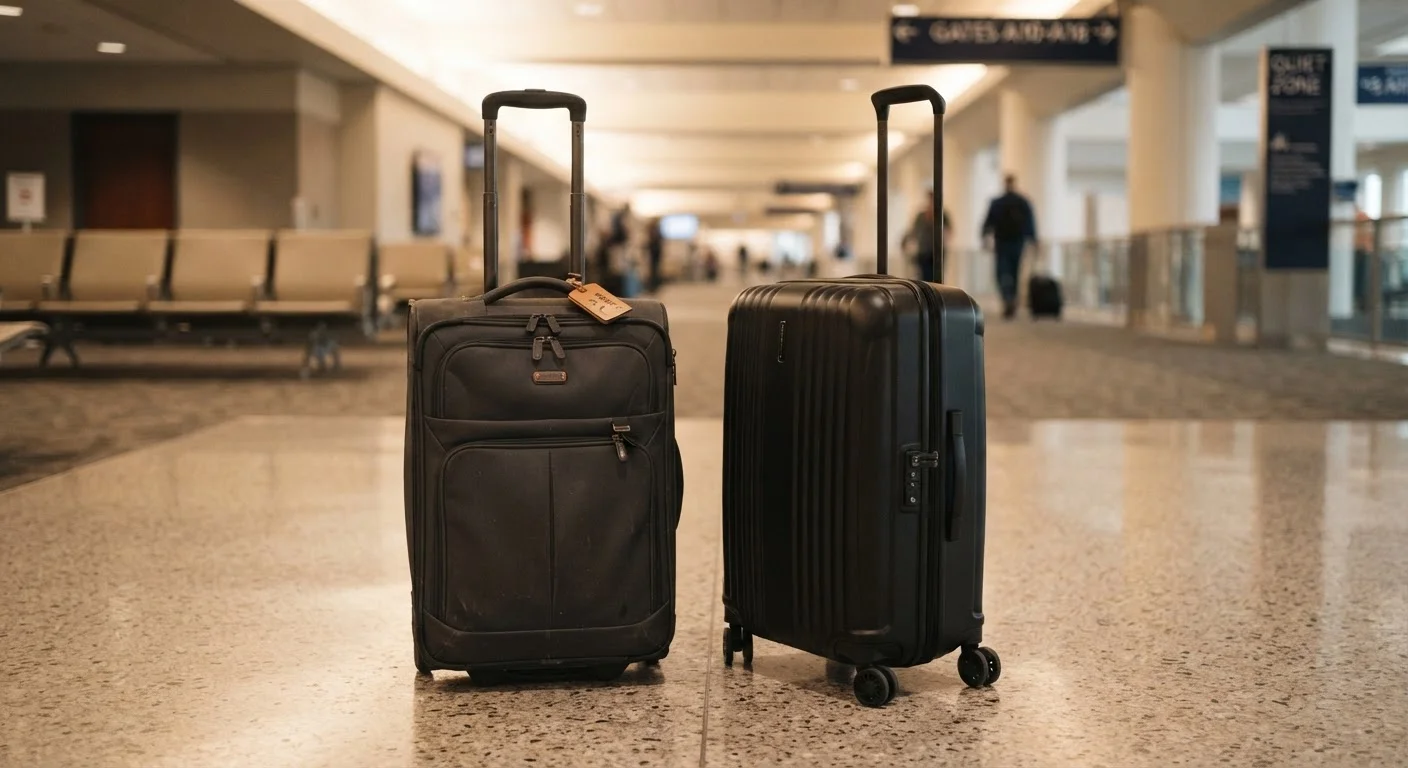
What Actually Separates the Two
At the most basic level, the difference is the outer shell. Soft-sided bags are made from fabric materials - nylon and polyester are most common - and their walls flex when pressure is applied. Hard-shell suitcases use rigid materials such as polycarbonate, ABS plastic, or aluminium, and they hold a fixed shape regardless of what's packed inside or stacked on top of them.
This single structural difference ripples through almost every practical aspect of travel: how much you can fit, how well your belongings are protected, how the bag behaves in tight spaces, and even how much the empty bag itself weighs before you've packed a single thing.
Understanding these knock-on effects - rather than just the surface-level material difference - is what helps you make a genuinely useful choice for your own travel style. See our guide on carry-on vs checked luggage for how bag type interacts with the size you actually need.
| Criterion | Soft-Sided Bags | Hard-Shell Suitcases |
|---|---|---|
| Flexibility | Flexes to fit tight spaces | Fixed rigid shape |
| Weight (empty bag) | Generally lighter | Generally heavier |
| Contents protection | Moderate; fabric absorbs some impact | Strong; shell deflects and distributes force |
| Water resistance | Lower; fabric can absorb moisture | Higher; shell sheds surface water |
| Exterior pockets | Common; easy quick access | Rare; full opening usually required |
| Expandability | Often available via expansion zip | Not expandable |
| Security | Fabric can be cut or forced | Harder to breach; lockable |
| Durability over time | May fray, snag, or sag | May crack or scratch, but holds shape |
Where Soft Bags Have a Genuine Advantage
Flexibility is the headline benefit of a soft bag, and it shows up in several practical ways. The fabric walls give slightly when you push a slightly-too-full bag into an overhead locker or a car boot - a rigid case simply won't budge. Many soft bags also feature expansion zippers that add a few extra centimetres of packing depth when you need them on the return journey.
Weight is another real advantage. A soft-sided carry-on can weigh noticeably less than its hard-shell equivalent, and on airlines with strict weight limits, that difference translates directly into more room for your belongings rather than the bag itself.
Exterior pockets - common on soft bags, rare on hard shells - let you access frequently needed items like a charging cable, snacks, or a transit document without opening the entire case. If you're the kind of traveller who reaches into their bag constantly, this is a meaningful convenience. Pairing a soft bag with good internal organisation is straightforward; the guide to packing cubes and organisation methods covers how to keep the interior manageable.
~15-20%
Typical weight difference between comparable soft and hard-shell bags
Industry luggage comparisons consistently show soft-sided bags weigh roughly 15-20% less than hard-shell equivalents at the same capacity, though this varies by construction quality.
2-3 cm
Extra depth most expandable soft bags can add
Most expandable soft-sided suitcases offer an additional 2-3 centimetres of packing depth via an expansion zipper, which can meaningfully increase usable volume.
Where Hard Shells Earn Their Place
The rigid structure of a hard-shell case does something a fabric bag simply cannot: it maintains a protective barrier around its contents regardless of what happens outside. Bags get stacked, dropped, and compressed in cargo holds. A hard shell absorbs and distributes that pressure rather than transferring it inward.
This matters most when you're carrying anything that can break, deform, or be damaged by compression - electronics, medications in glass bottles, delicate gifts, or professional equipment. It also matters for security: hard shells with integrated locks are considerably harder to slash open or force than fabric bags.
Water resistance is another practical edge. While neither luggage type is fully waterproof, hard shells shed rain and surface moisture more effectively than fabric, which can absorb water when left on wet tarmac. If you're travelling somewhere with unpredictable weather, or your checked bag regularly sits outside during loading, this is worth factoring in.
Hard shells also tend to keep their shape over years of use without sagging or developing structural weak points - though this depends heavily on the quality of the specific case rather than the material category alone.
Matching Your Bag to Your Trip
No single luggage type suits every journey, and the most useful question isn't "which is better" but "which suits this specific trip." A few factors that consistently point toward one option or the other:
- Trip length and packing volume: Longer trips with larger loads often benefit from the structural rigidity of a hard shell, which keeps the bag manageable when fully packed. For lighter, shorter trips, a soft bag's flexibility and lower weight tend to win out. The case for packing light is worth reading before you decide how much space you actually need.
- What you're carrying: If the bag contains fragile, valuable, or irreplaceable items, the hard shell's protection justifies the extra weight. If you're packing mainly clothes, a soft bag is plenty.
- How you'll handle the bag: Checking luggage exposes it to far more physical stress than carrying it on. A hard shell makes more sense for bags that will be checked frequently.
- Your travel habits: Frequent travellers who learn to pack smarter over time often settle on one type for specific trip categories rather than one universal bag for everything.
If you regularly travel through varied conditions and packing needs, owning one of each - a soft carry-on and a hard-shell checked case - is a practical solution many experienced travellers quietly land on.
Size and Bag Type Are Separate Decisions
It's easy to conflate luggage size with luggage type, but they're independent choices. Both soft bags and hard shells come in carry-on and checked sizes. Deciding which type suits your travel style is a different question from deciding how large a bag you need - and getting both right makes a bigger difference than either decision alone. For help with the size question, see our carry-on vs checked luggage overview.