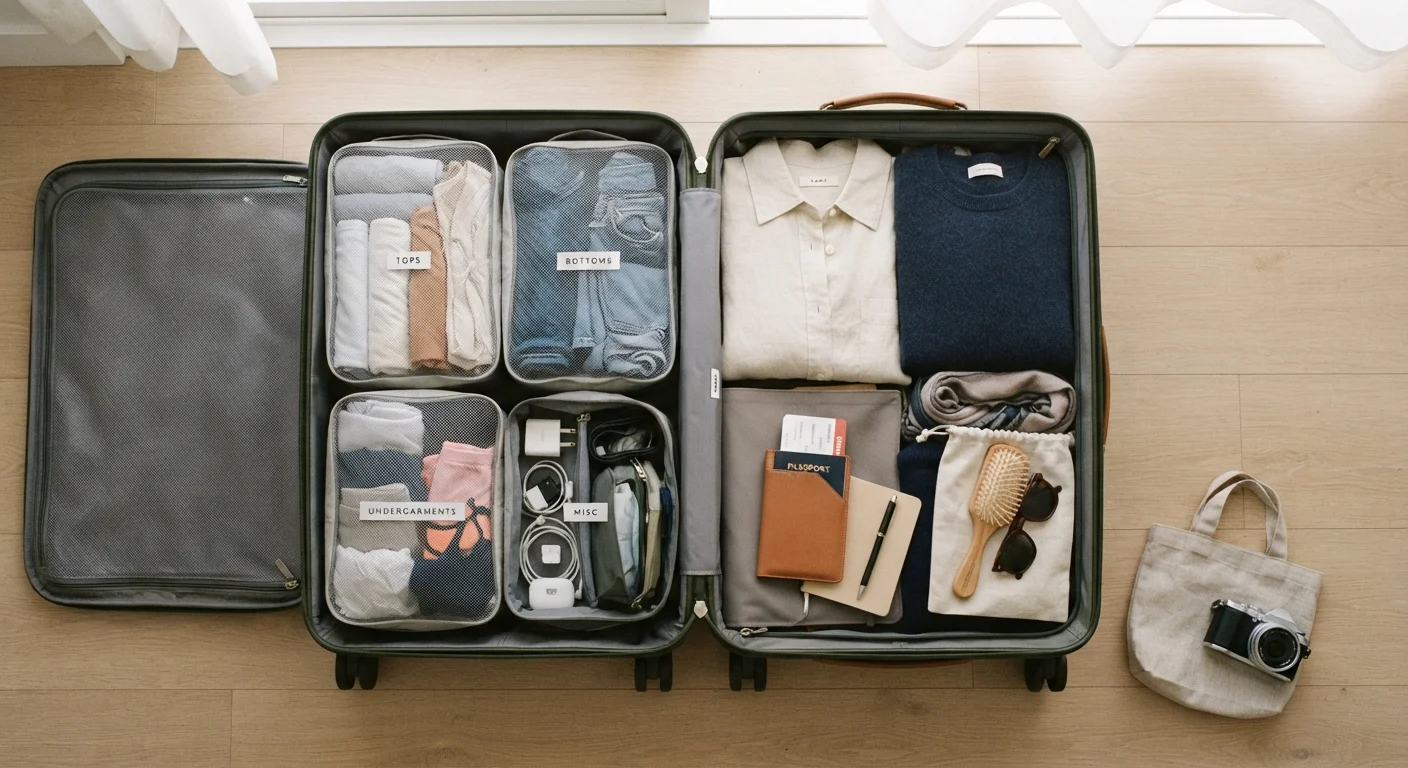
Why Organisation Method Matters More Than You Think
Most first-time packers treat luggage organisation as an afterthought - items go in roughly by size, gaps get filled with socks, and the zipper closes (barely). The result is a bag that's hard to search, prone to wrinkles, and often heavier than it needs to be.
The method you use to organise your clothes directly affects how much fits, how accessible things are mid-trip, and how your clothes look when you arrive. Before comparing specific techniques, it helps to understand that no method exists in isolation: the shape of your bag, the fabric of your clothes, and the length of your trip all play a role. See also our guide to soft vs hard-shell luggage - because bag structure affects which packing method works best inside it.
The four main approaches most travellers encounter are: packing cubes, rolling, folding, and bundle wrapping. Each has genuine strengths and real limitations.
Packing Cubes, Rolling, Folding, and Bundle Wrapping Side by Side
Understanding what each method actually does - rather than just how popular it is - helps you choose deliberately rather than by guesswork.
Packing cubes are zippered fabric compartments that slot into your bag. They don't compress clothes on their own (unless they are compression cubes with double zips), but they separate categories - tops in one, bottoms in another - and let you pull out an entire section without disturbing the rest. Their biggest advantage is speed: finding your gym kit at midnight without unpacking everything is genuinely useful.
Rolling involves tightly rolling each garment into a cylinder. It works well for soft, stretchy fabrics like T-shirts, jeans, and underwear because rolling tends to produce fewer creases than folding on those materials. It can also fill irregular spaces inside a bag more efficiently. However, rolling does not inherently save more space than folding - the difference is often smaller than claimed.
Folding remains the right choice for structured or woven garments. A button-down shirt folded flat along its seams wrinkles far less than one rolled into a cylinder. Suits and blazers should always be folded using the manufacturer's intended fold lines, or placed in a garment bag.
Bundle wrapping is less well known but worth understanding. Clothes are layered around a central core object (a toiletry bag works well) and wrapped around each other like a parcel. The continuous tension prevents individual items from shifting and reduces fold lines. It works best when packing a fixed set of items for the whole trip - it's impractical if you need to access clothes regularly.
| Packing Cubes | Rolling | Folding | Bundle Wrapping | |
|---|---|---|---|---|
| Space efficiency | Moderate - adds structure, not compression | Moderate - fills gaps well | Moderate - flat stacking can waste corners | High - minimises air pockets |
| Wrinkle reduction | Depends on contents | Good for soft fabrics | Best for structured garments | Good - continuous tension helps |
| Mid-trip access | Excellent - grab one cube | Good - cylinders stay visible | Fair - layers disturb others | Poor - must unwrap entirely |
| Learning curve | Low - straightforward | Low - quick to learn | Low - familiar to most | Medium - takes practice |
| Best suited for | Any trip length | Casual clothing | Business or structured clothes | Fixed wardrobes, single stays |
| Works in any bag shape | Yes - cubes are flexible | Yes - cylinders adapt | Better in rectangular bags | Better in rectangular bags |
For trips where you'll be living out of your bag or moving accommodations often, packing cubes paired with rolling tend to be the most practical combination. For a single-destination business trip, folding into cubes - or simply folding neatly - often produces better results. If you want to challenge your assumptions about how much you actually need, common packing myths that lead to heavy bags is worth reading alongside this comparison.
How to Combine Methods for Best Results
Experienced packers rarely use a single technique for everything. A practical hybrid approach might look like this:
- Roll T-shirts, underwear, socks, and casual trousers into cylinders and slot them into a packing cube by category.
- Fold dress shirts, blazers, or anything with structure, placing them flat on top of the cubes.
- Use a small separate cube or pouch for accessories and cables so electronics don't migrate to the bottom.
- Reserve your bag's exterior pockets for items you'll need during transit - not as overflow for things that didn't fit inside.
Test Your System Before You Travel
Pack your bag completely a day or two before departure, then close it and leave it overnight. The next morning, pull out the item you'd need first on arrival - your toiletry bag, a change of clothes. If it takes more than 30 seconds, your system needs adjusting. This trial run also reveals whether you've overpacked before it's too late to edit.
The goal is a system you can replicate consistently. If you pack differently every trip, you lose the time-saving benefit that organisation methods are supposed to provide. Smart packing habits every traveller eventually learns covers how to build this kind of repeatable routine, including keeping a running essentials list between trips.
If space is tight because you're packing for variable weather, packing for different climates in one suitcase explains how layering strategies interact with your organisation choices. And if you're weighing whether to pack lighter overall, the case for packing light offers an honest look at the trade-offs.