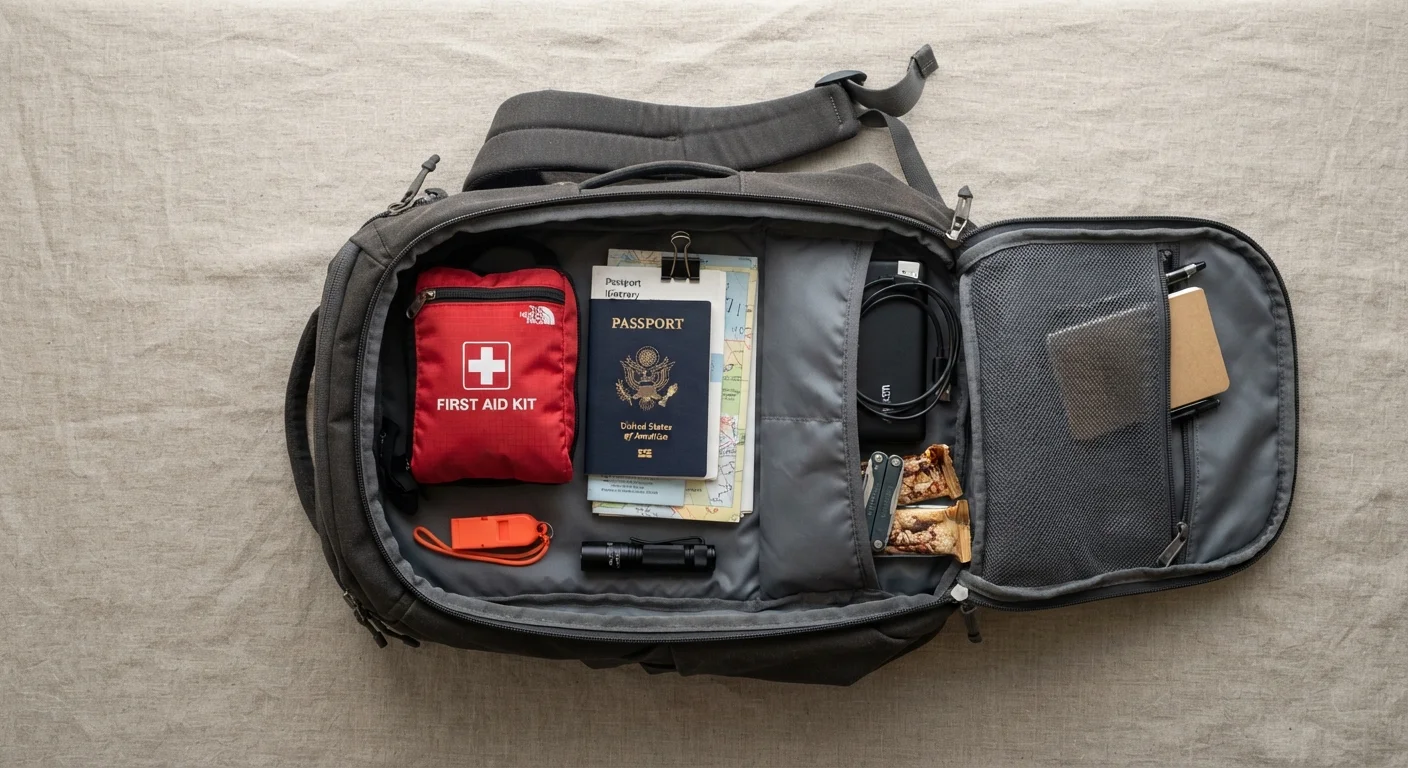
Why Safety Packing Deserves Its Own Checklist
Most first-time travelers focus their packing energy on clothes, toiletries, and adapters - which makes sense. But seasoned travelers tend to share a different kind of lesson: the items they wish they'd had weren't glamorous. They were a spare phone charger, a photocopy of a passport, or a small flashlight during a power cut at a rural guesthouse.
Safety packing isn't about preparing for worst-case disasters. It's about having the right small tools for the minor disruptions that actually happen - missed transport connections, a small cut with no pharmacy nearby, a dead phone in an unfamiliar neighborhood. These are the moments when a little foresight pays off quietly but meaningfully.
This list focuses on non-obvious items that are easy to overlook when building your packing list. For a broader foundation, the beginner's travel safety guide is a useful companion read. You can also cross-reference the international travel packing checklist to make sure your core essentials are covered before adding safety-specific gear.
Start With a Dedicated Safety Pouch
Rather than scattering safety items throughout your bag, keep them in a small, brightly colored pouch you can find quickly under pressure. Pack it first so it's always in a consistent, accessible spot. Treat it like a travel essential that moves with you on every trip without being rebuilt from scratch.
Items That Make a Real Difference
Photocopies and Digital Backups of Key Documents
Losing a passport or having a wallet stolen is disorienting enough without also losing every piece of identification you carry. Keeping physical photocopies of your passport photo page, travel insurance policy, and any visas - stored separately from the originals - gives you a fallback that speeds up replacement at an embassy or consulate.
Equally useful is a secure digital backup: scan your documents and store them in a password-protected cloud folder or encrypted email draft you can access from any device. This isn't a replacement for the originals, but it significantly reduces the friction of proving who you are when documentation goes missing.
Storing document copies separately from originals dramatically speeds up recovery when things go wrong.
A Compact, Well-Stocked First Aid Kit
Pharmacies aren't always accessible when you need them, and small injuries - blisters, cuts, mild allergic reactions - happen on almost every trip. A compact first aid kit doesn't need to be elaborate: adhesive bandages in multiple sizes, antiseptic wipes, blister plasters, antihistamine tablets, and any personal prescription medications cover the vast majority of minor situations travelers encounter.
Check the kit before each trip rather than assuming last trip's supplies are still intact. If you're traveling to destinations where healthcare access may be limited, consider augmenting with a rehydration sachet or two and a basic pain reliever. Always consult a healthcare professional about any medications you plan to carry, particularly if traveling internationally where regulations around certain medicines vary.
A compact first aid kit addresses the minor injuries and reactions that are far more common than major emergencies.
A Portable Power Bank
A dead phone in an unfamiliar city isn't just inconvenient - it removes your access to maps, translation tools, emergency contacts, and accommodation confirmations all at once. A portable power bank with enough capacity to fully charge your phone once or twice is one of the most consistently useful safety items you can carry.
Choose a capacity appropriate for your device and trip length. Note that aviation authorities place restrictions on power bank capacity for checked luggage - always carry power banks in your carry-on bag and verify current airline guidelines before flying.
A dead phone removes access to maps, contacts, and confirmations - a power bank restores all of it instantly.
Offline Maps Downloaded Before You Go
Data roaming can be unreliable, expensive, or simply unavailable in areas with poor signal. Downloading offline maps for your destination before departure ensures you can navigate without an internet connection. Several widely used navigation apps support offline map downloads for specific regions or cities.
Offline maps are particularly valuable during transit gaps - arriving at an airport, train station, or bus terminal in an unfamiliar city before your local SIM is active, or in areas where connectivity is patchy. For packing strategies that extend to managing tech and connectivity, see smart packing habits every traveler eventually learns.
Offline maps mean you can navigate confidently even when data roaming fails or hasn't been set up yet.
A Small Flashlight or Headlamp
Power outages are common in parts of the world that travelers visit frequently, and they tend to happen at the most inconvenient moments. A small LED flashlight or compact headlamp is lightweight, inexpensive, and immediately useful during an outage, when navigating poorly lit accommodation, or when arriving after dark in an unfamiliar area.
A headlamp is particularly practical because it keeps both hands free - useful when you're searching through a bag or navigating steps. Check the batteries before departure and carry a spare if the trip is long.
A small headlamp weighs almost nothing and is immediately useful whenever lighting unexpectedly fails.
An Emergency Contact Card in Your Wallet
If your phone is lost, stolen, or runs out of battery, knowing your emergency contacts from memory isn't something most people can actually do. A small card in your wallet - listing your travel insurance emergency number, a trusted home contact's phone number, and your accommodation address - costs nothing and can be genuinely critical in a disorienting situation.
Include the local emergency services number for your destination, since it varies by country. This pairs well with the broader preparation covered in the pre-departure checklist, which walks through how to organize your emergency information before any trip.
A written emergency contact card works when your phone doesn't - and takes thirty seconds to prepare.
A Doorstop Alarm or Personal Safety Alarm
For travelers staying in budget accommodation, guesthouses, or less familiar lodging situations, a small rubber doorstop wedged under a door adds a simple layer of physical security that works regardless of lock quality. Some versions include a built-in alarm that sounds if the door is pushed open.
A personal safety alarm - a small device that emits a loud sound when activated - is similarly compact and can help draw attention in an uncomfortable situation. These items aren't substitutes for good situational awareness, but they give travelers who feel uncertain an accessible, practical option. For broader habits around staying alert and safe, staying safe while travelling is worth reading before your trip.
A travel doorstop alarm adds meaningful security in unfamiliar lodging with no setup required.
Building Safety Into Every Pack
None of the items on this list require significant investment or add meaningful weight to your bag. What they share is that they're rarely remembered until the moment they're needed - and by then, it's too late to wish you'd packed them.
A practical approach is to keep a small, dedicated pouch for safety items that moves from bag to bag across every trip. That way, you're not rebuilding your safety kit from scratch each time. For more habits that make packing more effective overall, the smart packing habits guide covers the routines experienced travelers rely on. And before any upcoming trip, work through the pre-departure safety checklist to make sure nothing important slips through.
Verify Local Rules Before You Travel
Some safety items - including certain medications, personal alarms, and power banks - are subject to local regulations or airline restrictions that vary by destination and carrier. Always check current entry requirements and airline policies before your trip. Official government travel advisory sites and your airline's website are the most reliable sources for up-to-date rules.