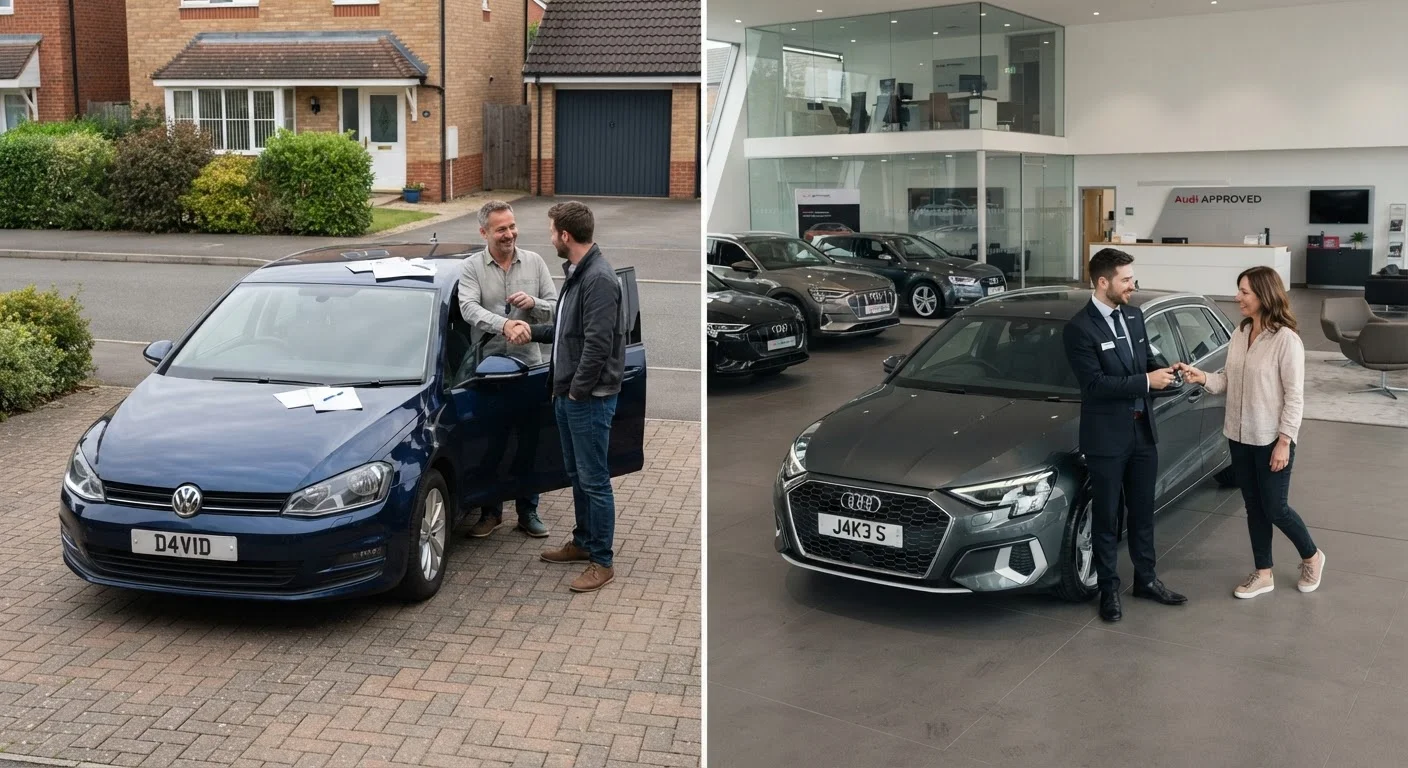
Why the Buying Channel Matters
When you're shopping for a used car, one of the first decisions you'll face is where to buy - from a private individual or from a licensed dealership. This choice affects far more than just the price tag. It shapes your legal rights, the paperwork involved, your access to financing, and what happens if something goes wrong after you drive away.
Many first-time buyers assume the process is similar either way. It isn't. Understanding the differences before you start shopping can save you from costly surprises. For a broader look at what type of car to buy in the first place, see our guide to new vs. used trade-offs.
| Private Sale | Dealership | |
|---|---|---|
| Consumer legal protections | Minimal - typically as-is | Regulated by state and federal law |
| Typical price | Often lower | Often higher, plus fees |
| Financing available | No - must arrange independently | Yes - in-house options available |
| Disclosure requirements | Limited, varies by state | Required under FTC Used Car Rule |
| Title transfer assistance | Buyer and seller handle it | Dealership manages paperwork |
| Warranty options | Rarely available | Often available on certified vehicles |
| Negotiation flexibility | Often more flexible | Structured, may have less room |
Legal Protections: A Significant Gap
This is where the two routes diverge most sharply. Licensed dealerships in the U.S. are regulated businesses. They must comply with federal and state consumer protection laws, including the FTC's Used Car Rule, which requires dealers to display a Buyers Guide disclosing warranty terms on every used vehicle. If a dealer misrepresents a vehicle's condition, you typically have legal recourse.
A private sale is a different story. In most states, private transactions are treated as "as-is" sales - meaning once you hand over the money, the vehicle is yours in whatever condition it's in. The seller is not legally required to volunteer information about past problems, and returning the car is rarely an option. Fraud is still illegal, of course, but proving it is difficult and expensive.
"As-Is" Means Very Limited Recourse
In a private sale, purchasing a car "as-is" means you accept the vehicle in its current condition, including any defects - even ones you didn't notice during the sale. If a major mechanical fault appears the day after purchase, recovering your money is extremely difficult in most states. Always have the vehicle independently inspected by a licensed mechanic before finalising any private sale.
This doesn't make private sales inherently bad - it just means the burden of investigation falls entirely on you before the sale is completed.
Price, Negotiation, and Financing
Private sellers generally list vehicles closer to wholesale value, which means prices are often lower than at a dealership. There's also more room for straightforward price negotiation - private sellers are typically motivated individuals rather than professional negotiators.
However, private sellers cannot arrange financing for you. You'll need to secure a loan independently - through your bank or credit union - before completing the purchase. Dealerships, by contrast, can offer in-house financing options, though it pays to compare them carefully. Our article on dealer finance vs. bank loans explains how those two paths work.
Dealerships also frequently add fees - documentation fees, dealer preparation charges, and others - that can narrow the price gap with private sellers. Always ask for a full out-the-door price before comparing.
Get Pre-Approved Before a Private Purchase
If you're considering a private sale, arrange your loan financing with a bank or credit union before you start seriously shopping. Knowing your approved loan amount gives you a clear budget and means you can move quickly when you find the right vehicle. Pre-approval also helps you avoid the temptation to stretch your budget in the moment.
Vehicle History and Disclosure Obligations
Dealerships are legally required to provide certain disclosures, including whether a vehicle has a branded title (such as salvage or flood damage). Many dealers also provide a vehicle history report as a standard part of the sale.
Private sellers have fewer mandatory disclosure requirements, though they vary by state. A seller might not mention a recurring mechanical problem unless directly and specifically asked - and even then, they aren't always legally obligated to answer. This is why a thorough test drive and an independent pre-purchase inspection by a qualified mechanic are essential steps in any private transaction.
Always run a vehicle history report yourself using the VIN (Vehicle Identification Number) regardless of what any seller tells you.
Paperwork and the Transfer Process
Dealerships handle most of the title transfer and registration paperwork on your behalf. For a first-time buyer, this is a meaningful convenience - the process can be confusing, and errors on title documents can cause problems later.
In a private sale, you and the seller are responsible for completing the title transfer correctly. Each state has its own process, forms, and deadlines for registering a privately purchased vehicle. Skipping steps or missing deadlines can result in fines or complications with your registration. Check your state's DMV website for the specific requirements in your area.
If you're heading to a dealership, our dealership preparation checklist will help you walk in ready to navigate the process with confidence.