What the Numbers Actually Mean
When you look at the sticker inside your driver's door jamb, you'll see a pressure figure in PSI or BAR - sometimes two figures, one for normal driving and one for a full load. That number is the pressure the vehicle's engineers calculated will keep the tyre's footprint (the part touching the road) at exactly the right size and shape for your car's weight and suspension design.
The number on the tyre sidewall - which says something like Max. Press. 51 PSI - is entirely different. It is the tyre's structural maximum, not a target. Using it as your inflation guide is one of the most common beginner mistakes and leads to over-inflation.
PSI stands for pounds per square inch; BAR is a metric unit of pressure. One BAR equals roughly 14.5 PSI. Most petrol station pumps display both, so you can use whichever unit your sticker shows.
Up to 3%
Fuel economy loss from under-inflated tyres
The U.S. Department of Energy estimates that tyres under-inflated by just 1 PSI each can reduce fuel economy by around 0.2% - and the effect compounds across all four tyres.
1-2 PSI
Typical monthly pressure loss through permeation
Even a tyre with no puncture or damage loses air gradually over time, making monthly checks necessary for all drivers.
~25%
Drivers estimated to have at least one significantly under-inflated tyre
Road safety surveys in multiple countries consistently find that a large proportion of vehicles on public roads are running on tyres below the manufacturer's recommended pressure.
The Real Costs of Getting It Wrong
Tyre pressure issues tend to feel invisible until something goes wrong - which is exactly why they are worth taking seriously before that point.
Under-inflation: the more common problem
A tyre that is even 6-8 PSI below its target is measurably softer. The sidewalls flex more than designed on every rotation, building heat inside the rubber. That internal heat is the leading cause of tyre blowouts at speed. Under-inflation also widens the contact patch, causing the outer edges of the tread to wear faster - meaning you buy new tyres sooner than you should. Fuel economy also drops because the engine must work harder to push a tyre that is partially collapsing underfoot.
Over-inflation: the overlooked risk
An over-inflated tyre bulges in the centre, so only a narrow strip of tread contacts the road. Grip is reduced, and the centre of the tread wears out while the edges remain relatively fresh - you end up replacing a tyre that looks fine on the outside. In wet conditions, the reduced contact patch is a genuine safety concern, affecting how quickly your car can stop. For more on how tyre condition affects stopping, see why tread depth matters beyond the legal minimum.
Check Pressure Before Long Trips
Before any journey of 90 minutes or more, add a tyre pressure check to your pre-trip routine. Motorway speeds generate more heat in tyres than city driving, and a tyre that is borderline low at the start of a trip is under greater stress at 70 mph. Two minutes at home before departure is far less disruptive than a breakdown on a busy road.
How to Check and Adjust Pressure Correctly
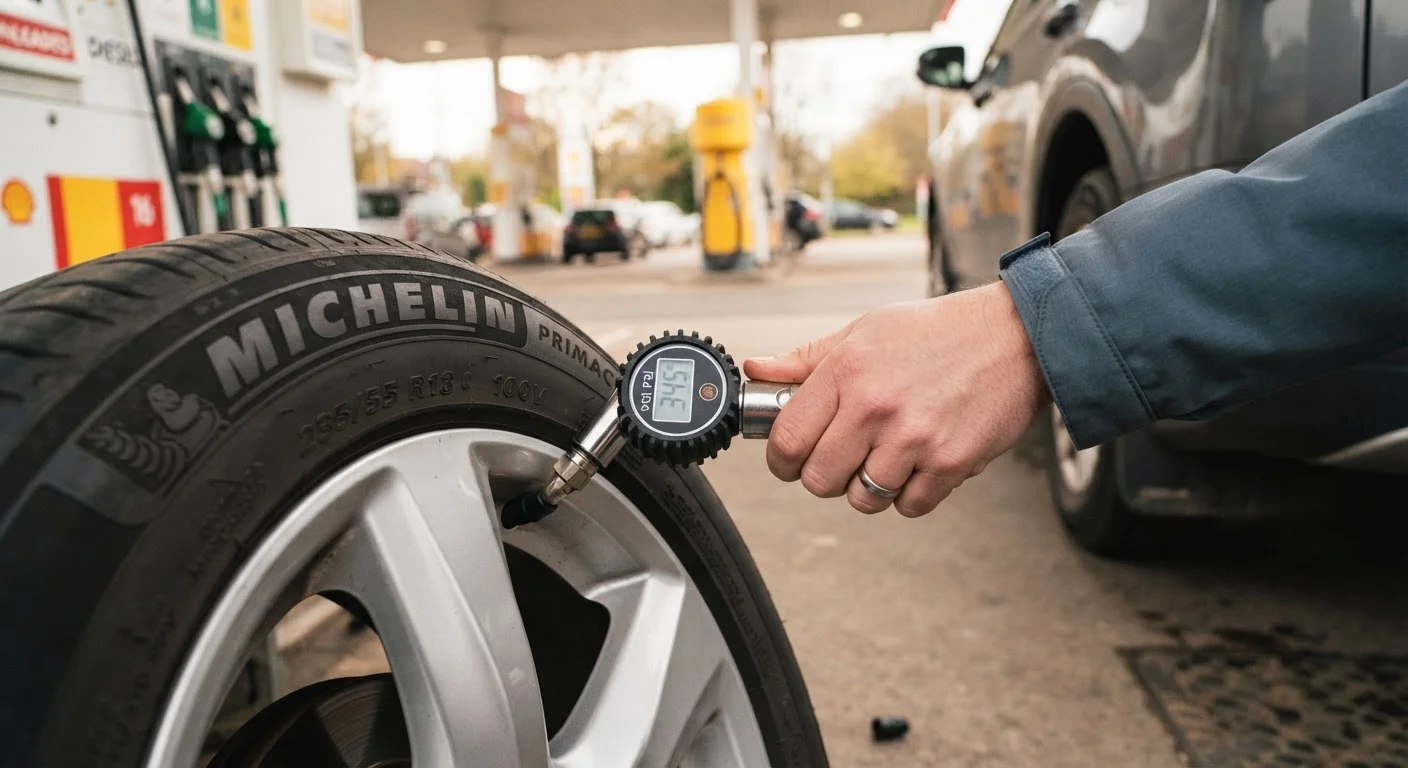
Checking your own tyre pressure requires only a pressure gauge - available inexpensively at any auto parts retailer - or a few minutes at a petrol station with a free air pump. Follow these steps for an accurate result:
- Check cold tyres. Wait until the car has been stationary for at least three hours, or before driving more than a mile. Heat from driving raises pressure temporarily and gives a misleading reading.
- Find your target figure. Look at the door jamb sticker or owner's manual. Note whether you need the standard or loaded figure.
- Remove the valve cap. The valve stem is a short rubber nub on the inner edge of the wheel. Keep the cap safe - it keeps dust out of the valve.
- Press the gauge firmly onto the valve. A hissing sound means the gauge is not seated properly. A stable reading should appear within a second or two.
- Compare and adjust. If pressure is low, add air in short bursts and recheck. If it is high, press the small pin inside the valve briefly to release air.
- Replace the valve cap. Check all four tyres - and your spare if you have one.
Ignoring pressure checks is one of the everyday habits that quietly shorten a car's lifespan. Alongside pressure, it is worth periodically checking brake condition so you have full confidence in your car's ability to stop safely.
TPMS Warning Lights Are a Last Resort, Not Routine Monitoring
Many modern vehicles have a Tyre Pressure Monitoring System (TPMS) that illuminates a dashboard warning when pressure drops significantly. However, most systems only trigger when a tyre is already 25% or more below the recommended level - well into the unsafe zone. Relying solely on this light means you are always reacting to a problem rather than preventing one. Regular manual checks remain the most reliable approach.