What Tread Depth Actually Does for You
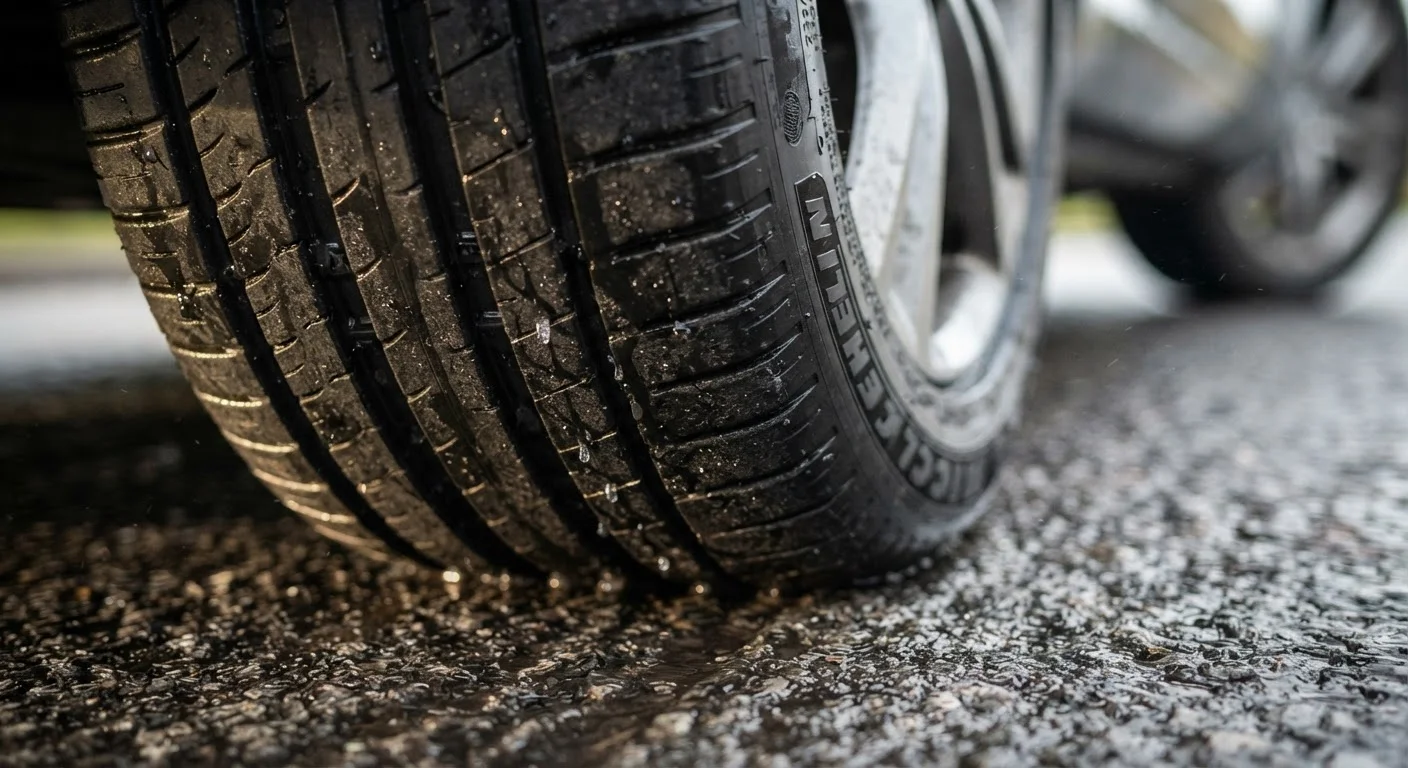
Think of a tyre's tread grooves as tiny drainage ditches. When it rains, water builds up between the rubber and the road surface. Without somewhere to go, that water acts as a lubricant, pushing the tyre away from the tarmac. The grooves' job is to evacuate that water outward before it can break the contact patch - the small area of tyre actually touching the road at any moment.
A new tyre with 7-8 mm of tread can move a remarkable volume of water per second at highway speeds. As the rubber wears down, that capacity shrinks. At the legal minimum of 2/32 inch, the grooves are so shallow that wet-road grip is significantly compromised even in moderate rain. This is why tread depth is not simply a box to tick - it is a direct measure of your car's ability to stop, steer, and stay in control when the road is anything other than bone dry.
Make It a Monthly Habit
Tread wears gradually and invisibly - you won't feel it happen. Building a quick tread check into a monthly routine (pair it with a tyre pressure check) means you'll catch the warning signs with plenty of time to act before safety is compromised. A digital tread depth gauge costs just a few dollars and gives a precise millimetre reading in seconds.
How to Check Your Tread Depth in Two Minutes
You don't need a gauge (though they cost just a few dollars and give precise readings). The coin method works well for a quick check:
- Quarter test for 4/32 inch: Insert a U.S. quarter into a tread groove, Washington's head facing down. If any part of his head disappears into the groove, you have more than 4/32 inch remaining - good for now. If his full head is visible, start budgeting for new tyres.
- Penny test for 2/32 inch: Use the same method with a penny and Lincoln's head. Full head visible means you're at or below the legal limit.
- Check multiple spots: Uneven wear tells its own story. Test the inside edge, centre, and outside edge of each tyre. Uneven readings can signal an alignment or pressure issue - see our guide on tyre pressure and its effects for more context.
Many new tyres also include moulded wear indicator bars - small raised rubber bridges at the bottom of the main grooves. When the tread wears down to the same level as these bars, you've reached 2/32 inch.
The Real-World Impact on Stopping Distance
Stopping distance has two parts: reaction distance (how far you travel before your foot hits the brake) and braking distance (how far the car slides before it stops). Tread depth only affects the second part - but that part can be the difference between a near-miss and a collision.
Testing by organisations such as NHTSA consistently shows that tyres worn to the legal minimum require meaningfully longer distances to stop on wet roads compared with tyres at mid-life depth. The gap widens the faster you're travelling. At highway speeds in rain, the difference in stopping distance between a worn tyre and a tyre with adequate tread can be equivalent to several car lengths.
2/32"
U.S. legal minimum tyre tread depth
Per federal regulations for passenger vehicles; equivalent to approximately 1.6 mm.
4/32"
Recommended wet-weather replacement threshold
Widely cited by tyre safety organisations as the practical minimum for adequate wet-road braking performance.
7-8 mm
Typical new tyre tread depth
Standard starting depth for most new passenger car tyres sold in the U.S. market.
These numbers interact directly with following distance and speed choices. Our article on stopping distances at common speeds explains how speed compounds every safety variable, including tyre condition.
When Tread Becomes a Braking System Issue
Your brakes and your tyres are two halves of the same stopping system. Even the most advanced anti-lock braking system (ABS) cannot overcome a tyre that has lost the grip needed to convert braking force into deceleration. ABS prevents wheel lock-up, but it relies entirely on the tyre having enough tread to create friction with the road.
This connection matters when you're evaluating your car's overall safety. If you're already dealing with brake wear symptoms alongside low tread, the combined effect on stopping performance is compounded. Address both issues - neither compensates for the other.
Understanding smooth braking technique is also worth your attention: worn tyres are far less forgiving of harsh, sudden inputs than tyres with healthy tread.
This article is for general informational purposes only. Always consult a qualified tyre technician or mechanic for an assessment of your specific vehicle's tyres before making safety decisions.