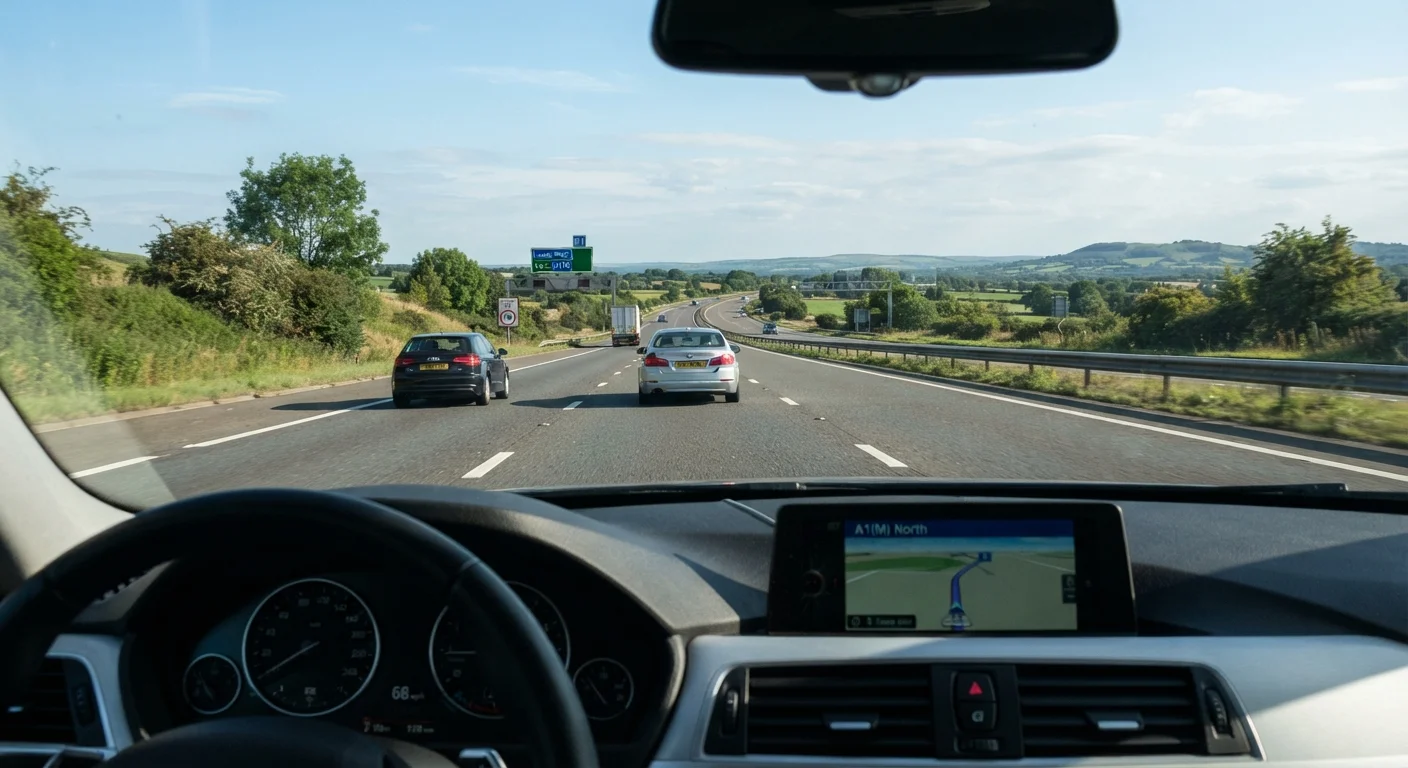
Why Motorways Feel Intimidating - and Why They Shouldn't
Most new drivers feel a spike of anxiety the first time they see a motorway on-ramp. Everything happens faster: vehicles travel at up to 70 mph, lanes are wider, and decisions feel less forgiving. That anxiety is completely normal, but it's also largely based on unfamiliarity rather than actual danger.
In practice, motorways eliminate many hazards that make other roads stressful - there are no pedestrians, no junctions, no oncoming traffic, and no traffic lights. Once you understand the rules and build a mental routine, motorway driving becomes one of the more predictable environments you'll encounter. Compare this to the split-second judgements required on complex urban roads, which we explore in our guide to adjusting your driving style between urban and rural roads.
The key is preparation. Read through this guide before your first attempt, ideally practise with an experienced driver or driving instructor alongside you, and give yourself time to build confidence progressively.
What you will need
What You'll Need Before You Set Off
Before tackling a motorway for the first time, make sure your vehicle and your mindset are both ready. A quick pre-drive check takes only a few minutes and removes unnecessary variables.
Vehicle owner's manual
Confirms tyre pressures, fluid specifications, and any model-specific warnings relevant to sustained high-speed driving.
Tyre pressure gauge
Allows you to verify tyre inflation is correct before a motorway journey, which affects handling and braking.
Sat-nav or mapping app (hands-free mount)
Gives advance notice of your exit junction so you can plan lane positioning without last-minute decisions.
Breakdown cover membership
Provides roadside assistance if your vehicle breaks down on the hard shoulder, where self-recovery is not safe.
Also consider your route. Pick a motorway stretch that is not too long, avoiding peak rush-hour traffic if possible. Familiarity with your destination in advance means you can focus on driving rather than navigation decisions at 70 mph.
Step-by-Step: How to Drive on a Motorway
Follow these steps in sequence. Each one builds on the last, so resist the temptation to skip ahead.
Check your mirrors and vehicle before joining
Before you reach the slip road, confirm your mirrors are correctly adjusted and your fuel level is sufficient. Set your sat-nav destination so you know your exit number. Take a few slow breaths - a calm, alert state is your most important safety tool.
Use the slip road to build speed
The slip road - the acceleration lane leading onto the motorway - exists specifically so you can match the speed of traffic already on the carriageway. Accelerate steadily along it, aiming to reach a speed close to the flow of motorway traffic before you reach the end.
Check your right-hand mirror and blind spot early and repeatedly as you accelerate. Signal right to indicate your intention to merge.
Merge smoothly into the left lane
When there is a safe gap in the left lane - ideally two seconds or more ahead of the vehicle behind that gap - move into it with a smooth steering input. Cancel your signal once you're fully in lane. Avoid cutting across sharply or forcing other drivers to brake.
If no gap appears and the slip road is ending, slow slightly and wait for a gap rather than forcing your way in.
Stay left and maintain a safe following distance
Once on the motorway, keep to the left lane unless overtaking. This is both a legal requirement and a practical safety habit. In the left lane, you face fewer vehicles passing on your right and the driving environment feels less pressured.
Use the two-second rule to judge your gap: as the vehicle ahead passes a fixed point (a bridge, sign, or road marking), count two full seconds before you reach the same point. In wet conditions, double this to four seconds. At 70 mph, two seconds represents roughly 63 metres of stopping distance buffer.
Overtake safely and return to the left lane
To overtake, check your centre mirror, then your right-hand mirror, then your right blind spot over your shoulder. Signal right, move into the lane when it is clear, pass the vehicle at a steady pace, then check your left mirror and blind spot before signalling left and returning to the left lane.
Do not hover in the middle or right lane once you have finished overtaking - this is lane hogging and is both illegal and frustrating to other drivers.
Plan and execute your exit
Motorway exits are signposted at one mile, half a mile, and at the junction itself. When you see the one-mile sign for your junction, move to the left lane calmly - don't leave it until the last sign. At the half-mile marker, signal left. As you enter the slip road, begin braking progressively. After sustained motorway speeds, your sense of speed may be distorted: check your speedometer as you approach any roundabout or junction at the end of the slip road.
First Time? Consider a Practice Run
Many driving instructors offer motorway lessons specifically for recently qualified drivers. A short supervised session on a quiet stretch - ideally mid-morning on a weekday - can build confidence far faster than reading alone. Practising with a calm, experienced passenger is a worthwhile alternative if professional instruction isn't available.
Weather can change how every one of these steps plays out. Our guide to handling different weather conditions as a new driver explains how rain, fog, and ice specifically affect high-speed driving.
If Something Goes Wrong
Breakdowns and emergencies feel more frightening at speed, but there is a clear procedure to follow.
Hard Shoulder Rules Have Changed on Smart Motorways
On sections of 'smart motorway' - where the hard shoulder has been converted to a running lane - the rules differ from traditional motorways. Emergency Refuge Areas (ERAs), marked with blue signs and an orange SOS telephone symbol, are spaced at intervals and should be your target if you need to stop. If you cannot reach an ERA and your vehicle stops in a live lane, switch on hazard lights immediately and call 999. Do not attempt to exit the vehicle unless you are certain it is safe to do so.
If you feel a tyre blow, grip the wheel firmly, ease off the accelerator gently, and steer smoothly to the left - do not brake sharply. Once on the hard shoulder, switch on your hazard lights immediately. Exit through the left-hand door, move well behind the barriers or up the embankment away from live traffic, and contact your breakdown service. Never attempt to change a tyre on the hard shoulder itself.
If you feel drowsy at any point, leave at the next junction or services. Fatigue at motorway speeds dramatically reduces reaction time. Night journeys carry additional risk - our article on night driving and how to adapt covers this in detail.
Watch Your Speed After Leaving the Motorway
After driving at 70 mph for an extended period, speeds of 30-40 mph can feel deceptively slow. Your brain adapts to high-speed movement, a phenomenon sometimes called 'velocity adaptation.' Always glance at your speedometer as you enter slower-speed zones following a motorway exit - never rely on feel alone.