Why Road Signs Are Designed the Way They Are
Road signs in the United States follow a standardized system defined by the MUTCD, a federal guide that specifies sign shapes, colors, and meanings. This uniformity means a driver in Maine and a driver in Arizona see the same visual language. Once you understand the system behind the signs, reading them becomes instinctive.
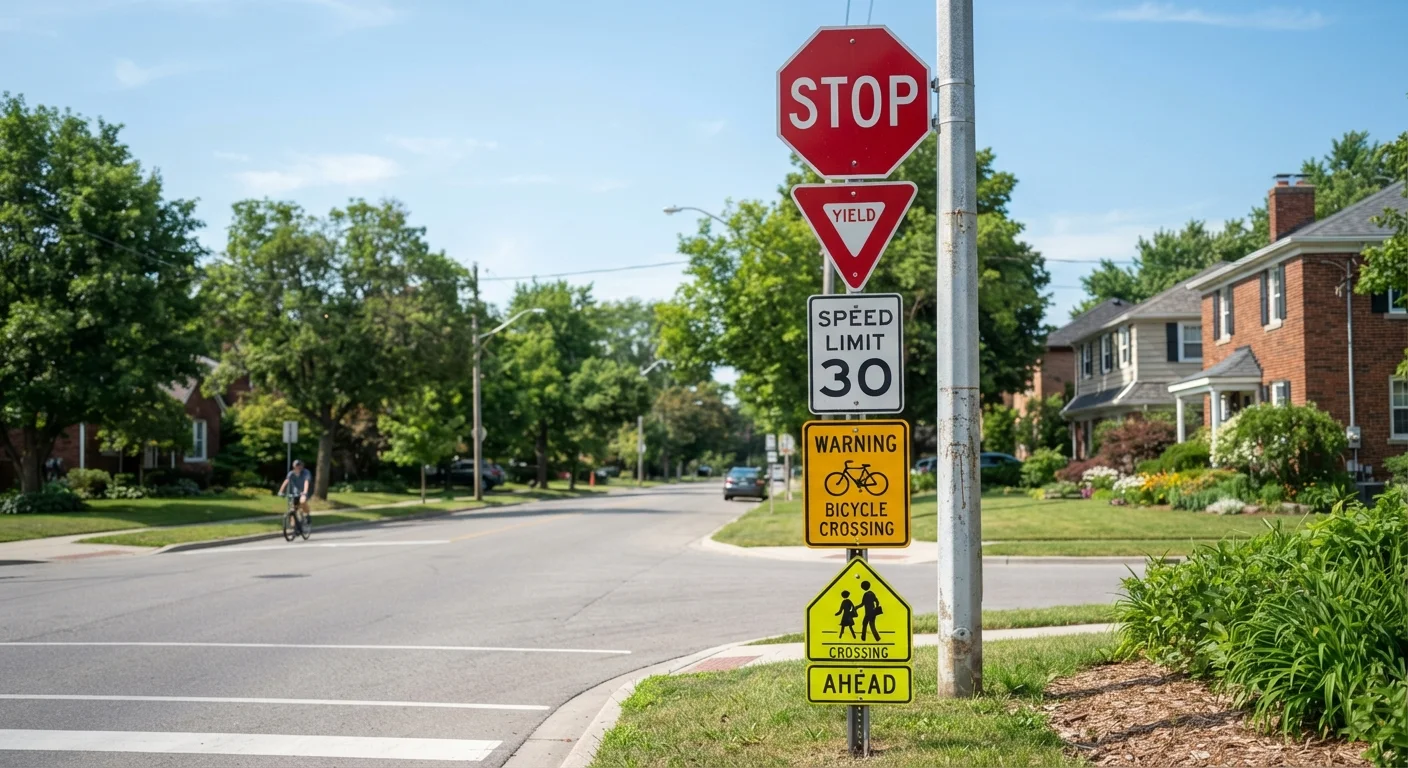
Shape carries the first message. Even if a sign is partially obscured by snow or a tree branch, its shape alone gives you a cue. An eight-sided sign is always a stop. A triangle pointing down is always a yield. A diamond always warns of a hazard ahead. Knowing this lets you react before you can even read the text.
Color adds a second layer of meaning. Red signals prohibition or mandatory action. Yellow means caution or warning. Green provides directional guidance. Orange marks construction or temporary conditions. Blue indicates services - fuel, food, lodging. Brown points to recreational and cultural destinations.
| Governing standard for U.S. road signs | MUTCD (Manual on Uniform Traffic Control Devices) (U.S. Department of Transportation) |
| Shape indicating mandatory stop | Eight-sided octagon |
| Color indicating a warning or hazard | Yellow (MUTCD color coding system) |
| Color indicating services (fuel, food, lodging) | Blue |
| Color indicating construction or temporary conditions | Orange |
| Shape indicating a yield | Downward-pointing equilateral triangle |
Together, shape and color create a redundant system: even colorblind drivers can distinguish most signs by shape and position alone. That's intentional design, not coincidence.
The Signs You'll Encounter Most Often
Rather than cataloguing every sign in the MUTCD, this section focuses on the ones new drivers encounter on nearly every trip - and where confusion most often leads to errors.
Regulatory Signs (Red & White)
These signs tell you what you must or must not do. They carry the force of law.
- Stop (octagon): Come to a complete standstill at the stop line or before the crosswalk. Check all directions for crossing traffic and pedestrians before proceeding. A rolling stop - slowing but not stopping fully - is a traffic violation.
- Yield (downward triangle): Slow down and be prepared to stop if necessary. Give the right-of-way to traffic already in the intersection or merging lane. You do not have to stop if the way is clear.
- Speed Limit (rectangular): The number shown is the maximum legal speed under ideal conditions. In rain, fog, or heavy traffic, a safe speed is often lower. See how conditions affect safe speed for practical guidance.
- Do Not Enter / Wrong Way: You are approaching a one-way road from the wrong direction. Stop immediately and turn around safely.
- No U-Turn: The maneuver is prohibited at that location. Attempting one anyway is illegal and potentially dangerous.
Warning Signs (Yellow Diamond)
These alert you to a hazard or change in road conditions ahead. They don't prohibit - they prompt you to adjust.
- Curve or Winding Road: Reduce speed before the bend, not during it. Braking mid-curve can cause skidding.
- Pedestrian Crossing: A pedestrian may be in or about to enter the roadway. Scan left and right.
- Merge / Lane Ends: One lane is disappearing. Traffic must combine. Use your signals correctly - the proper signal sequence matters here.
- Railroad Crossing (round, black & yellow): A train crossing is ahead. Slow down, look both ways, and never race a train.
MUTCD
The Manual on Uniform Traffic Control Devices - a federal document published by the U.S. Department of Transportation that standardizes the design and placement of road signs, signals, and markings across all U.S. jurisdictions.
Regulatory sign
A sign that communicates a legal requirement or prohibition. Failing to obey a regulatory sign is a traffic violation and can result in a fine or license points.
Warning sign
A sign that alerts drivers to a potential hazard or change in road conditions ahead. It does not mandate a specific action but calls for increased caution and speed adjustment.
Right-of-way
The legal right to proceed through an intersection or merging point before other vehicles or pedestrians. Yield signs and many intersection rules are built around assigning right-of-way.
Guide sign
An informational sign - typically green or blue - that provides direction, distance, or service information to help drivers navigate without requiring a specific action.
Guide Signs (Green & Blue)
Green rectangular signs show route numbers, destinations, and distances. Blue signs mark services. These are informational - they don't require action, but they help you plan your lane position early rather than swerving at the last moment.
Road signs and road markings work together as a complete communication system. Understanding both gives you a much fuller picture of what any stretch of road is telling you.
Signs Look Different Abroad
The U.S. sign system differs significantly from those used in Europe, Asia, and elsewhere. If you plan to drive in another country, familiarize yourself with local signs before you travel. Our guide on driving safely in unfamiliar traffic covers what to check before getting behind the wheel abroad.