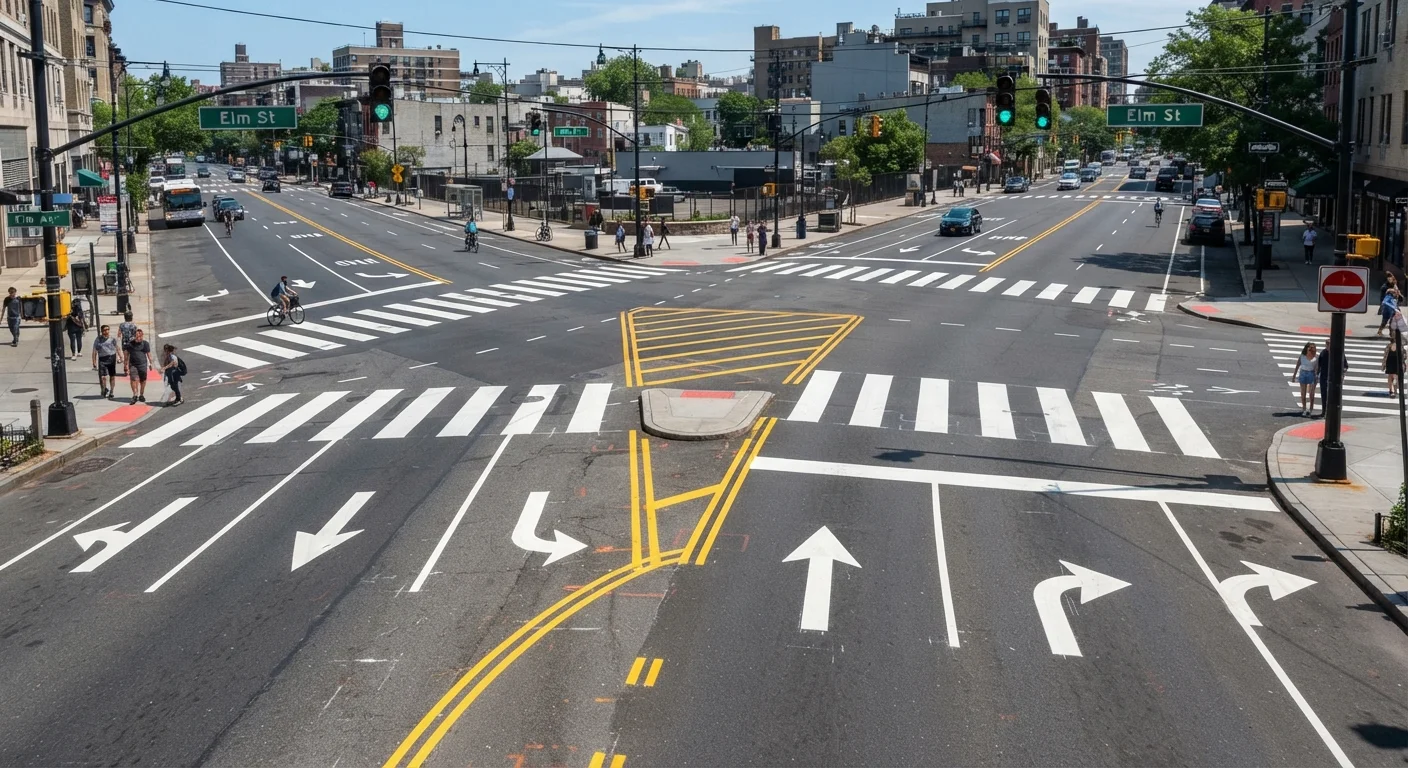
Why Road Markings Have Legal Force
Road markings are not decorative. In the United States, they are part of the traffic control system governed by the MUTCD, the federal standard that states adopt to regulate road design. Ignoring a marking can constitute a moving violation in the same way that running a red light does. For new drivers, understanding markings is just as important as reading signs - and the two systems work together. See our guide to road signs for how the sign system complements what's painted on the road.
Markings fall into three broad categories: longitudinal lines (running along the road), transverse markings (crossing the road), and special-purpose markings such as arrows, words, and colored zones. Each uses a standardized color and pattern to convey a specific message.
| Governing standard (U.S.) | Manual on Uniform Traffic Control Devices (MUTCD) (Federal Highway Administration) |
| White line direction | Same-direction traffic separation |
| Yellow line direction | Opposite-direction traffic separation |
| Double solid yellow lines | No passing for either direction |
| Broken white line | Lane change permitted when safe |
| HOV diamond | High-Occupancy Vehicle lane; check posted sign for rules |
White Lines: Separating Traffic Moving in the Same Direction
White markings always describe lanes or boundaries where traffic flows in the same direction.
Longitudinal marking
A line or marking that runs parallel to the direction of travel, such as lane dividers and edge lines. These guide drivers along the road.
Transverse marking
A marking that crosses the road at an angle or perpendicular to travel, such as stop lines and crosswalk bars. These regulate where vehicles stop or pedestrians cross.
Double solid yellow lines
Two unbroken yellow lines painted side by side at the center of a road. No vehicle may cross them to pass in either direction.
Hatched area
A zone of diagonal stripes enclosed by lines on the road surface. Solid borders mean no entry; broken borders allow entry when necessary and safe.
HOV lane
A High-Occupancy Vehicle lane reserved for vehicles carrying a minimum number of occupants. Entry rules are posted on roadside signs and vary by location.
Yield line (shark's teeth)
A row of painted triangles pointing toward approaching drivers, marking where they must give way to other traffic - commonly used at roundabout entries.
- Broken white line (lane divider): The dashed lines separating lanes on a multi-lane road. You may change lanes across them when it is safe to do so. Always use your mirrors and signal first - the correct sequence is explained in our lane-change guide.
- Solid white line: Discourages lane changes. On a highway, a solid white line near an on-ramp or exit marks where merging traffic should not cross into through-traffic lanes. On surface streets, it often marks the edge of the roadway or a bike lane boundary.
- Double solid white lines: Prohibit lane changes entirely. You must not cross them. They typically appear at toll plazas or where lane separation is critical for safety.
- White stop line: A thick transverse line at intersections. Your front bumper must stop at or behind it, not over it.
- Crosswalk lines: Two parallel white bars or a ladder pattern marking a pedestrian crossing. You must yield to pedestrians in or entering the crosswalk.
Yellow Lines: Separating Opposing Traffic
Yellow markings indicate the division between traffic traveling in opposite directions. They appear on two-lane roads and the left edge of one-way roads.
- Broken yellow line: Passing is permitted when the way ahead is clear. Only cross it to overtake when you have adequate visibility and space.
- Solid yellow line on your side: You must not pass. The solid line applies to your direction of travel regardless of what the line on the other side shows.
- Double solid yellow lines: Passing is prohibited for traffic in both directions. Crossing double solid yellows is illegal except to turn into a driveway or property.
- Yellow center line (undivided roads): Marks the center of the road. Stay to the right of it at all times unless overtaking where permitted.
Understanding who has right of way at intersections connects directly to how center-line markings work. Our right-of-way explainer covers those rules in full.
~30%
Crashes involving improper lane use
According to FHWA research, improper lane use and passing account for a significant share of roadway crashes on two-lane rural highways.
11 ft
Standard U.S. lane width
The MUTCD and AASHTO design guidelines cite 11-12 feet as the standard lane width on most U.S. roads, directly influencing how markings are spaced.
Special Markings: Boxes, Arrows, and Hatched Zones
Beyond simple lines, roads use several painted symbols that carry distinct instructions.
- Turn arrows: Painted in a lane to indicate permitted direction of travel. If your lane shows a straight-ahead arrow with a left-turn arrow, you may do either. A lone left-turn arrow means you must turn left from that lane.
- Yield line (shark's teeth): A row of triangles pointing toward approaching drivers, indicating where you must give way - commonly at roundabouts.
- Railroad crossing markings: An 'X' with the letters 'RR' and a stop line warn of a rail crossing ahead. Never stop on the tracks themselves.
- Hatched or chevron areas: Diagonal lines enclosed within solid or broken lines. Solid-bordered hatched areas must not be entered. Broken-bordered hatched areas may be entered if necessary and safe - for example, to pass a slow vehicle where the road width permits.
- Yellow box junctions: Found in some cities, these yellow grid-painted boxes prohibit stopping inside the box unless your exit is clear. You may enter only if you can clear the box without stopping.
- HOV diamond: A white diamond painted in a lane marks a High-Occupancy Vehicle lane. Entry restrictions (minimum passenger count, permitted hours) are posted on roadside signs.
If you are planning to drive in another country, be aware that marking conventions differ significantly. Our road safety abroad guide outlines what to expect before you travel.
Markings Vary by State and Locality
While the MUTCD sets federal standards, individual states may adopt supplements or variations. Some cities use additional colored markings - such as green for protected bike lanes or red for bus-only lanes - not covered by the base federal standard. When you see an unfamiliar color or pattern, check for nearby signage that explains it. Your state's driver handbook is also a reliable reference for local variations.