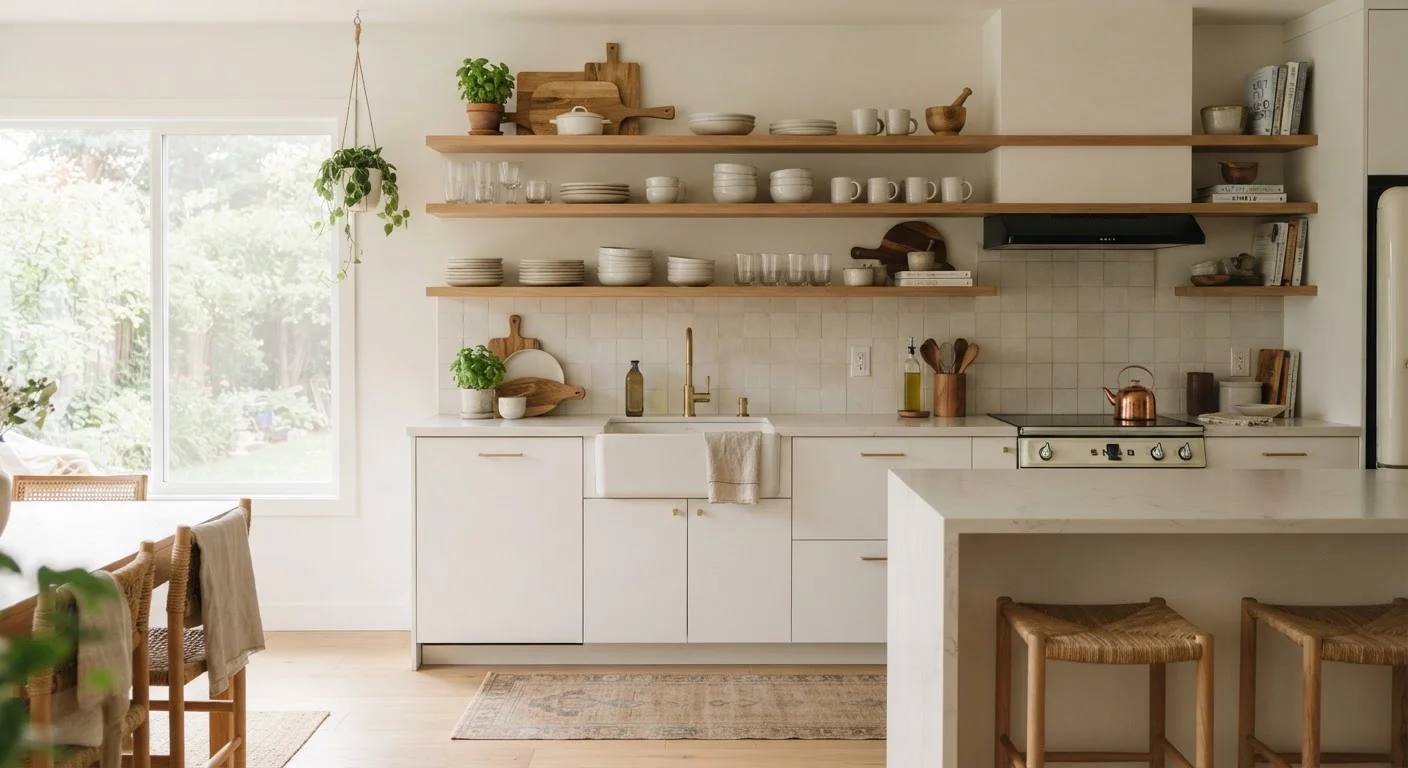
Understanding the Core Trade-Off
When setting up a home for the first time, one of the earliest decisions you'll face is deceptively simple: should things be visible or hidden? Open shelving - think wall-mounted shelves, open bookcases, floating ledges - puts everything in plain sight. Closed storage, including cabinets with doors, drawers, lidded bins, and wardrobes, tucks items away behind a surface.
Both approaches solve a real problem. Open shelving makes it easy to find and grab what you need at a glance, and it can make a room feel larger and more personal when styled well. Closed storage keeps visual noise low, which is a significant advantage in rooms where you want calm - and it's far more forgiving of the natural accumulation of everyday life.
The key variable most first-time homeowners overlook is maintenance load. Open shelves are only as attractive as what's on them. If your kitchen shelves hold mismatched mugs, half-open bags, and random gadgets, open storage actively works against you. Closed storage, on the other hand, lets you close a door and move on. See our guide to assessing your real storage needs before committing to either approach.
| Open Shelving | Closed Storage | |
|---|---|---|
| Visual effect | Airy and personal when styled | Clean, calm, and uniform |
| Maintenance required | High - dust, grease, and tidiness visible | Low - mess hidden behind doors |
| Accessibility | Instant at-a-glance access | Requires opening door or drawer |
| Best content types | Attractive, uniform, frequently used items | Mismatched, bulky, or rarely used items |
| Works best in | Living rooms, kitchen upper zones | Bedrooms, entryways, bathrooms |
| Flexibility | Easy to restyle or rearrange | Protects contents from dust and damage |
Room-by-Room Breakdown
Kitchen
The kitchen is where this debate gets the most attention - and the most nuance. Open shelving works well for items you use daily and that look uniform: matching dinnerware, glass storage jars, a row of cookbooks. It also creates breathing room in a small galley kitchen where upper cabinets can feel heavy and enclosing.
The challenge is that kitchens accumulate grease and dust, meaning open shelves require regular cleaning. Items you rarely use will look neglected quickly. Closed lower cabinets are almost always worth keeping - they hold pots, pans, cleaning supplies, and the less photogenic side of cooking life. For more on managing kitchen clutter, read our take on the kitchen junk drawer.
Living Room
Living rooms are well-suited to a mix. Open shelving, particularly a built-in bookcase or media wall unit, gives you a place to display books, plants, framed photos, and decorative objects that make a space feel lived-in. Pair those open shelves with closed base cabinets or a sideboard to store remote controls, cables, board games, and other functional clutter.
Bedroom
Bedrooms benefit most from closed storage. Research in environmental psychology consistently links visual clutter in sleeping spaces to disrupted rest and elevated stress. A wardrobe, dresser, and under-bed storage with lids keep the room visually calm. If you want an open element, a single styled shelf above a desk or nightstand can add personality without adding noise.
Start With Closed, Add Open Intentionally
If you're moving into a new home and unsure where to begin, default to closed storage first. It gives you a clean slate while you figure out how you actually use each room day-to-day. Once you identify items you reach for constantly - and that you wouldn't mind seeing every day - you can introduce open shelving for just those categories. This approach avoids the common mistake of committing to open shelves before knowing whether your habits support the upkeep.
Home Office and Entryway
In a home office, a mix again serves most people well: open shelves for reference books, binders, and items you reach for constantly; closed drawers and cabinets for paperwork, supplies, and anything that creates visual distraction during work. Entryways are high-traffic zones where closed storage (a coat closet, a bench with a lift-top lid, a row of closed hooks with a cover panel) typically performs better than open options, which can look chaotic within days.
How to Decide What Goes Where
A practical rule: anything you're proud to display and reach for regularly is a candidate for open storage. Anything you use but don't want to look at - or anything that arrives in inconsistent sizes and shapes - belongs behind a door. Start by asking three questions about each category of items:
- Do I access this at least a few times a week? Frequent-use items benefit from visibility.
- Does this look presentable on its own? Uniform, attractive, or meaningful items suit open shelving.
- How much time am I willing to spend tidying this area? Be honest - open shelves demand regular attention.
If you're working with limited square footage, our guide to organizing compact homes covers how to layer both storage types efficiently without overwhelming a small floor plan.
Finally, remember that your storage system doesn't need to be decided all at once. Start with closed storage as a baseline - it's the more forgiving default - and introduce open elements deliberately as you learn how you actually use each room. For a full room-by-room framework, see The Complete Guide to Organizing Every Room in Your Home.