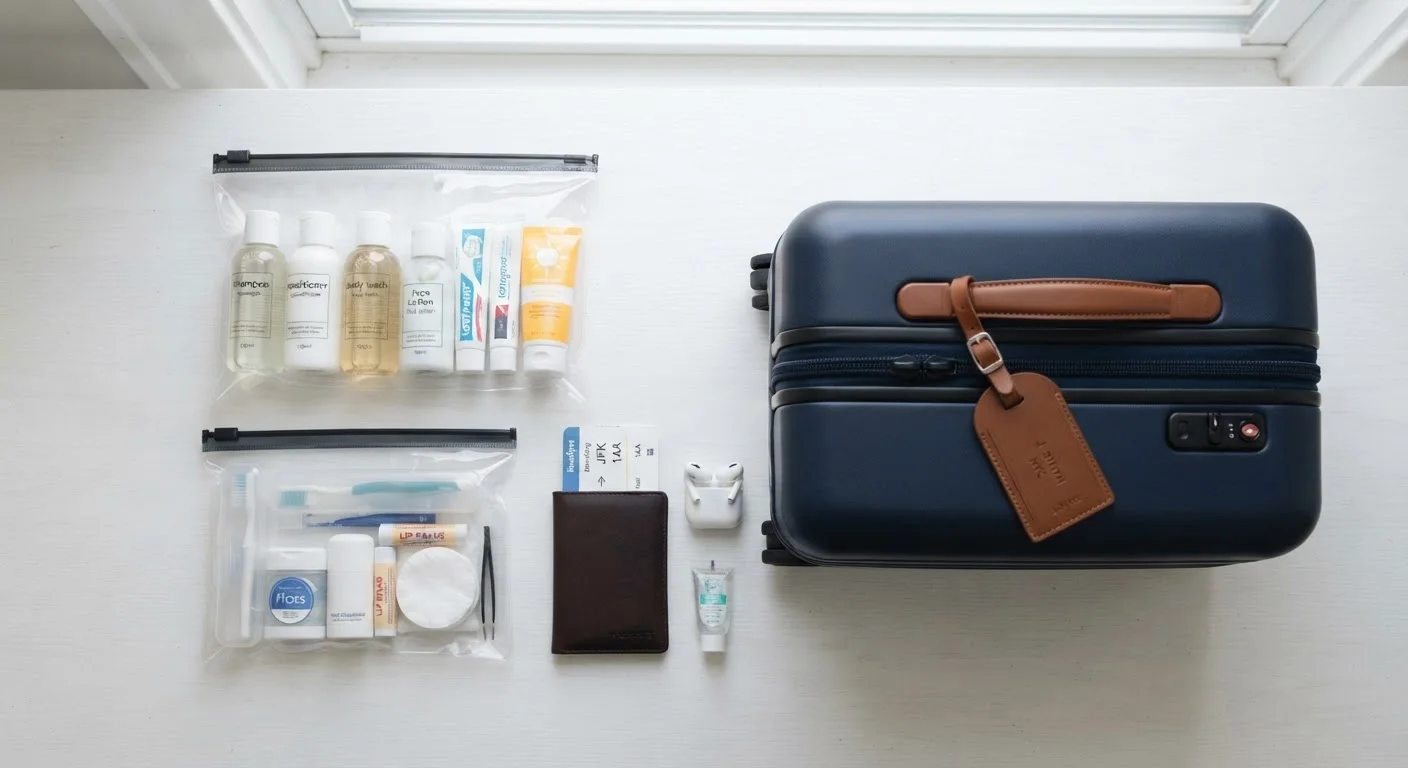
The 3-1-1 Liquids Rule: What It Actually Means
If you've heard the phrase "3-1-1" at airport security and weren't sure what it referred to, here's a plain explanation. The rule - enforced by the Transportation Security Administration (TSA) in the United States and used in broadly similar forms by security agencies in many other countries - limits the liquids, gels, and aerosols you can bring in a carry-on bag.
| Maximum liquid container size | 3.4 oz / 100 ml (TSA 3-1-1 Rule) |
| Bag type for liquids | 1 quart-sized, clear, resealable bag (TSA 3-1-1 Rule) |
| Bags per passenger | 1 liquids bag per traveler (TSA 3-1-1 Rule) |
| Scissors blade limit (carry-on) | Less than 4 inches from pivot point (TSA prohibited items list) |
| Spare lithium batteries | Carry-on only - not in checked bags (FAA and most airline policies) |
| Power banks / portable chargers | Carry-on only (FAA hazardous materials rules) |
The three numbers break down like this:
- 3.4 oz (100 ml): The maximum size of any single liquid container.
- 1 quart-sized bag: All containers must fit in one clear, resealable plastic bag.
- 1 bag per passenger: Each traveler is allowed one such bag, placed in the screening bin separately.
"Liquids" is interpreted broadly. It includes gels, aerosols, creams, pastes, and anything that flows or spreads - toothpaste, shampoo, lotion, lip gloss, peanut butter, yogurt, and even snow globes fall under this rule. When in doubt, treat a substance as a liquid.
Containers must be 100 ml or smaller - a 200 ml bottle that's only half-full does not qualify. The limit applies to the container size, not what's inside it.
Exceptions to the Liquids Rule
Several categories of liquids are exempt from the standard 3-1-1 limits, though they are subject to additional screening at the checkpoint.
Rules Vary by Country and Airport
The 3-1-1 framework is a U.S. TSA standard, and while many countries use a similar 100 ml / 1-liter bag approach, enforcement details, exemptions, and additional restrictions differ. If your trip involves connections through multiple countries, check the security rules for each one. Always verify current requirements with official government or aviation authority sources before you travel, as policies can change.
- Medications: Prescription and over-the-counter liquid medications in reasonable quantities are permitted. Keep them in their original labeled containers where possible and be prepared to declare them to officers.
- Infant and toddler feeding supplies: Formula, breast milk, and juice for young children are allowed in quantities exceeding 3.4 oz. A child does not need to be traveling with you for these to qualify in most cases, but policies vary - verify with your airline and the relevant security authority before travel.
- Medically necessary items: Ice packs, gel packs, and liquids required for medical devices may be allowed with proper documentation. Policies differ by airline and country.
Outside the U.S., liquids rules vary. Many countries use the same 100 ml / 1-liter bag standard, but enforcement details and exemption handling can differ. Always check the requirements of every country you are transiting through, not just your destination. Official government travel or aviation authority websites are the most reliable source for current rules.
Sharp Objects, Tools, and Other Restricted Items
Liquids get the most attention, but other categories of items are restricted or prohibited in carry-on bags. Understanding these rules before you pack prevents confiscation at the checkpoint and potential delays.
3-1-1 Rule
A TSA security standard requiring that all carry-on liquids be in containers of 3.4 oz (100 ml) or less, all fitting inside one quart-sized clear bag, with one bag allowed per passenger.
Checked luggage
Bags that are handed over to the airline at check-in, stored in the aircraft cargo hold, and retrieved at baggage claim after landing. Distinct from carry-on bags, which stay with the passenger in the cabin.
Prohibited item
Any object that security regulations do not permit on board a commercial flight, either in the cabin or in the cargo hold. Lists vary by country and airline.
Lithium-ion battery
A rechargeable battery type used in most portable electronics. Spare (uninstalled) lithium-ion batteries are typically required to travel in carry-on bags due to fire risk concerns in the cargo hold.
Quart-sized bag
A clear, resealable plastic bag with a capacity of approximately one quart (about one liter). Used to contain all carry-on liquids for security screening.
Sharp Objects
- Knives: Most knives - including pocket knives, folding knives, and utility blades - are not permitted in carry-on bags in the U.S. They may be packed in checked luggage.
- Scissors: Scissors with blades shorter than 4 inches (measured from the pivot point) are generally allowed. Longer blades must go in checked luggage.
- Razors: Safety razors with the blade removed and disposable cartridge razors are allowed. Straight razors and razor blades are not.
Tools
Most tools longer than 7 inches are prohibited in carry-on bags. This includes screwdrivers, wrenches, and pliers above that length. Shorter versions may be allowed - verify with the TSA or your country's aviation authority before travel.
Sports Equipment
Baseball bats, golf clubs, ski poles, hockey sticks, and similar items must be checked. Compact sporting goods - such as a single badminton racket - may be permitted depending on the airline and security agency.
Firearms and Ammunition
Firearms, ammunition, and realistic replicas are strictly prohibited in carry-on bags on commercial flights. Legally owned unloaded firearms may be transported in locked, hard-sided checked luggage under very specific conditions set by airlines and federal law. Consult your airline's official policy and applicable regulations if this applies to you.
For a broader sense of what to include - and what to leave at home - see our guide on common packing myths that often lead to overstuffed bags.
Electronics and Batteries: What Goes Where
Electronics generally travel in carry-on bags rather than checked luggage - both for security and safety reasons. Lithium-ion batteries, which power most laptops, phones, and cameras, pose a fire risk in the cargo hold. Most airlines require that spare lithium batteries (not installed in a device) travel in carry-on baggage only.
100 ml
Max single liquid container in carry-on
This limit is applied by the TSA in the U.S. and is broadly adopted by aviation security agencies in many other countries.
4 inches
Blade length limit for carry-on scissors
Scissors with blades measuring less than 4 inches from the pivot point are generally permitted in carry-on luggage under TSA guidelines.
7 inches
Tool length threshold for carry-on prohibition
Most tools longer than 7 inches are not permitted in carry-on bags and must be placed in checked luggage according to TSA rules.
Key Electronics Rules
- Laptops and tablets: At many U.S. security checkpoints, laptops must be removed from bags and placed in a separate bin. Tablets may or may not require removal depending on the scanner technology in use.
- Portable chargers (power banks): Must travel in carry-on bags, not checked luggage. Watt-hour limits apply - most consumer power banks fall within acceptable limits, but very high-capacity units may be restricted. Check the specific limit with your airline.
- E-cigarettes and vaping devices: Must be in carry-on bags. Using or charging them on board is prohibited.
If you're traveling internationally, security screening procedures may differ. Some airports require all electronics larger than a phone to be removed; others use advanced imaging that doesn't require this step. Follow the instructions posted at the checkpoint and given by officers.
Planning an overseas trip? Our international travel packing checklist covers electronics, adapters, and other essentials to verify before departure. And if safety items are a priority, see what experienced travelers recommend in our packing-for-safety guide.