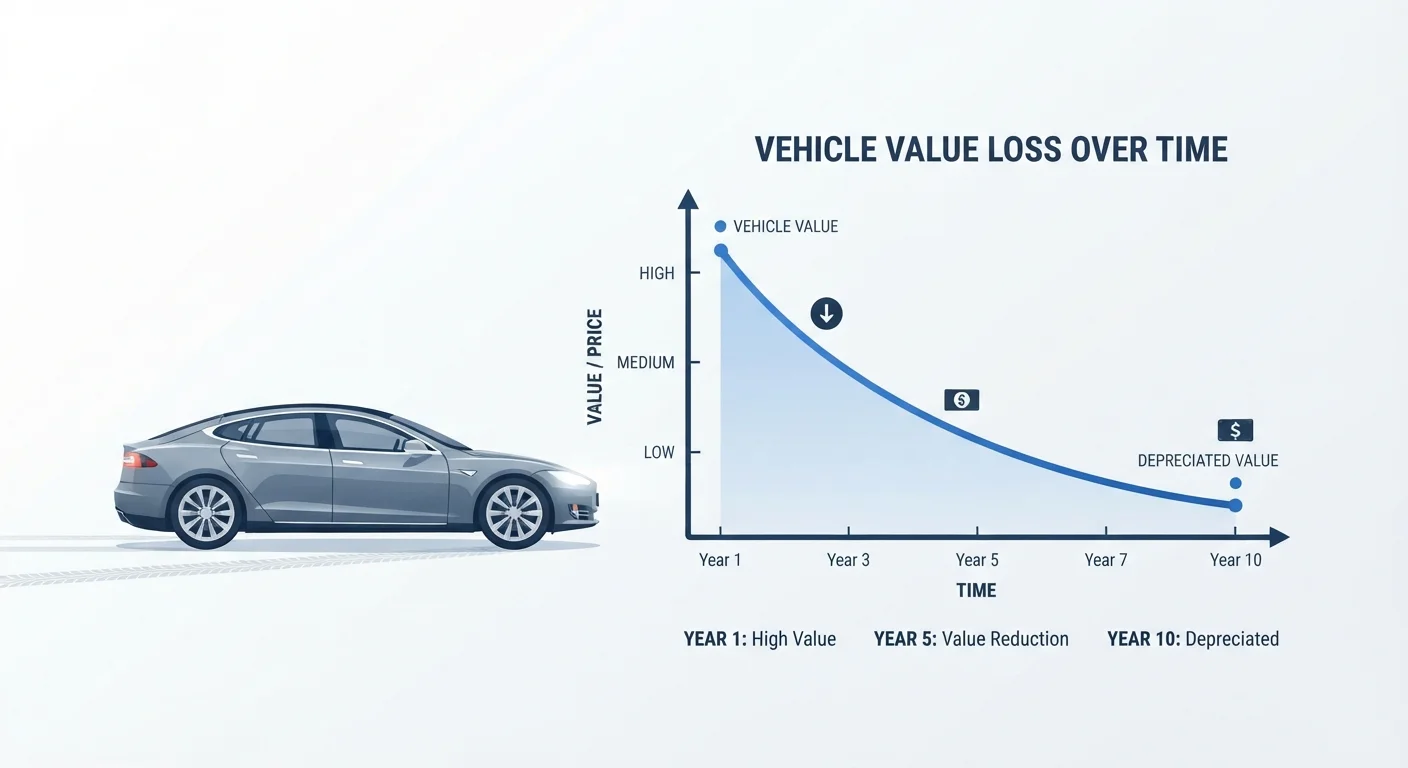
What Depreciation Actually Means for Your Wallet
When you buy a car, you are not just paying for transportation - you are accepting that the asset will steadily decline in value. Depreciation is simply the gap between what you paid and what the car would sell for at any later point. Unlike a house, which may appreciate over time, cars almost always move in one direction: down.
The steepest drop happens early. Industry data consistently shows that new vehicles lose a substantial portion of their value within the first one to three years. After that, depreciation slows and levels off. Understanding this curve matters because it shapes your true cost of ownership, not just the sticker price.
For a fuller picture of every expense you will face, see our guide to total cost of ownership - depreciation is one of its biggest components.
~20%
Average value lost in year one
Automotive valuation research consistently shows new vehicles lose roughly 15-25% of their value in the first 12 months of ownership.
~50%
Value retained after five years
Many vehicles retain only around half their original purchase price after five years, though this varies considerably by model and segment.
Year 1-3
Steepest depreciation window
The rate of value loss slows significantly after the third year, making slightly older used vehicles a common way to avoid the sharpest declines.
Why Some Cars Depreciate Faster Than Others
Not all vehicles shed value at the same pace, and the reasons are practical. Vehicles with strong reliability reputations, broad consumer demand, lower running costs, and widely available parts tend to hold their value better. Models known for expensive repairs, poor fuel economy, or rapidly evolving technology can lose value more quickly.
Segment also plays a role. Compact and mid-size vehicles often depreciate more moderately than large luxury sedans or high-end sports cars, where the market of potential buyers is narrower. Popularity in the used-car market is essentially a vote of confidence that supports resale values.
When comparing a new versus used purchase, depreciation is a central reason many financial educators suggest the used market deserves serious consideration. Our new vs. used car trade-offs article walks through the full picture.
How to Factor Depreciation Into Your Buying Decision
Depreciation should be a line item in your thinking, not an afterthought. Here is how to approach it practically:
- Research historical resale values. Look up what a model you are considering sells for at three and five years old compared to its original price. This gives you a real-world depreciation rate.
- Consider buying one to three years used. At this age, the sharpest value drop has already happened and you can often find a well-maintained vehicle at a significantly lower price than new.
- Account for depreciation in your budget. If you plan to sell or trade in within a few years, a car with lower depreciation protects more of your investment. Our realistic budget guide can help you build this in from the start.
- Understand how it affects leasing. Depreciation is the engine behind lease pricing - see our buying vs. leasing explainer for how this works in practice.
Use Historical Listings as a Free Research Tool
Search for the exact model you are considering at two, three, and five years of age on used-vehicle listing sites. Compare those prices to the original manufacturer's suggested retail price (MSRP) to calculate a rough real-world depreciation rate. This takes about 15 minutes and gives you concrete data before you commit.
If you are buying used, a pre-purchase inspection can verify that a vehicle's condition matches its price - important when you are relying on lower depreciation as part of your value argument.
This article is for general informational purposes only and does not constitute financial or purchasing advice. Individual circumstances vary; consult a qualified professional for guidance specific to your situation.