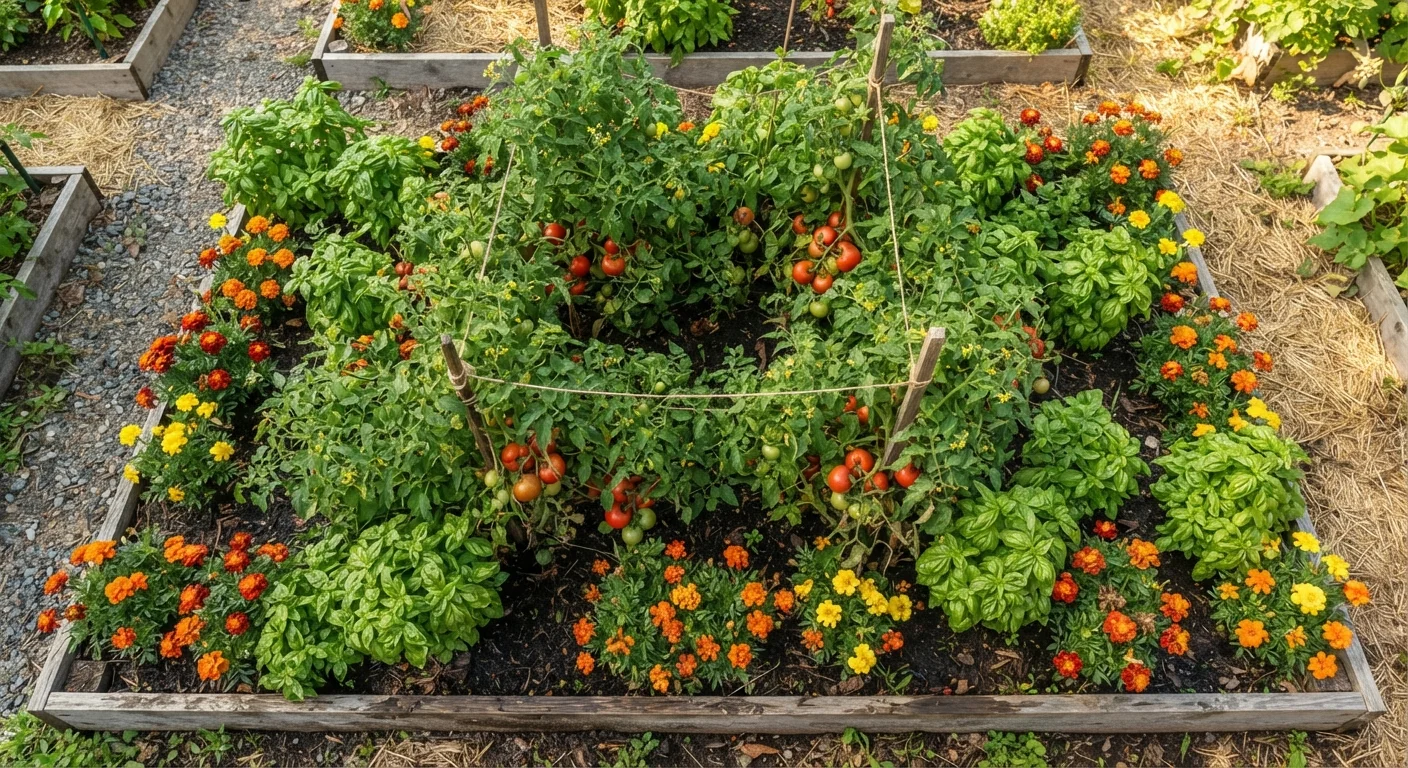
Why Plant Vegetables Next to Each Other Strategically?
Companion planting is the practice of growing different plants near each other to gain some kind of mutual benefit. The idea is rooted in ecology: in nature, plants don't grow in neat single-species rows. They grow together, and that proximity can influence pest populations, soil health, water retention, and pollinator activity.
For beginners, companion planting can feel like folklore - and it's fair to be cautious. Some combinations have solid research behind them; others are passed down through gardening tradition with mixed evidence. The honest approach is to treat it as an informed experiment. Start simple, observe your garden, and adjust.
Whether you're working in a raised bed or in-ground garden - see our practical comparison of both approaches - companion planting can be layered into almost any setup without extra cost or complicated equipment.
Tomatoes and Basil
This is perhaps the most famous companion pairing in the vegetable garden. Basil is thought to repel aphids and thrips - common tomato pests - through its strong volatile oils. Some gardeners also report that basil may improve tomato flavor, though the evidence for that specific claim is largely anecdotal.
What's more practical: basil attracts pollinators, and the two plants have compatible water and sunlight needs. Plant basil at the base of tomato plants or in the surrounding area. It's a low-risk pairing for beginners and makes good use of limited bed space.
Basil's strong scent may help deter common tomato pests like aphids and thrips.
Corn, Beans, and Squash (The Three Sisters)
The Three Sisters is a traditional Indigenous American planting system that demonstrates companion planting at its most functional. The three crops support each other in distinct ways: corn provides a vertical structure for beans to climb; beans fix nitrogen from the air into the soil, feeding the corn and squash; and squash spreads low and wide, shading the soil to retain moisture and suppress weeds.
This combination requires space - it's better suited to a larger in-ground bed or a generous raised bed than a small container setup. But if you have room, it's a genuinely effective system with a long track record.
Each of the Three Sisters plays a different supporting role - structure, soil nutrition, and ground cover.
Carrots and Onions
Carrots and onions are often recommended as companions because their respective pests tend to dislike each other's scent. Carrot root fly is said to be repelled by the smell of onions, while onion fly may be deterred by carrots nearby. The evidence is more observational than laboratory-proven, but the pairing is widely practiced and low-risk to try.
Both crops are also compact and have different root depths - carrots grow deep while onions are shallow - so they don't compete heavily for nutrients underground. That makes them a space-efficient choice for a smaller bed.
Carrots and onions may mutually deter each other's main fly pests through scent.
Lettuce and Tall Vegetables
Lettuce is a cool-season crop that bolts (goes to seed and turns bitter) quickly in hot sun. Planting it in the partial shade of taller plants - such as tomatoes, peppers, or trellised beans - can extend its growing season by protecting it from the harshest midday heat.
This is a practical use of vertical space and sunlight management rather than a pest or nutrient interaction. It's especially useful in summer, when unshaded lettuce can fail quickly. The taller plants don't suffer; the lettuce benefits. It's a simple efficiency win.
Planting lettuce under taller crops shields it from heat and extends its useful growing season.
Marigolds Near Most Vegetables
Marigolds - particularly French marigolds (Tagetes patula) - are a well-studied companion plant. Research has shown that they release a chemical from their roots that suppresses certain soil nematodes (tiny soil-dwelling pests that damage plant roots). They also attract hoverflies, which prey on aphids.
Interplanting marigolds throughout a vegetable bed or planting them as a border is a low-effort strategy with reasonable scientific backing. They're inexpensive to grow from seed and add visual interest. Note that they work best when planted densely and consistently - a single plant offers limited benefit.
French marigold roots release compounds shown to suppress harmful soil nematodes.
What Not to Plant Together
Companion planting isn't only about beneficial pairings. Some vegetables inhibit each other's growth or compete too aggressively. A few well-documented examples worth knowing:
- Onions and beans: Onions and other alliums (garlic, leeks) are thought to stunt bean growth. Keep them separated where possible.
- Fennel and most vegetables: Fennel releases compounds that inhibit the growth of many nearby plants. It's generally best grown in its own spot or in a container away from the main bed.
- Potatoes and tomatoes: Both are in the same plant family (Solanaceae) and share diseases like blight. Growing them together concentrates that risk and makes it easier for disease to spread between them.
Being aware of these combinations is just as useful as knowing the beneficial ones. For a broader look at common mistakes new gardeners make, the garden myths guide covers some frequently misunderstood growing advice.
Fennel inhibits many neighboring plants - grow it separately from your main vegetable bed.
Getting Started Without Overcomplicating It
You don't need to redesign your entire garden around companion planting right away. Pick one or two pairings from this list that suit what you already plan to grow, and observe how things develop over the season. Keep loose notes on what you notice - which plants seemed to thrive, which attracted more pests, and whether certain corners of your bed produced more than others.
Start Small and Observe
Rather than restructuring your whole garden around companion planting, try one or two pairings in your first season. Take note of pest pressure, plant vigor, and yield compared to previous years or nearby uncompanioned plants. Your own garden observations are valuable data that general advice can't replicate.
If you're still deciding what to grow from scratch, our guide on seeds vs. seedlings can help you figure out where to begin. And if you're working with containers or grow bags rather than a bed, it's worth checking what works in container growing before choosing your pairings, since space constraints affect which combinations are practical.
Companion planting is one piece of a larger gardening picture. For a broader view of when to do what throughout the year, the gardening year overview is a good companion read.